Kambala at Pallakad by Achintya Guchhait
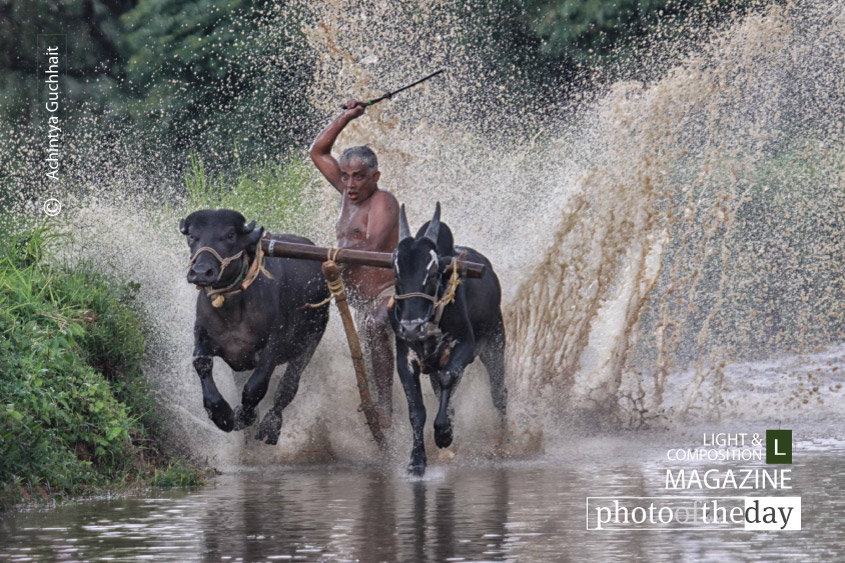
Captured at the vibrant Kambala cattle race in Pallakad, this photograph freezes a high-speed moment of traditional rural sport. Using a long focal length to isolate the action, the photographer expertly tracks the intensity of the villager and his cattle against the backdrop of Kerala. The image is award-worthy for its dynamic composition and the raw, kinetic energy it conveys, successfully documenting a fleeting cultural tradition. By balancing a fast shutter speed with precise timing, the photographer transforms a local event into a compelling narrative of human and animal endurance.
Achintya Guchhait
Based in Bangalore, India, Achintya Kumar Guchhait is a dedicated photographer who balances a professional career in technology with a deep passion for visual storytelling. His work focuses on capturing the authentic essence of daily life and the coexistence of humanity within diverse environments. As a Getty contributor and an avid traveler, he continuously refines his craft by observing the world around him, transforming common scenes into evocative portfolios that highlight the beauty of human experience.
Resonance Score Breakdown
Transparency Note: The resonance score (12.6/20) is calculated based on social engagement metrics collected before the award announcement.
Expert Photography Reviews · 8
The Rhythm of the Earth
I was running for the bus this morning, my bag slipping off my shoulder and my breath coming in short, jagged bursts. For a few seconds, I wasn't thinking about my to-do list or the emails waiting in my inbox.
Read the reflection →The Pulse of the Earth
There is a rhythm that precedes language, a drumbeat buried deep within the soil that only the feet can truly understand.
Read the reflection →Reviews & Comments
Share your thoughts about this award-winning photograph. Your reviews contribute to the community engagement score.

Most action shots from this event are just blurry chaos. What separates this from the pack is the precise tension in the handler’s grip against the blurred, rhythmic stride of the buffalo. It’s raw, visceral, and it makes my heart race even now, a decade later. While the framing is tight, the focus on the man’s strained expression ensures this won’t be forgotten. It’s a rare, honest document of endurance that will still matter in thirty years.
The mud flies. The muscle strains. It’s chaos, yet I’m drawn to the blur behind the man. He’s running, but the frame holds a stillness I didn’t expect. The background dissolves into a soft, brown haze. It’s a quiet breath in the middle of a race. Nothing here is accidental. The empty corner is not empty. It’s the space where the noise finally stops. I’ve found a moment of peace in the dirt.
In the mud of Pallakad, we see a man tethered to the raw, kinetic pulse of his cattle. It’s not just a race; it’s a silent conversation between two species straining against the earth. I feel the grit in my own teeth looking at his focused, desperate gaze. He’s listening to the rhythm of hooves, not just running. It’s a portrait of endurance that haunts me. This is a photograph that asks to be returned to.
The ochre spray of mud, reminiscent of a Turner tempest, collides with the deep, saturated umber of the buffaloes’ hides, creating a chromatic tension that’s truly visceral. It’s not merely movement; it’s a symphony of earth tones that makes my heart race. One finds the palette here isn’t just descriptive, but an emotional weight, grounding the kinetic chaos in the ancient, sun-drenched dust of Kerala. I’m utterly breathless watching these pigments quarrel in the heat.
The dust rises, a golden veil caught in the harsh, flat light of the Kerala afternoon. Achintya didn’t just capture a race; he listened to the frantic rhythm of hooves against mud. I feel the heat radiating from those straining muscles, a visceral pulse of life. It’s a chaotic, beautiful prayer of endurance. He stood there, patient amidst the thunder, waiting for the exact moment the spirit of the land revealed its raw, kinetic truth.
The frame’s geometry is tight, almost claustrophobic. It’s a violent collision of muscle and mud, yet the spatial tension holds. The diagonal thrust of the cattle anchors the picture plane, forcing the eye toward the lower quadrant. It’s brutal, and frankly, I’m exhausted by the sheer kinetic weight of it. The background blur is a necessary concession to the subject’s velocity. It doesn’t collapse into chaos. The architecture remains rigid. It’s a rare, disciplined success.
One suspects the mud didn’t fly quite this perfectly on the first pass. It’s easy to snap a shutter at a race, but capturing that specific, frantic synchronicity between man and beast suggests Guchhait didn’t just show up; he likely spent the entire day inhaling grit. I’ve been covered in enough field muck to respect the commitment here. It’s a visceral, earned frame. He clearly waited for the chaos to finally make sense.
At 235mm, the compression of the focal plane is aggressive, forcing the mud and muscle into a singular, frantic layer. The f/5 aperture keeps the diffraction limit at bay, yet it’s the chromatic aberration along the cattle’s horns that betrays the lens’s struggle with such high-velocity light. I’m genuinely moved by how the motion blur doesn’t obscure the intensity; it’s a visceral, optical collision. It’s not just a race; it’s physics in a frenzy.