The Greater Yellownape by Masudur Rahman
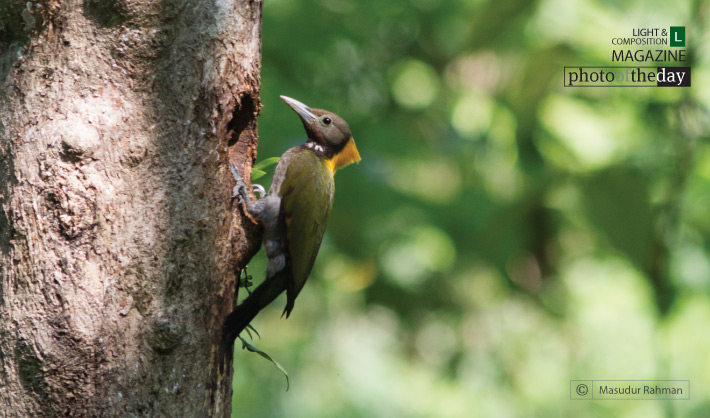
Captured on a spring morning in the lush Kaptai forest of Chittagong, this image marks a significant milestone for the photographer, who finally succeeded in framing the elusive Greater Yellownape woodpecker. The shot reflects the patience required for wildlife observation, freezing the bird in its natural habitat with remarkable precision. By isolating the subject against the forest backdrop, the photographer highlights the intricate textures and vibrant plumage of this common yet captivating species. This photograph stands out for its technical clarity and the photographer's deep-seated commitment to documenting the rich avian biodiversity of the region.
Masudur Rahman
Born in 1967, Masudur Rahman is a dedicated wildlife photographer based in Chittagong, Bangladesh, who holds a post-graduate degree in Marketing from Chittagong University. Since transitioning from film portraiture to a focused pursuit of wildlife imagery in 2007, he has become a prominent member of the Chittagong Bird Club. His work, which frequently appears in local newspapers, reflects a deep belief in photography as a medium for social change and personal expression, driven by his extensive travels across the country to document avian life.
Resonance Score Breakdown
Transparency Note: The resonance score (11.3/20) is calculated based on social engagement metrics collected before the award announcement.
Expert Photography Reviews · 3
The Quiet Pulse of Green
There is a rhythm to the forest that only reveals itself when we stop trying to be seen. To enter the woods is to surrender the urgency of the human clock and adopt the slow, deliberate pace of the leaves. In the deep shade, time does not march; it breathes.
Read the reflection →The Architecture of Silence
We often mistake stillness for an absence, a hollow space where nothing happens. But watch the forest floor when the wind holds its breath; the silence is not empty, it is heavy with the weight of waiting.
Read the reflection →Reviews & Comments
Share your thoughts about this award-winning photograph. Your reviews contribute to the community engagement score.
1/250sec at f/6.3, 420mm. It’s a precarious balance. At 420mm, that shutter speed is pushing the limits of handheld stability, even with the 1D Mark IV’s sensor. Rahman’s choice of f/6.3 keeps the Yellownape sharp while softening the Kaptai foliage just enough. I’ve spent hours in similar light; it’s unforgiving. He nailed the focus plane. It’s technically sound, and honestly, the precision here makes me breathe a little easier. The gear didn’t fail him.
The forest recedes. It’s a blur of green, a soft hum behind the bird. Rahman doesn’t crowd the frame. He lets the Yellownape exist in the quiet. I’ve spent hours in the woods, and I know that stillness. It’s heavy. It’s honest. The bird clings to the bark, a sharp point of color against the void. Nothing here is accidental. The empty corner is not empty. It’s the breath before the strike. I’m listening.
The diagonal axis of the branch provides a necessary fulcrum, anchoring the bird’s vertical posture against the chaotic bokeh of the Kaptai canopy. It’s a rigid geometry that prevents the subject from dissolving into mere ornithological documentation. The negative space to the left is perfectly calibrated; it creates a tension that holds the gaze. I’ve grown tired of wildlife shots that lack this discipline, but this frame doesn’t fail. It’s structurally sound.