The White Throated Fantail by Saniar Rahman Rahul
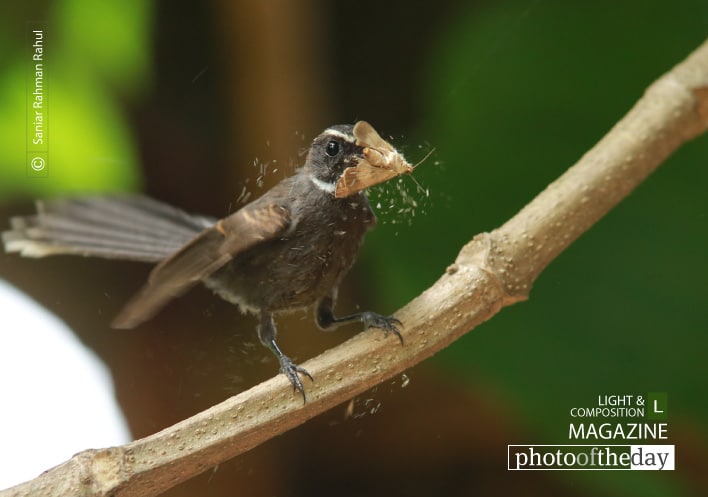
Captured near the wildlife-rich village of Master Para, this image documents a fleeting, intimate moment with a White-Throated Fantail during its active breeding season. The photographer encountered the bird as it arrived with prey, capturing the species' characteristic, restless tail-dancing behavior in a single, precise frame. The photograph is award-worthy for its ability to freeze a dynamic, high-energy avian display, showcasing the intricate textures of the bird's plumage against the natural backdrop of its sanctuary. It serves as a testament to the patience and keen observation required to document the vibrant, often overlooked wildlife found on the fringes of Bhawal National Park.
Saniar Rahman Rahul
Saniar Rahman Rahul is a dedicated nature and wildlife photographer based in Bangladesh, with a profound interest in documenting the avian diversity of the region. His work frequently explores the ecological richness of areas surrounding Bhawal National Park, where he focuses on capturing the behavioral nuances of local bird species. Through his lens, Rahul seeks to bridge the gap between human observers and the natural world, highlighting the vibrant, restless beauty of wildlife in its native habitat.
Resonance Score Breakdown
Transparency Note: The resonance score (12.7/20) is calculated based on social engagement metrics collected before the award announcement.
Expert Photography Reviews · 6
The Weight of a Wingbeat
There is a stillness that precedes movement, a held breath before the world decides to turn. We spend our lives waiting for the signal, the sudden shift in the air that tells us it is time to go, or time to stay.
Read the reflection →The Architecture of a Breath
We often mistake stillness for an absence of movement, forgetting that the seed beneath the soil is a riot of ambition, and the mountain is merely a slow-motion collision of earth.
Read the reflection →Reviews & Comments
Share your thoughts about this award-winning photograph. Your reviews contribute to the community engagement score.
The frame’s geometry hinges on the bird’s fan-shaped tail, creating a sharp diagonal that slices the negative space. It’s a calculated disruption of the background’s soft blur. The plumage textures provide necessary weight, grounding the subject against the void. I’ve rarely seen such precise spatial tension in avian work. It doesn’t rely on the subject’s movement; the architecture holds the energy captive. It’s a rigorous, disciplined capture that finally justifies the bird’s restless nature.
The plumage, a charcoal soot reminiscent of Morandi’s dustiest still lifes, vibrates against the verdant, humid blur of the Bangladeshi undergrowth. It’s the way the light catches those white-throated accents—like the pale, flickering luminescence of a Vermeer pearl—that truly steals one’s breath. I’ve found myself mesmerized by how the bird’s restless energy harmonizes with the forest’s emerald depths, creating a chromatic tension that feels less like a mere capture and more like a fever dream.
The air in Master Para holds a heavy, humid stillness, yet here, the Fantail shivers with life. I’ve spent enough dawns in the brush to know the ache in Saniar’s shoulders as he waited for this precise, frantic dance. The light is soft, filtered through the canopy, catching the delicate, fanned feathers. It’s a quiet miracle. My own breath catches, feeling the sudden, sharp intimacy of that tiny, beating heart against the vast, green silence.
The White-Throated Fantail’s frantic energy is usually lost to the blur of motion, yet here it’s pinned against a void. I’m struck by how the darkness behind the bird doesn’t just recede; it actively consumes the periphery. It’s a cold, existential silence. When I look at those sharp, white feathers cutting through the gloom, I feel a sudden, sharp ache for the things we fail to notice in the dark. It’s a beautiful, heavy resistance.
The focal plane here is razor-thin, perfectly isolating the Fantail’s iridescent plumage. At this magnification, the diffraction limit hasn’t softened the fine barbs of the feathers, revealing structural details our eyes usually miss. I’m genuinely moved by how the bokeh, a function of a wide aperture, renders the foliage into soft, painterly light. It’s a rare instance where the optics don’t just capture a bird; they resolve the very physics of its restless, fleeting energy.
Before the eye identifies the bird, a sudden stillness catches in the throat. It’s the tension of that fanned tail, a frantic, electric geometry suspended in the humid air of Gazipur. I feel my own pulse quicken, mirroring the creature’s restless energy. When I return to this frame, the blur of the wings feels like a memory of movement itself. It’s a quiet, sharp ache—the feeling of something wild refusing to be held.