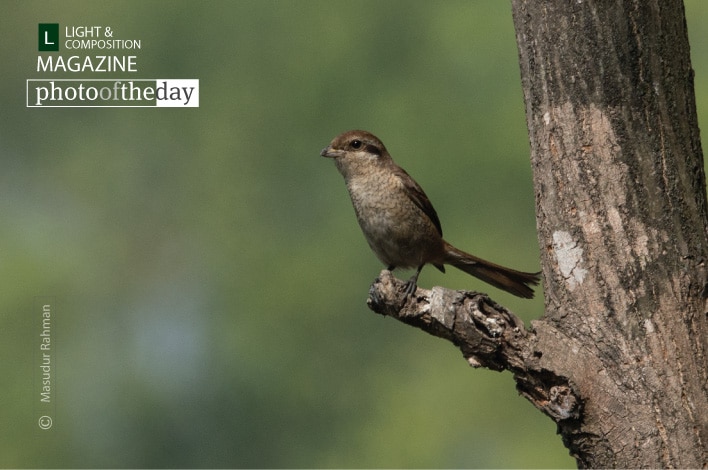
Curious Brown Shrike by Masudur Rahman
Captured at the serene Faillatoli Sea Beach in Chittagong, Bangladesh, this photograph highlights the delicate presence of a Brown Shrike, a migratory visitor from the northern reaches of Asia. The photographer utilized a long focal length to isolate the bird against its natural environment, capturing a moment of quiet curiosity. By balancing a high shutter speed with a precise aperture, the image renders the intricate textures of the bird's plumage with remarkable clarity. This work is award-worthy for its ability to transform a fleeting encounter with wildlife into a poignant, intimate portrait that celebrates the beauty of avian migration.
Masudur Rahman
Born in 1967, Masudur Rahman Mamoon is a dedicated photographer based in Chittagong, Bangladesh, who began his creative journey with film portraiture in 1998. After a hiatus to focus on his career in the RMG sector, he returned to his passion in 2007, specializing in wildlife and bird photography. A member of the Chittagong Bird Club, Mamoon frequently documents his observations in local weekly publications. He views photography as a vital medium for personal expression and a catalyst for positive social change.
Resonance Score Breakdown
Transparency Note: The resonance score (13.2/20) is calculated based on social engagement metrics collected before the award announcement.
Expert Photography Reviews · 6
The Weight of a Glance
Why do we assume that to be observed is to be understood? We spend our lives projecting ourselves into the world, hoping that a stray glance from a stranger or a fleeting moment of recognition will validate our existence.
Read the reflection →The Architecture of a Glance
We spend our lives building walls, yet we are constantly looking for the cracks to see what lies on the other side. There is a profound vulnerability in the act of watching—a stillness that demands we set aside our own noise to witness the quiet pulse of another existence.
Read the reflection →Reviews & Comments
Share your thoughts about this award-winning photograph. Your reviews contribute to the community engagement score.
Most wildlife shots are just technical exercises, but this one lingers. I’ve seen thousands of birds captured with long glass, yet Rahman’s Brown Shrike avoids the clinical trap. The shallow depth of field isolates the subject, but it’s that sharp, inquisitive eye contact that anchors the frame. It’s a quiet, fragile moment I’d still want to see in thirty years. It doesn’t just document a species; it captures a singular, fleeting spark of genuine curiosity.
One suspects the bird didn’t simply pose for the D800E on a whim. Getting that level of detail on the plumage requires a fair amount of shivering in the salt air, waiting for the creature to forget you’re there. It’s a quiet, patient bit of work. I’ve spent enough mornings in the damp to know when someone’s put in the hours. It’s a decent result, and frankly, I’m rather envious of the stillness.
The shutter snaps, and the world freezes. It’s a perfect tracking shot that stopped dead in its tracks. Rahman caught the Brown Shrike in a moment of pure, unblinking tension. That 1/1600sec exposure holds the plumage with the crispness of a high-end film stock. I’ve spent hours in editing suites looking for this kind of stillness. It’s honest, sharp, and quiet. Honestly, I’d kill for that focus. The cut would have been a mistake.
Before the eye identifies the bird, something in the chest tightens. It’s that sudden, sharp stillness of a creature caught between flight and curiosity. The plumage’s intricate, earthy textures pull my focus inward, slowing my pulse to match the Shrike’s alert gaze. I’ve returned to this frame a dozen times, and each time, I feel a strange, quiet ache for the migratory distance it’s traveled. It’s a small, feathered anchor for my own restless thoughts.
At 390mm, the Nikkor’s focal plane is razor-thin, yet Rahman has nailed the eye’s micro-contrast perfectly. By stopping down to f/7.1, he’s avoided the diffraction limit while maintaining enough depth to render the shrike’s plumage with startling, clinical precision. I’m genuinely moved by the way the bokeh dissolves the beach into a soft, monochromatic wash. It’s rare to see such technical discipline applied to a migratory subject; he’s captured a clarity that the naked eye simply can’t hold.
The Brown Shrike sits in a light that refuses to forgive. It’s a creature defined by the sharp, unforgiving edges of its own isolation. I’m struck by how the background dissolves into a void, forcing the bird to confront its own solitude. It doesn’t invite us in; it demands we acknowledge the silence of the migration. When I look at those dark, piercing eyes, I feel a cold, existential ache. It’s beautiful, but it’s a lonely beauty.