When Leaves Fall Down by Zahraa Al Hassani
Captured in the serene setting of Annaya, Lebanon, this photograph explores the delicate interplay between light and shadow. While descending a staircase, the photographer was struck by the rhythmic descent of autumn leaves, prompting a moment of quiet observation. By choosing to sit and wait, the photographer captured a harmonic balance where the natural elements interact with the shifting light. This image is award-worthy for its ability to transform a fleeting, everyday occurrence into a composed study of stillness and grace, demonstrating a keen eye for the subtle beauty found in the transition of seasons.
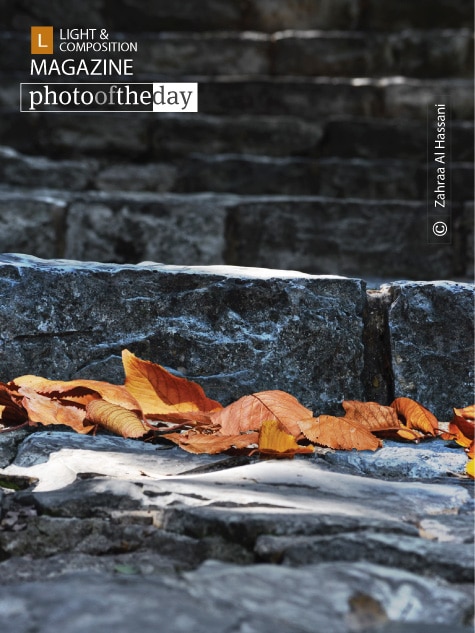
Exposure 1/125sec @ f/7.1 | ISO 250 | Focal Length 86mm
Zara Otaifah
Based in Baghdad, Iraq, Zahraa Al Hassani balances a successful career as a senior graphic designer at Zain Telecommunications with a deep-seated passion for photography. A graduate of the University of Technology in Baghdad, she leverages her extensive design background to refine her photographic perspective, often creating visuals to enhance her professional design projects. Having transitioned from early equipment to Nikon systems, she remains dedicated to the pursuit of purist photography, constantly seeking to expand her technical knowledge and artistic vision.
Resonance Score Breakdown
Transparency Note: The resonance score (12.7/20) is calculated based on social engagement metrics collected before the award announcement.
Expert Photography Reviews · 8
The Architecture of Letting Go
In the quiet corners of a garden, there is a rhythm to the shedding of a season that we rarely stop to measure. We are taught to value the bloom, the upward reach, the stubborn insistence of green against the heat of summer.
Read the reflection →The Wisdom of Letting Go
There is a quiet grace in the way a season releases its hold. We often fear the shedding of things, viewing the descent as an ending, a loss of form or color. Yet, if we watch closely, we see that nothing is truly lost.
Read the reflection →Reviews & Comments
Share your thoughts about this award-winning photograph. Your reviews contribute to the community engagement score.
The shutter clicks and the world stops breathing. It’s a rhythmic descent, a sequence frozen mid-fall. I love the way the light catches those edges; it’s like a jump cut that never lands. At 86mm, the compression feels intimate, almost claustrophobic. You’ve captured the exact frame an editor would fight to keep. It’s quiet, precise, and honestly, it makes me miss the stillness of a film set before the director yells action. Beautifully held.
At f/7.1, the 86mm focal length renders the leaf textures with a crispness that pushes against the sensor’s resolution limit. It’s a delicate balance; the diffraction isn’t yet softening the veins, allowing the light to trace their cellular structure with startling clarity. I’m genuinely moved by how the bokeh, as a function of that aperture, softens the Annaya background into a gentle, painterly wash. It’s a precise, quiet triumph of optics over the fleeting chaos of autumn.
The ochre of these fallen leaves, a shade reminiscent of Morandi’s dust-choked palettes, doesn’t merely sit upon the stone; it breathes, vibrating against the cool, slate-grey shadows like a whispered secret in Annaya. I’m utterly undone by how the light catches those brittle edges, turning decay into a luminous, golden suspension. It’s a fragile, aching harmony, one that reminds me that even in the quietest descent, colour remains our most profound, unyielding language.
Annaya’s air holds a particular stillness in autumn. She must have felt the cooling shift as the leaves began their slow, rhythmic descent. I’ve spent enough hours waiting for the light to settle to recognize that patience in her frame. It’s not just a study of falling foliage; it’s a quiet conversation with the earth. Looking at it, I feel a sudden, sharp ache for the mountainside. She didn’t rush; she simply listened.
In Annaya, we don’t just see leaves falling; we hear the rhythm of a season ending. Zahraa sat and listened to the staircase until the light told her a story of transition. It’s a portrait of a place catching its breath. I find myself holding mine, too. When we look at these scattered shadows, we aren’t just watching nature; we’re witnessing a quiet, graceful surrender. It’s a photograph that asks to be returned to.
Before the eye identifies the leaves, a sudden stillness settles in the chest. It’s a rhythmic, quiet descent that forces my own breath to match the pace of the falling foliage. I’ve returned to this frame three times today; each visit, the shadows feel heavier, like a memory I’m not quite ready to release. It doesn’t just capture Annaya; it anchors a fleeting, melancholic grace deep in my pulse. I find myself wanting to sit there, too.
The frame’s geometry is compromised by a lack of anchoring mass. While the rhythmic descent of foliage suggests movement, the spatial tension remains unresolved. It’s a study in dispersal that doesn’t quite coalesce. The negative space feels hollow rather than deliberate, leaving the eye adrift. I’ve found myself wishing for a sharper fulcrum to ground the composition. It’s technically competent, yet the structural discipline required to elevate these falling leaves into a cohesive architecture is missing.
Most folks would’ve snapped a frame and kept walking. It’s a common impulse, and usually a mistake. Al Hassani, however, chose to sit on those stairs in Annaya until the light settled into something worth keeping. I’ve spent enough hours shivering on hillsides to recognize the patience required here. It’s a quiet, deliberate piece of work. I find myself genuinely envious of the stillness she managed to extract from that afternoon. She earned it.