Willow Catkins by Lothar Seifert
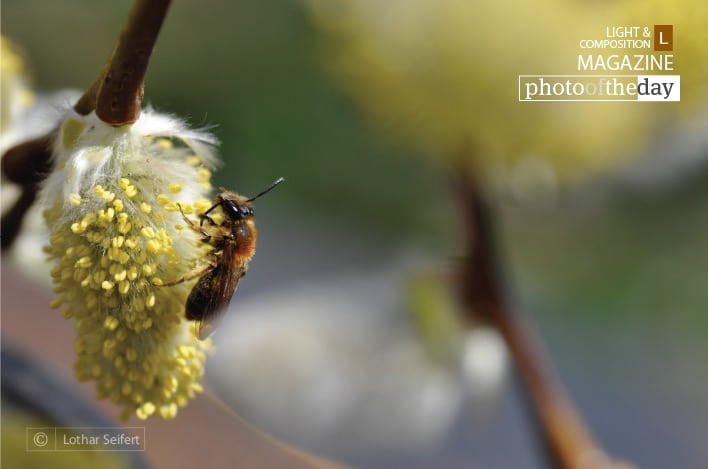
Captured during the awakening of spring, this intimate macro study highlights the vital symbiotic relationship between willow catkins and wild bees. Lothar Seifert masterfully documents the first signs of new life, emphasizing the ecological importance of these plants as an essential food source for insects. By focusing on the delicate textures and the quiet interaction between flora and fauna, the photographer draws attention to the fragility of the environment. The image is award-worthy for its sharp technical execution and its ability to transform a small-scale natural occurrence into a poignant narrative about environmental conservation and the interconnectedness of life.
Lothar Seifert
Born in Germany in 1955, Lothar Seifert resides in a small village in Upper Lusatia, where he balances a professional career as a design engineer and environmental officer with his passion for photography. His work is deeply influenced by his extensive travels across Asia, particularly in Nepal, Kashmir, and India, where he developed a profound interest in portraiture and social documentary. Beyond his humanitarian efforts to support schooling and clothing for children in the Himalayas, Seifert is a dedicated nature photographer who uses his macro imagery to foster a deeper public understanding of environmental conservation.
Resonance Score Breakdown
Transparency Note: The resonance score (12.8/20) is calculated based on social engagement metrics collected before the award announcement.
Expert Photography Reviews · 6
The Weight of Awakening
Why do we assume that the most significant shifts in the world must arrive with thunder? We look for grand gestures of change, ignoring the quiet, insistent pulse of the earth as it prepares to breathe again.
Read the reflection →The First Breath of Green
In the deep, quiet months of the year, we often mistake stillness for absence. We look at the bare, grey branches against a winter sky and assume the world has simply ceased its labor. But beneath that brittle exterior, there is a frantic, silent preparation.
Read the reflection →Reviews & Comments
Share your thoughts about this award-winning photograph. Your reviews contribute to the community engagement score.
The air in Lusatia must have been crisp, that singular, biting chill of early spring. Lothar waited for the light to soften, catching the catkins just as the bee arrived. It’s a quiet, holy communion. I’ve spent enough mornings in the damp grass to know the patience this required. Looking at the delicate fuzz and the bee’s frantic, vital work, I feel a sudden, sharp ache for the fragility of it all. It’s breathtakingly still.
Spring’s awakening isn’t a celebration; it’s a brutal, silent labor. Seifert’s catkins emerge from a void that swallows the background, forcing us to confront the velvet fuzz not as life, but as an intrusion upon the dark. I’ve stared at these grey, alien forms until my eyes ached. It’s unsettling. The shadows don’t merely frame the flora; they devour the context, leaving only the raw, desperate hunger of the insect clinging to the edge of existence.
Before the eye identifies the catkins, a sudden stillness settles in the chest. It’s the tactile weight of the fuzz, that soft, silver resistance against the lens. I feel a strange, primal relief in the yellow dust of the pollen. When I return to this, I’m not looking at biology; I’m remembering the first warm day of the year. It’s a quiet, golden ache that stays with me long after I’ve turned away.
The chartreuse of these catkins, vibrating against the muted, atmospheric grey of a Lusatian spring, evokes the soft, dusty stillness of a Morandi study, yet it’s the sudden, electric gold of the pollen that truly undoes me. One finds it’s not merely a macro study, but a chromatic respiration, where the cool, damp light of Saxony breathes life into the velvet textures, creating a harmony so fragile I’m terrified that even a whisper might disturb it.
1/640sec at f/8, ISO 200, 90mm. Stopping down to f/8 on a 90mm macro lens is a calculated risk. It’s the difference between a clinical slice of focus and a coherent subject. Seifert’s choice here provides enough depth to resolve the catkin’s texture without losing the bee to background noise. I’ve seen too many macro shots fail by chasing razor-thin bokeh. This one doesn’t. It’s technically sound. Honestly, the precision here is refreshing.
At f/8, the Tamron’s focal plane is razor-thin, yet it resolves the catkin’s trichomes with startling clarity. The diffraction limit hasn’t softened the fine, silver hairs, and the bokeh—a function of that 90mm compression—renders the background into a soft, buttery wash. I’m genuinely moved by how the light catches those tiny, translucent filaments. It’s a rare, clinical precision that doesn’t sacrifice the fragile, fleeting essence of spring. It’s simply beautiful optics at work.