Crater Lake by Ronnie Glover
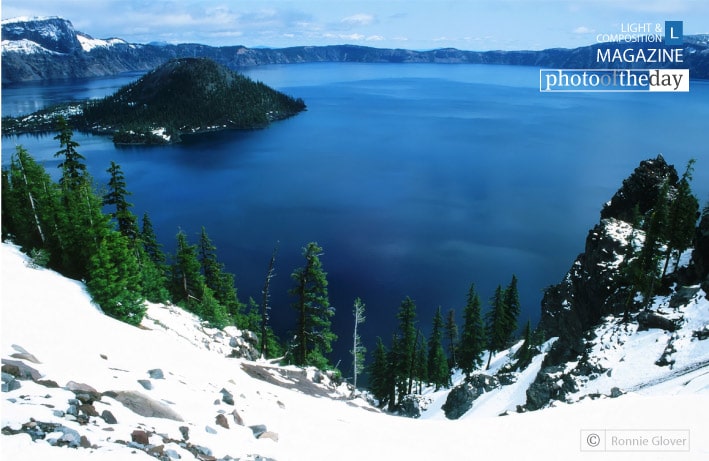
Captured at the iconic Crater Lake, this photograph showcases the profound depth and intense blue hues of the United States' deepest lake. The photographer skillfully framed the sheer volcanic cliffs just moments before a severe snowstorm descended, transforming the serene landscape into a dramatic, white-out environment. This image is award-worthy for its impeccable timing and the stark contrast between the tranquil, spiritual stillness of the lake and the impending volatility of the weather, capturing a fleeting moment of clarity in one of nature’s most majestic settings.
Ronnie Glover
Based in Gig Harbor, Washington, Ronnie Glover developed his professional foundation at the Southeastern Center for the Arts in Atlanta after pursuing his initial college degree. His extensive fourteen-year residency in Alaska provided him with unparalleled opportunities to refine his nature photography, fostering a deep appreciation for the wilderness. Glover’s work, which also spans the realm of travel photography, is driven by a desire to share the beauty of diverse cultures and natural landscapes with a global audience.
Resonance Score Breakdown
Transparency Note: The resonance score (15.0/20) is calculated based on social engagement metrics collected before the award announcement.
Expert Photography Reviews · 4
The Weight of Stillness
There is a moment before the storm when the air stops moving. It is not a peaceful silence, but a heavy one, as if the earth is holding its breath to see what will happen next.
Read the reflection →The Breath Before the Cold
The air before a storm has a specific texture; it feels like wet wool pressed against the skin, heavy and expectant. I remember standing on a porch in late autumn, the wind turning sharp, smelling of damp earth and the metallic tang of ozone.
Read the reflection →Reviews & Comments
Share your thoughts about this award-winning photograph. Your reviews contribute to the community engagement score.
Crater Lake isn’t merely a body of water; it’s a void waiting to swallow the sky. Glover captures the volcanic cliffs not as stone, but as a threshold. The encroaching white-out doesn’t just obscure the view; it erases the horizon, forcing the viewer into a claustrophobic silence. I’ve felt this specific dread before—that sudden, cold realization that nature doesn’t care if you’re watching. It’s a brutal, honest confrontation with the absolute nothingness lurking beneath the blue.
The air at Crater Lake holds a heavy, expectant silence. Ronnie stood there as the light thinned, listening to the mountain’s breath before the white-out arrived. It’s a fragile, blue clarity—the kind that only reveals itself when the earth is about to turn. I’ve felt that same shiver in my own bones, waiting for the storm to break. He didn’t force the frame; he simply waited until the lake was ready to be seen.
The volcanic rim creates a rigid, diagonal anchor that forces the eye toward the caldera’s center. It’s a disciplined geometry. The negative space of the encroaching storm provides a necessary, chilling counterweight to the lake’s saturated blue. I’ve rarely seen such a brutal, structural clarity in landscape work. The frame holds because the tension between the cliffs and the white-out is absolute. It doesn’t rely on sentiment; it relies on the sheer weight of the architecture.
The indigo of this water, a hue reminiscent of Vermeer’s deepest ultramarine, pulls at one’s soul with a gravity that’s almost terrifying. It’s a chromatic silence, interrupted only by the encroaching, bruised-grey clouds that threaten to swallow the volcanic rim. I’ve never felt such a visceral shiver from a print; it’s as if the lake itself is exhaling a final, frigid breath before the white-out descends, leaving us suspended in this exquisite, melancholic tension.