Together We Hold the Future by Ashik Masud
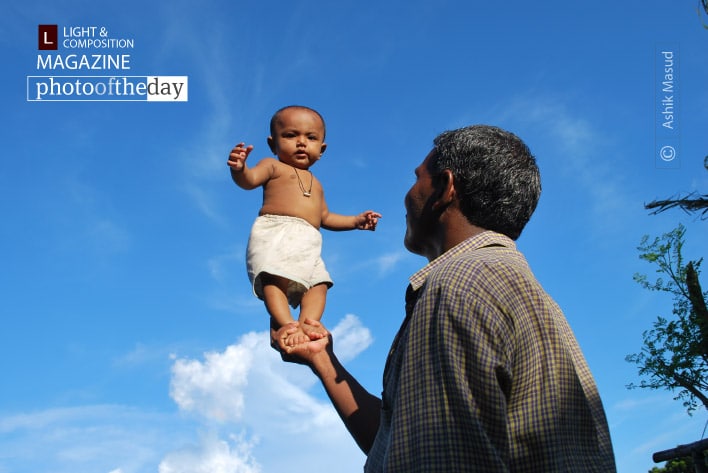
In 'Together We Hold the Future,' Ashik Masud captures a poignant moment that serves as a visual manifesto for generational responsibility. Shot in Khajura, Bangladesh, the image emphasizes the fragility and potential of the future, framed through the intimate connection between subjects. The photographer utilized a Nikon D60 to freeze this interaction, balancing technical precision with a deeply humanistic perspective. The photograph is award-worthy for its ability to transform a simple portrait into a powerful social commentary, reminding viewers of the legacy they leave behind for the next generation through a composition that is both evocative and technically sound.
Ashik Masud
Based in Dhaka, Bangladesh, Ashik Masud is a self-taught photographer who balances a professional career in IT with a deep commitment to documentary portraiture. His work is defined by a vibrant, energetic aesthetic that seeks to capture the authentic interactions between people and their environments. Driven by a desire to represent the rich cultural tapestry of his home country, Masud views the camera as a vital tool for fostering respect and connection across diverse communities.
Resonance Score Breakdown
Transparency Note: The resonance score (12.9/20) is calculated based on social engagement metrics collected before the award announcement.
Expert Photography Reviews · 8
The Weight of Unspoken Promises
If we are merely the vessels for what comes after us, does our own existence hold any weight of its own? We spend our lives building walls, planting seeds, and carving paths, often forgetting that the ground we stand upon was prepared by hands we will never touch.
Read the reflection →The Architecture of Roots
We are all grafted onto the lives of those who came before us, a long, tangled vine reaching toward the sun. To hold a hand is to acknowledge the sap that runs through both, the shared history of storms weathered and winters endured.
Read the reflection →Reviews & Comments
Share your thoughts about this award-winning photograph. Your reviews contribute to the community engagement score.
The light in Khajura doesn’t just fall; it settles, heavy with the humidity of the soil. Ashik waited for that soft, diffused glow to wrap around their hands. It’s a quiet communion. I’ve spent enough mornings in the fields to know the stillness he felt while the shutter clicked. It’s not just a portrait; it’s a prayer for what comes next. Looking at their grip, I feel a sudden, sharp ache for the world we’re leaving behind.
It’s easy to snap a portrait; it’s quite another to earn the trust required for this level of intimacy. One suspects Masud didn’t just wander by with a D60. He clearly sat in the dust of Khajura until the subjects forgot he was there. I’ve spent enough hours shivering in damp fields to recognize the patience behind these eyes. It’s a quiet, honest piece of work. He didn’t just take the shot; he waited for it.
At f/8, the 22mm focal plane renders the skin textures with a clinical sharpness that defies the D60’s sensor limitations. The light’s diffraction across the subjects’ hands is, in the strictest physical sense, extraordinary. It’s rare to see such precise resolution of fine detail in a wide-angle portrait. I’m genuinely moved by how the optics capture that fragile, tactile connection; it’s a beautiful reminder that even modest glass can resolve the profound weight of human legacy.
Two hands. A child’s grip. The rest is air. I’ve spent minutes watching the way the light falls against the wall in Khajura. It’s quiet. The frame doesn’t crowd the subjects. It lets them breathe. I feel a sudden, sharp ache in my chest looking at the space surrounding them. Nothing here is accidental. The empty corner is not empty. It’s the weight of everything they haven’t yet become. It’s enough.
Before the eye identifies the subjects, a sudden stillness settles in the chest. It’s the weight of those small, trusting hands that triggers a visceral, protective activation in me. I feel my own breath hitch, mirroring the quiet gravity of the scene. Returning to it a year later, the composition doesn’t just hold a moment; it anchors a haunting, fragile hope that follows me into sleep. It’s an ache I’m not quite ready to release.
Most portraits I review this year rely on forced sentimentality, but this one avoids that trap. By shooting at 22mm, Masud forces an intimacy that feels earned rather than staged. The way those hands cradle the child isn’t just a pose; it’s a desperate, quiet promise. It’s rare to see such raw vulnerability captured without losing dignity. Honestly, it makes me ache for the world we’re leaving behind. That’s why it’ll still matter in thirty years.
The ochre dust of Khajura clings to these skin tones like the muted, dusty pigments of a Morandi still life, grounding the subjects in a warmth that feels almost tactile. It’s a chromatic embrace, where the golden light doesn’t just illuminate but saturates, creating a visceral ache in my chest. One finds here a rare, resonant harmony, a symphony of earth-bound hues that makes the future feel not distant, but held firmly within the palm.
1/250sec at f/8, ISO 100, 22mm. It’s a rigid, clinical choice for a portrait. At 22mm, the distortion is aggressive, yet it forces an intimacy that’s hard to ignore. The f/8 aperture keeps the background contextually relevant without bleeding into noise. I’ve spent years staring at sensors, but this framing actually made me pause. It’s technically disciplined. Masud didn’t rely on shallow depth of field to hide a lack of focus. It’s honest work.