Work Gloves by Keith Goldstein
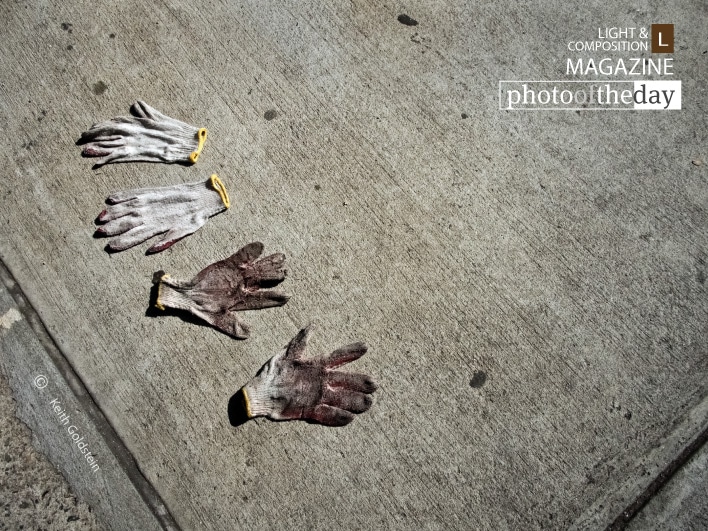
In this evocative still life, a pair of weathered work gloves rests abandoned on a New York City sidewalk. Captured in the heart of Chinatown, the image transforms a mundane, discarded object into a poignant symbol of labor and urban transience. The photographer utilized a high shutter speed to freeze the scene with clinical precision, highlighting the rich textures of the worn fabric against the stark pavement. This photograph is award-worthy for its ability to find profound narrative depth in the overlooked details of daily life, demonstrating a keen eye for composition that elevates a simple street find into a compelling visual story.
Keith Goldstein
Born in Brooklyn in 1957, Keith Goldstein is a distinguished fine art and commercial photographer based in New York City. After earning his BFA from the School of Visual Arts and an MFA from the Cranbrook Academy of Art, he developed a deeply emotive approach to the medium, influenced by mentors like David Attie and Tad Yamashiro. With a career spanning over four decades, Goldstein has exhibited internationally and contributed to numerous prestigious publications and book covers. He remains committed to a minimalist philosophy, favoring a simple kit that allows him the creative freedom to explore the world through his lens.
Resonance Score Breakdown
Transparency Note: The resonance score (13.0/20) is calculated based on social engagement metrics collected before the award announcement.
Expert Photography Reviews · 8
The Salt of Labor
There is a specific grit that settles into the creases of the palms, a fine, grey dust that smells of iron and old pavement.
Read the reflection →The Architecture of Toil
We often mistake the skin for the person, forgetting that the true map of a life is written in the things we leave behind. A tool, a garment, a shell—these are the husks of our intentions, discarded once the work is done.
Read the reflection →Reviews & Comments
Share your thoughts about this award-winning photograph. Your reviews contribute to the community engagement score.
The ochre of these exhausted gloves, a shade reminiscent of Morandi’s dust-choked jars, bleeds into the cold, slate-grey concrete with a melancholy that’s frankly devastating. It’s a quiet, chromatic ache; the way the light catches the frayed fibers makes my heart stutter, as if the city itself were exhaling. One finds here a palette of urban fatigue, where the warmth of human labor dissolves into the indifferent, monochromatic indifference of a New York sidewalk.
The pavement stretches. It’s cold. Two gloves lie there, fingers curled into the grit of Chinatown. They’ve held weight. Now, they hold only the air. I feel a sudden, sharp ache in my own palms looking at them. Nothing here is accidental. The empty corner is not empty. It’s a deliberate silence. Goldstein trusts the void. He lets the concrete breathe. It’s a rare, quiet discipline. I’d stay here all day.
Most street photography today is just noise, but these gloves stopped me cold. Of the thousands of submissions I’ve reviewed, few capture the exhaustion of labor so viscerally. It’s the way the frayed, salt-stained leather curls against the unforgiving concrete that haunts me; it’s a portrait of a person who isn’t there. I’ll remember this in thirty years because it’s not just a discarded object—it’s the ghost of a city’s daily, grinding survival.
1/4000sec at f/9, ISO 1250, 14mm. Why the ISO 1250 in broad daylight? It’s a technical blunder that introduces unnecessary noise into the pavement’s texture. You’ve traded signal-to-noise ratio for a shutter speed that’s overkill for a static subject. It’s frustrating to see such sharp optics wasted by a lazy exposure choice. The composition is solid, but the sensor data reveals a photographer who doesn’t understand their own light. I’d have preferred a cleaner file.
Before the eye identifies the leather, something in the chest tightens. It’s the sudden, heavy stillness of a body that’s just walked away. I feel a phantom ache in my own knuckles looking at those frayed, empty fingers on the cold concrete. It’s a quiet, visceral reminder of exhaustion. When I return to this a year later, the gloves feel even emptier, a lingering ghost of someone’s long, hard day left behind on the sidewalk.
They’ve been left behind, haven’t they? I find myself staring at the grit beneath those gloves, imagining the hands that once filled them. It’s a quiet, heavy stillness. The light here isn’t dramatic; it’s the honest, flat grey of a city morning that doesn’t ask for attention. I feel a sudden, sharp ache for the labor that’s vanished. He stood here, patient, letting the pavement tell its own tired, beautiful story of absence.
At f/9, the Panasonic 14mm avoids the diffraction limit, rendering the gloves’ frayed fibers with startling, clinical clarity. I’m genuinely moved by how the focal plane slices through the weave, revealing microscopic wear that’s invisible to the naked eye. It’s a rare instance where the sensor’s resolution perfectly matches the grit of Chinatown’s pavement. The light’s interaction with those synthetic threads is physically exquisite; it’s a haunting, high-speed capture of labor’s quiet, discarded remains.
The gloves anchor the frame, creating a rigid fulcrum against the concrete’s chaotic grain. It’s a study in spatial tension. The negative space surrounding the leather isn’t merely empty; it’s a calculated void that forces the eye back to the frayed stitching. I’ve grown tired of street photography’s sentimentality, but the geometry here holds. The composition doesn’t collapse under the weight of its own narrative. It’s a rare instance where the frame actually works.
Thank you!!!