DaVinci by Christine Sovig Gilbert
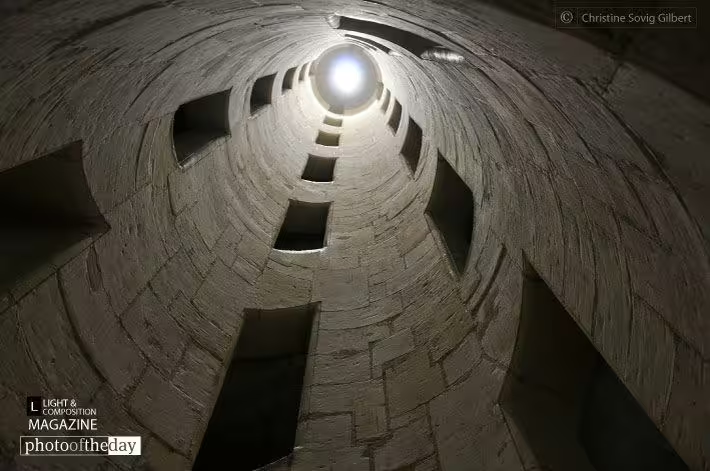
Captured in July 2010 within the historic walls of Chambord Castle in France, this photograph explores the intricate geometry of the famous double helix staircase attributed to Leonardo da Vinci. By framing the shot looking upward, the photographer emphasizes the architectural genius and spiraling symmetry of the structure, originally commissioned by King Francois I. The image is award-worthy for its masterful use of perspective, transforming a functional historical staircase into a compelling study of light, shadow, and complex form, effectively bridging the gap between Renaissance engineering and modern photographic composition.
Christine Sovig Gilbert
Born to Norwegian parents in Rapid City, South Dakota, Christine Sovig Gilbert is a third-culture photographer whose international upbringing has shaped her unique perspective. After earning an M.A. in English from the University of Bergen, she lived in various global locations before settling in Denver, Colorado. Known in the metaverse as Strumpet101, she balances her professional life as a consultancy office manager with a dedicated passion for photography and gaming. Her work reflects a keen eye for detail and a commitment to exploring new creative mediums.
Resonance Score Breakdown
Transparency Note: The resonance score (13.8/20) is calculated based on social engagement metrics collected before the award announcement.
Expert Photography Reviews · 3
The Geometry of Ascent
In the quiet corners of old libraries, one often finds books that have been read so many times the spines have begun to curve, mimicking the very shape of the ideas they contain.
Read the reflection →The Spiral of Stone
We build to keep the wind out. We stack stone upon stone, creating chambers where the air grows heavy with the weight of centuries.
Read the reflection →Reviews & Comments
Share your thoughts about this award-winning photograph. Your reviews contribute to the community engagement score.
Chambord’s double helix is a tourist’s gauntlet, yet Gilbert has managed to clear the frame of the usual clutter. It’s a rare feat of patience in such a crowded monument. I’ve spent hours waiting for a staircase to empty, and I know the ache of that stillness. One suspects she didn’t just snap and leave. She waited until the architecture finally breathed. It’s a quiet, disciplined piece of work. I find myself quite envious of the silence.
Of the thousands of architectural studies I’ve reviewed, most collapse into mere geometry. What separates this from the rest is how the light bleeds into the stone, turning DaVinci’s staircase into a living, breathing throat. It’s dizzying. I’ve stood in that stairwell, but Gilbert’s perspective makes me feel the vertigo of the Renaissance itself. It’s not just a record of a structure; it’s a capture of time spiraling upward. That’s why it’ll endure.
The double helix of Chambord isn’t merely stone; it’s a trap for the eye. Gilbert captures the ascent, yet it’s the encroaching gloom that haunts me. I’ve stood in that cold, spiraling void, and it’s terrifying how the shadows swallow the geometry. She doesn’t just document architecture; she forces us to confront the silence between the steps. It’s a dark, dizzying descent into the mind of a genius who knew that light is only half the story.