Amid the Lights by Nirupam Roy
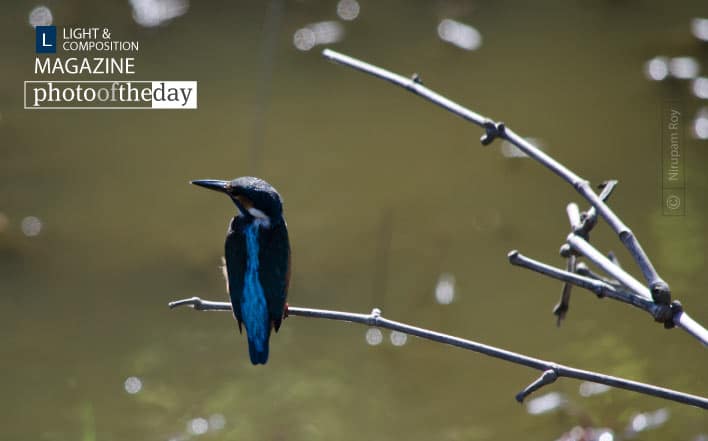
Captured in the wetlands of Salbari, this image of a Common Kingfisher showcases the beauty of persistence in wildlife photography. After a challenging day spent tracking the elusive bird, the photographer lay on the muddy bank to secure a unique, high-angle perspective. The background features the pond's surface, transformed by the sun into a shimmering, stage-like display of light. This shot is award-worthy for its technical precision and the photographer's willingness to endure unconventional conditions to capture a fleeting, intimate moment with nature, turning a barren day into a masterclass in patience and observation.
Nirupam Roy
Nirupam Roy is a dedicated school teacher based in Tufanganj, West Bengal, whose passion for photography was ignited during a family trip to the coast of Odisha. What began as a desire to document his son and the scenic beauty of the sea evolved into a profound artistic journey that has reshaped his perspective on nature and humanity. Finding peace and spiritual rejuvenation through his lens, Roy continues to explore the natural world with a keen eye for detail and a deep appreciation for the quiet moments of life.
Resonance Score Breakdown
Transparency Note: The resonance score (13.1/20) is calculated based on social engagement metrics collected before the award announcement.
Expert Photography Reviews · 8
The Quiet Wait
I spent an hour this morning watching a spider weave a web between the porch chairs. I had a pile of emails to answer and a grocery list that was growing longer by the minute, but I just couldn't pull myself away.
Read the reflection →The Weight of Stillness
There is a particular kind of waiting that happens in the cold. It is not the waiting for a train or a letter. It is a suspension of the self.
Read the reflection →Reviews & Comments
Share your thoughts about this award-winning photograph. Your reviews contribute to the community engagement score.
Muddy banks have a way of revealing a photographer’s true character. Most would have packed up when the light turned stubborn, but Roy clearly stayed put. I’ve spent enough damp afternoons in the reeds to know that perspective isn’t found; it’s endured. The way the water catches that light, turning a simple kingfisher into something regal, is quite something. It’s a proper bit of work. One suspects he didn’t mind the mud at all.
He lay in the mud for hours, waiting for the kingfisher to find its rhythm. I’ve felt that damp chill against my own chest, watching the light fracture across the water’s surface. It’s not just a bird; it’s a quiet communion with the wetlands. When the sun finally caught those ripples, he didn’t rush. He listened to the light until it was ready to sing. It’s a rare, beautiful stillness that he’s pulled from the earth.
The kingfisher doesn’t merely perch; it exists in a violent tension against the bokeh’s aggressive shimmer. Roy has forced the bird into a silhouette that refuses to yield to the pond’s superficial brilliance. I’ve spent hours staring at these wetlands, and I’m unsettled by how the darkness here feels like a physical weight, pressing against the bird’s fragile anatomy. It’s a cold, necessary isolation. Shadows aren’t just missing light; they’re the only thing keeping this creature real.
The kingfisher’s placement creates a precarious fulcrum against the bokeh’s aggressive geometry. It’s a rigid, calculated geometry that anchors the frame. The negative space doesn’t merely exist; it exerts a gravitational pull, forcing the subject into a sharp, structural dialogue with the light. I’m genuinely unsettled by how the bird’s beak slices the plane. It’s a cold, precise architecture. The composition holds because it refuses to soften its edges. It’s a rare, disciplined triumph.
The water isn’t just a backdrop. It’s a field of light. The kingfisher sits, a sharp point of color against the vast, shimmering blur. I’ve spent hours watching birds, but I’ve rarely felt this stillness. It’s quiet. The frame breathes. Nothing here is accidental. The empty corner is not empty. It’s the weight of the pause. I find myself holding my breath, waiting for the bird to move. It doesn’t. It’s perfect.
At f/7.1, the Nikon’s sensor resolves the kingfisher’s plumage with startling acuity, yet it’s the bokeh that truly captivates. By positioning the focal plane against the pond’s specular highlights, Roy has turned diffraction into a shimmering, liquid stage. I’m genuinely moved by how the lens renders those distant light clusters; they don’t just blur, they dance. It’s a rare instance where the physics of the aperture perfectly elevates the subject’s fleeting, vibrant presence.
Most wildlife shots are just trophies, but this kingfisher lingers. Of the thousands I’ve reviewed, few capture the light’s geometry this precisely. By dropping to the mud, Roy turned a mundane pond into a shimmering, abstract stage. It’s the deliberate low angle that saves this from being another bird-on-a-branch cliché. I’ll admit, seeing that sharp, defiant eye against the bokeh makes me smile. It’s a rare, quiet victory that will still matter in thirty years.
The kingfisher’s electric cerulean, that sharp, piercing hue of a summer sky caught in a sudden storm, vibrates against the pond’s surface, which has dissolved into a shimmering, molten gold reminiscent of Turner’s most fevered, light-drenched horizons. It’s a chromatic collision that makes my pulse quicken; one can’t help but feel the humidity of the Salbari wetlands, where the light doesn’t merely illuminate the subject, but rather consumes it in a glorious, liquid, amber embrace.
thanks L&C.