Fatih Camii by Ersavaş Güdül
Captured on a crisp February afternoon in 2007, this aerial photograph offers a rare perspective of the Fatih Camii as the photographer’s flight descended toward Istanbul. By timing the shot during the landing approach, the photographer successfully framed the historic mosque against the dense urban tapestry of the old town. The image is award-worthy for its unique vantage point, transforming a routine travel moment into a striking architectural study. The clarity of the composition highlights the intricate geometry of the mosque, demonstrating a keen eye for capturing grand landmarks from the challenging, fleeting environment of an airplane window.
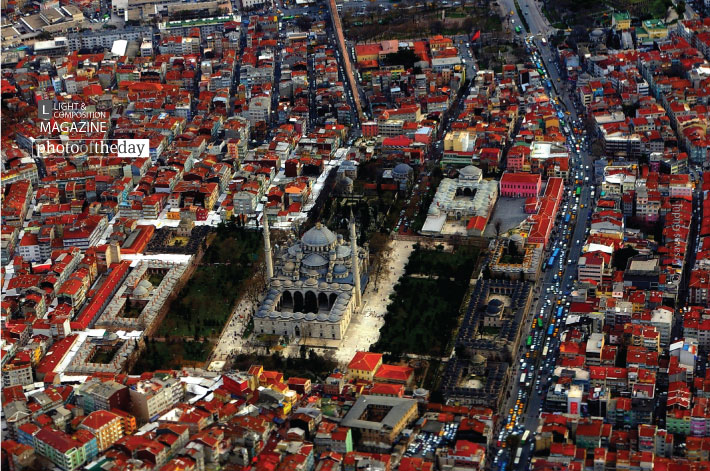
Exposure 1/60sec @ f/11 | ISO 200 | Focal Length 18-55mm
Ersavaş Güdül
Born in Istanbul in 1977, Ersavaş Güdül has cultivated a diverse background through his studies and professional life in both Turkey and Germany. Currently established in the telecommunications industry, he approaches photography as a dedicated creative pursuit. His technical versatility is reflected in his use of various systems, including Pentax, Nikon, and Panasonic equipment, which he employs to document his travels and observations with a thoughtful, discerning eye.
Resonance Score Breakdown
Transparency Note: The resonance score (14.0/20) is calculated based on social engagement metrics collected before the award announcement.
Expert Photography Reviews · 4
The Geometry of Arrival
There is a peculiar vertigo that comes with looking down from a great height. On the ground, we are defined by our proximity to things—the texture of a brick wall, the sound of a neighbor’s gate, the specific shade of a garden gate.
Read the reflection →The Geometry of Breath
The smell of cold stone always brings me back to the damp basements of my childhood, where the air felt heavy and thick with the history of things left behind.
Read the reflection →Reviews & Comments
Share your thoughts about this award-winning photograph. Your reviews contribute to the community engagement score.
Aerial shots usually reek of convenience, but one can’t help but admire the discipline here. Snapping a crisp frame through a vibrating cabin window while descending over Istanbul isn’t exactly a walk in the park. It’s a fleeting, frantic window of opportunity. I’ve spent enough hours shivering on hillsides to appreciate when someone actually commits to the moment. It’s a tidy piece of geometry, and frankly, I’m rather impressed he didn’t fumble the focus.
Most aerial shots of Istanbul are cluttered, chaotic messes. What separates this from the usual travel scrap is the restraint; by catching the Fatih Camii at the precise moment the urban grid aligns with the mosque’s geometry, Güdül forces order onto a sprawling city. I’ve looked at thousands of these, and honestly, this one still makes me hold my breath. It’s a rare, quiet anchor in a landscape that usually feels like it’s screaming for attention.
From the fuselage, Istanbul isn’t a city; it’s a geometry of grief. Güdül captures the Fatih Camii not as a monument, but as a dark anchor in a sea of grey stone. I’ve stared at these shadows until my eyes ached, feeling the weight of the Ottoman past pressing against the glass. It’s a cold, detached perspective, yet it’s honest. Light doesn’t reveal the mosque here; the encroaching darkness defines its true, lonely stature.
The terracotta tiles of Fatih Camii bleed into the city’s grey-blue sprawl like a Morandi still life caught in a sudden, breathless descent. It’s the ochre of sun-baked clay meeting the bruised, slate-cold shadows of an Istanbul winter that truly captures me, leaving me quite dizzy with its atmospheric weight. One finds the chromatic tension between those warm, earthen rooftops and the encroaching, melancholic urban haze absolutely exquisite, as if the light itself were mourning the fading day.