Before Migration by Ryszard Wierzbicki
Captured in the vast expanse of Tanzania’s Ngorongoro Crater in September 2011, this image documents a herd of gnu antelopes moments before their great migration. The photographer skillfully utilized the unique atmospheric conditions, where low-hanging clouds created a rhythmic, wave-like backdrop that emphasizes the movement and scale of the wildlife. By isolating the subjects against this ethereal, textured sky, the composition transforms a routine wildlife sighting into a poignant, painterly scene. This photograph is award-worthy for its masterful balance of natural drama and technical precision, capturing a fleeting, majestic moment in the cycle of the African wilderness.
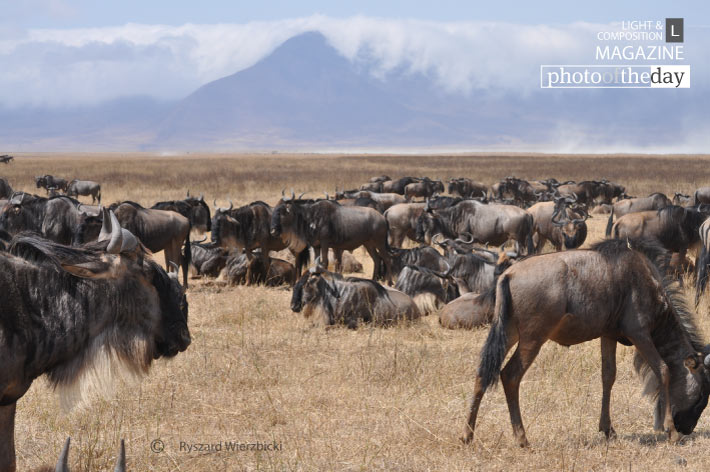
Exposure 1/2000sec @ f/6.7 | ISO 400 | Focal Length 175mm
Ryszard Wierzbicki
Born in 1963, Ryszard Wierzbicki is a Polish-born photographer and educator who transitioned from a diverse career in social sciences and marketing to a life of global exploration. After emigrating to the United Kingdom in 2006, he dedicated himself to documenting the world through photography and scuba diving, eventually founding the travel and photography forums Instant Travelling and World Around. His work is deeply informed by his extensive travels across South-East Asia and his commitment to humanitarian efforts, reflecting a profound curiosity for the natural world and the human experience.
Resonance Score Breakdown
Transparency Note: The resonance score (13.0/20) is calculated based on social engagement metrics collected before the award announcement.
Expert Photography Reviews · 8
The Rhythm of Departure
In the quiet hours of the morning, before the kettle has whistled or the house has begun its daily creaking, there is a sense of impending motion. It is a strange, heavy stillness that precedes a change in the weather or the departure of a friend.
Read the reflection →The Rhythm of Leaving
There is a specific kind of silence that precedes a departure, a stillness that gathers in the chest like dust before a storm. We are all, in our own ways, creatures of the horizon, tethered to the earth by roots we barely understand, yet pulled by a tide that demands we move.
Read the reflection →Reviews & Comments
Share your thoughts about this award-winning photograph. Your reviews contribute to the community engagement score.
The horizon line bisects the frame with surgical intent, anchoring the chaotic mass of the herd. It’s a rigid architecture. The rhythmic layering of the clouds provides a necessary counterweight to the antelopes’ kinetic density. The spatial tension here is undeniable; the negative space doesn’t just exist, it breathes. I’ve rarely seen such disciplined geometry in the wild. It’s cold, precise, and entirely unforgiving. The frame holds because the chaos is finally, mercifully, contained.
At 175mm, the lens resolves the gnu with clinical sharpness, yet it’s the diffraction of light across those low-hanging clouds that truly captivates me. By stopping down to f/6.7, Wierzbicki avoids the diffraction limit while maintaining a focal plane that renders the herd’s texture against the atmospheric haze. It’s a rare, haunting interplay of optics and biology. I’ve stared at these silhouettes for hours; the way the light bleeds into the horizon feels almost sacred.
The low, grey light of Ngorongoro doesn’t just illuminate; it hums. Ryszard stood there as the clouds pressed against the earth, waiting for the gnu to find their rhythm. I’ve felt that same stillness, where the air grows heavy with the coming journey. It’s a quiet, painterly surrender to the wild. Looking at these silhouettes against that textured sky, I feel a sudden, sharp ache for the vastness of the crater. He listened well.
One suspects Wierzbicki spent a fair few mornings shivering in the crater before the clouds aligned with the herd. It’s a rare thing to see the gnu treated with such painterly restraint rather than the usual frantic shutter-clicking. I’ve spent enough time in the damp to know when someone’s actually put in the hours. The composition doesn’t just happen; it’s bought with patience. It’s a quiet, earned triumph. I’d have liked to have been there.
The sky presses down. A heavy, grey weight. Below, the gnu gather. They aren’t just animals; they’re ink strokes on a vast, pale canvas. I feel a sudden, sharp ache in my chest looking at the distance between them. It’s the silence of the crater. Nothing here is accidental. The empty corner isn’t empty. It’s the breath before the journey begins. Wierzbicki doesn’t show us the migration. He shows us the pause. It’s enough.
The muted, bruised ochres of the gnu’s hide bleed into the vaporous, slate-grey heavens, creating a tonal symphony that recalls the melancholic, dust-choked palettes of Morandi. It’s a haunting, monochromatic meditation where the light doesn’t merely illuminate; it dissolves the boundary between earth and sky. I’m breathless, truly, watching how those soft, charcoal clouds cradle the herd, turning a simple migration into a sublime, ethereal passage through the quiet, silvered light of the crater.
The gnu don’t merely walk; they dissolve into the bruised, heavy sky of Ngorongoro. Wierzbicki’s choice to crush the foreground into near-blackness forces us to confront the migration as a threshold, not a journey. It’s haunting. I’ve spent hours staring at these silhouettes, feeling the cold weight of the abyss pressing against the herd. When light retreats, the truth emerges. It doesn’t invite us to look; it demands we acknowledge the encroaching, silent dark.
Most wildlife shots are just snapshots of biology, but this one captures a mood that’s rare. Of the thousands of migration photos I’ve reviewed, this succeeds because the low-hanging clouds don’t just sit there; they act as a heavy, rhythmic curtain pressing down on the herd. It’s haunting. I’d hang this in my own home because it feels like a memory of a world that’s slowly vanishing. It’s the weight of the sky that wins it.