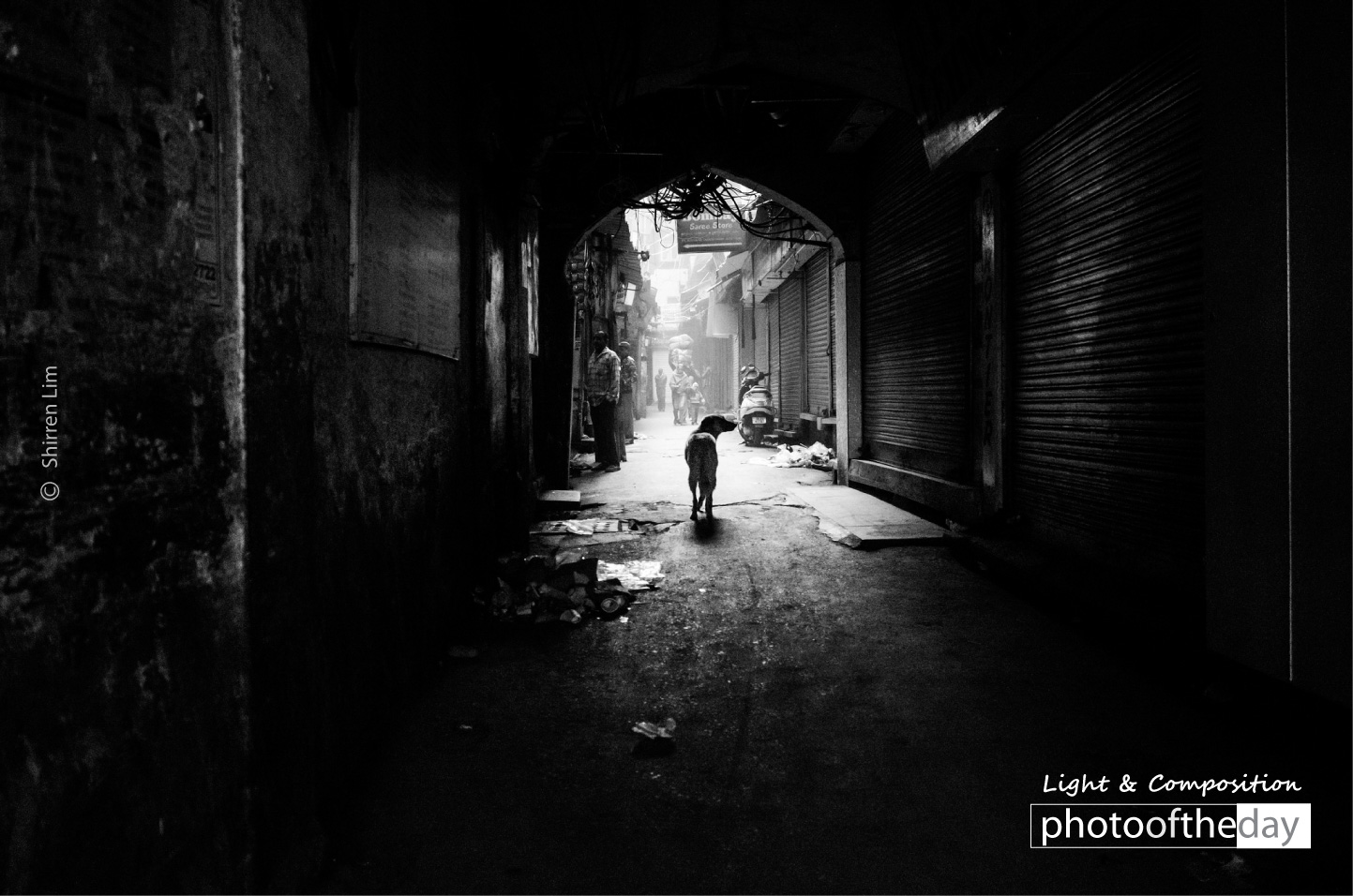
Stray Dog in an Alleyway by Shirren Lim
Captured during a quiet Sunday morning in the historic Chandni Chowk market of Delhi, this photograph documents a fleeting encounter in a secluded alleyway. The photographer, wandering through the typically bustling district while the shops remained shuttered, was drawn to the stillness of the scene. By focusing on a stray dog as it turned its head to catch the soft morning light, the image transforms a mundane urban moment into a poignant study of light and shadow. Its award-worthy quality lies in this precise timing and the evocative, intimate connection established with a solitary subject in an otherwise empty space.
Shirren Lim
Born in Penang Island, Malaysia, in 1970, Shirren Lim is a Jakarta-based photographer who discovered her true passion for the craft in 2009. Her work is characterized by an intense, earthy aesthetic that prioritizes sincere human expression and simple, impactful compositions. Deeply inspired by the iconic portraiture of Steve McCurry, she strives to capture humanity in its most authentic forms, aiming to create images that resonate with the same emotional depth as the National Geographic photography that defined her childhood.
Resonance Score Breakdown
Transparency Note: The resonance score (11.7/20) is calculated based on social engagement metrics collected before the award announcement.
Expert Photography Reviews · 6
The Quiet After the Rush
I remember walking through the backstreets of Istanbul just as the call to prayer began. The markets had been a riot of shouting merchants and clattering carts only an hour before, but in the sudden lull, the city felt like a held breath.
Read the reflection →The Dignity of the Unseen
Epictetus reminded his students that we are like actors in a play, and it is not our business to choose the role, but to play the assigned part well. Whether one is cast as a king or a beggar, the quality of the performance remains the same: a commitment to the present duty.
Read the reflection →Reviews & Comments
Share your thoughts about this award-winning photograph. Your reviews contribute to the community engagement score.
Chandni Chowk isn’t just a backdrop; it’s a living, breathing history. Why does the dog become the focal point of this historic space while the human labor that sustains these alleys vanishes? It’s a clean, well-lit shot, but I feel a strange, cold distance here. Does the stray represent a romanticized solitude, or are we just ignoring the people who actually inhabit this frame? It’s technically sharp, yet it leaves me feeling profoundly uneasy.
The alleyway holds its breath. A dog turns. It’s a quiet geometry of dust and shadow. I’ve walked these streets, yet I’ve never felt this stillness. The shuttered shops aren’t just closed; they’re waiting. Nothing here is accidental. The empty corner is not empty. It’s a vessel for the morning light. I find myself leaning in, afraid to break the silence. It’s rare to see Delhi stripped of its noise. It’s beautiful.
The jury’s obsession with clarity here feels stifling. Why demand the dog’s fur be rendered in clinical detail? I’m far more intrigued by the alley’s encroaching shadows, which swallow the architecture into a painterly void. It’s closer to Sugimoto’s long-exposure theatres than conventional street reportage. I’d have pushed the motion blur further, letting the animal dissolve into the Delhi light. Why resolve the subject when the atmosphere is clearly the point? It’s hauntingly beautiful.
It’s a quiet, honest frame. I’ve spent enough dawn hours waiting for a subject to trust my presence to recognize when a photographer has simply stood still. That dog’s posture—the slight turn toward the light—suggests a photographer who didn’t intrude, but waited for the animal to acknowledge them. It’s a rare, gentle interaction. I find myself breathing easier looking at this; it’s an earned moment, not an extracted one. A beautiful, respectful stillness.
Chandni Chowk is usually a riot, but Lim caught the silence. That dog turning its head? It’s everything. One tenth of a second later and the shadow has moved, the frame has collapsed. I’ve spent years chasing that specific quality of light in alleyways, and honestly, it makes my heart race. She didn’t hesitate. She waited for the dog to meet the sun, and she nailed it. It’s a perfect, fleeting, unrepeatable instant. Pure street.
Most street photography in Delhi is just noise, but this quietude hits differently. Of the thousands of alleyway shots I’ve reviewed, this one survives because the dog’s posture isn’t just a pose; it’s a deliberate anchor in the frame. The way the light catches that single eye makes me ache for the animal’s solitude. It’s not about the market’s history, but the dog’s singular, fleeting dignity. In thirty years, this stillness will still feel heavy.