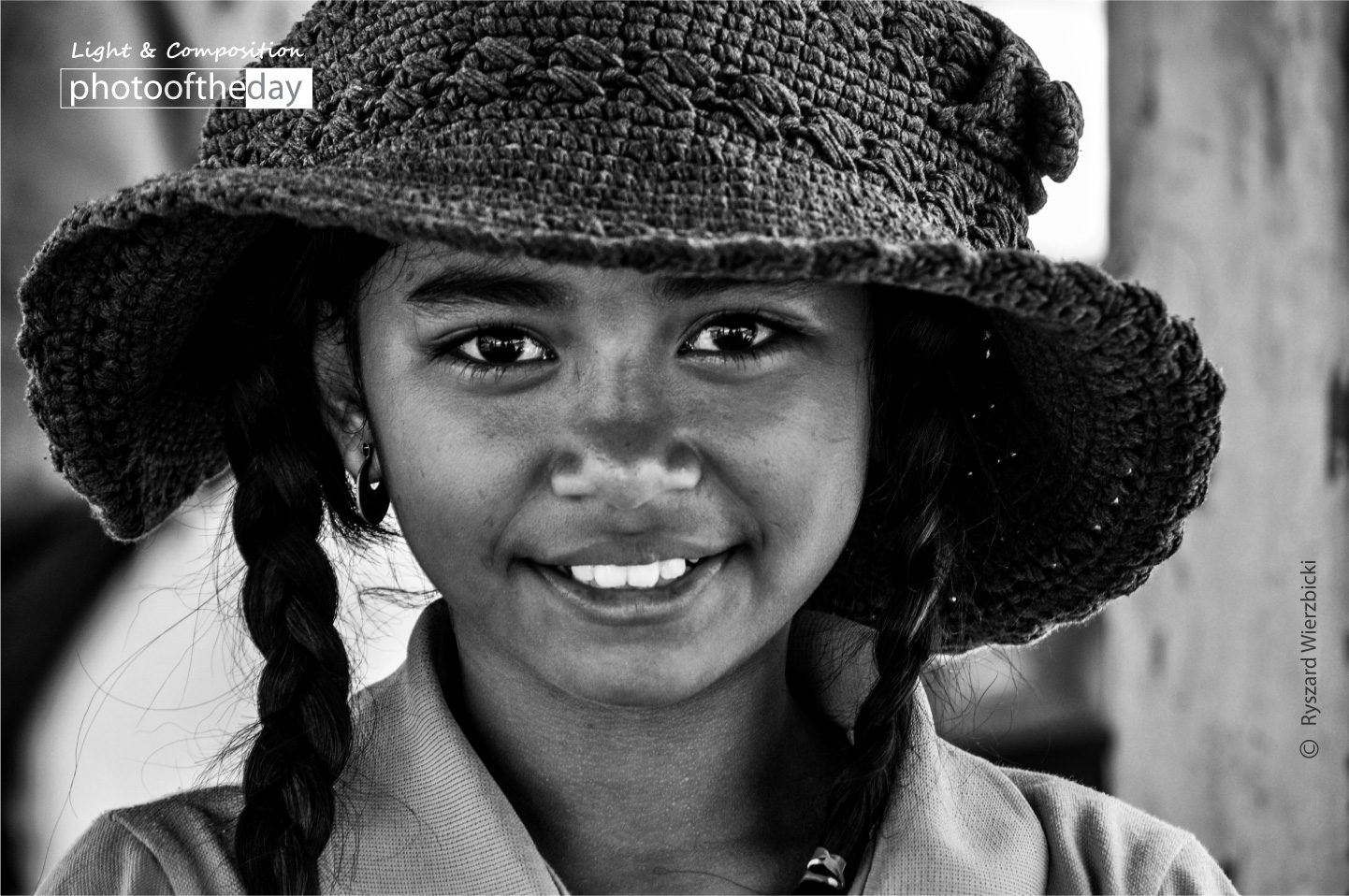
The Stallholder Girl by Ryszard Wierzbicki
Captured at the bustling Benoa Port in Bali, this poignant portrait highlights the reality of childhood in South East Asia, where young ones often support their families through trade. The photographer was struck by the girl's radiant expression amidst her daily responsibilities as a stallholder. By focusing on her genuine smile, the image transcends a simple documentary shot, transforming a fleeting moment of labor into a powerful, humanizing narrative. The composition is award-worthy for its ability to capture both the cultural context of the region and the resilient, innocent spirit of the subject.
Ryszard Wierzbicki
Born in 1963, Ryszard Wierzbicki is a Polish-born photographer and educator currently based in Swindon, United Kingdom. After a diverse career in social sciences and marketing, he transitioned to a life of exploration, focusing his lens on the vibrant cultures of South-East Asia. His work is deeply informed by his background in child care and his commitment to humanitarian efforts, frequently documenting the lives of those he encounters during his extensive travels. Through his photography and travel forums, he shares a unique perspective on the world, blending technical skill with profound empathy.
Resonance Score Breakdown
Transparency Note: The resonance score (11.7/20) is calculated based on social engagement metrics collected before the award announcement.
Expert Photography Reviews · 5
The Weight of a Smile
I remember a morning in a market in Luang Prabang where a young boy was selling woven baskets. He couldn't have been more than ten, yet he handled the currency with the weary precision of a banker twice his age.
Read the reflection →The Weight of Small Hands
We are taught that childhood is a season of waiting. A long, slow thaw before the real work of living begins. But in many places, the frost never truly leaves the ground, and the work starts before the sun has climbed the ridge.
Read the reflection →Reviews & Comments
Share your thoughts about this award-winning photograph. Your reviews contribute to the community engagement score.
1/125sec at f/5.6, 100mm. ISO 200. It’s a safe, clinical choice for a portrait. The depth of field is sufficient to isolate the subject from the chaotic port background without losing the context of her trade. I’ve seen enough soft, wide-open portraits to appreciate the discipline here. It’s sharp where it needs to be. Honestly, the clarity of that smile against the industrial grit actually caught me off guard. It’s a technically sound, honest execution.
The frame’s geometry is compromised. The subject’s placement lacks the necessary tension to anchor the chaotic background of the Benoa Port. While the focal length isolates the girl, the spatial weight shifts awkwardly toward the periphery, leaving the center hollow. It’s a structural failure. I’ve seen this lack of discipline too often in documentary work. The composition doesn’t hold. It’s frustrating, really, because the tonal balance is precise, yet the architecture simply isn’t there.
The weathered wood of the stall creates a textured, tactile frame that grounds the girl in her reality. That soft, diffused light catching the edges of her wares feels almost Dutch, elevating the humble inventory to a still life. I’m struck by how the clutter defines her resilience. It’s not just a backdrop; it’s her world. When I look at the way she leans into those crates, I feel a sudden, sharp ache for her lost childhood.
We look at this girl in the Port of Benoa and we hear the hum of the market before we see her smile. Ryszard didn’t just capture a stallholder; he listened to the weight of her day. It’s in her eyes—that quiet, resilient spark that defies the labor. I find myself wanting to sit at her stall and just listen to her story. It’s a portrait that asks to be returned to, again and again.
At f/5.6, the 100mm focal length renders the girl’s eyes with startling clinical precision. I’m genuinely moved by how the lens resolves the micro-contrast in her iris, capturing light that the naked eye simply misses. The bokeh, a function of that specific aperture, isolates her against the port’s chaotic geometry without succumbing to diffraction limits. It’s a rare instance where the optics don’t just record a face; they reveal the raw, luminous biology of her resilience.