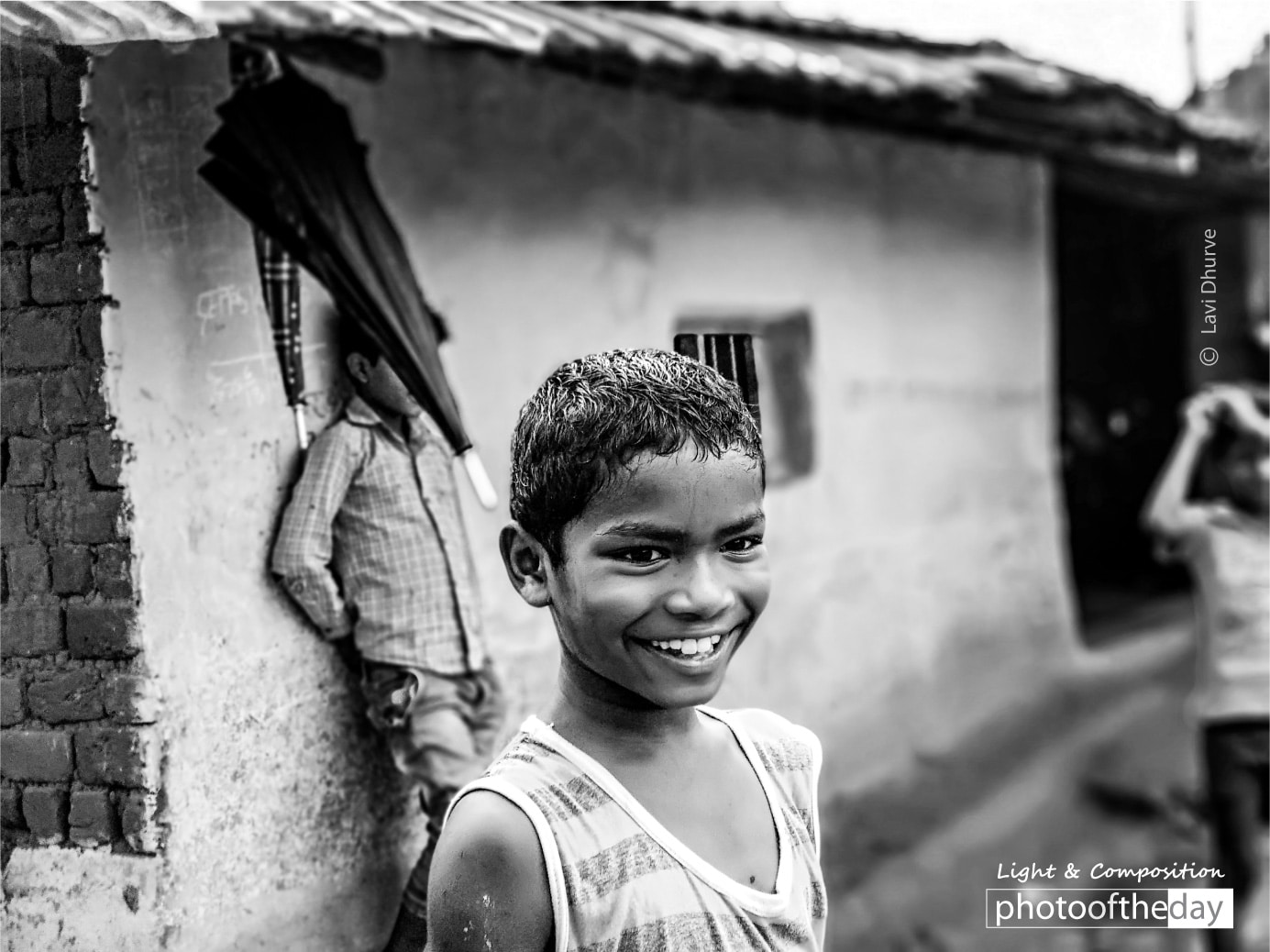
The Laughing Boy by Lavi Dhurve
Captured during the refreshing morning hours of the rainy season in Madhya Pradesh, this portrait freezes a fleeting moment of pure, unadulterated joy. As children made their way to school following a rainfall, the photographer was struck by the infectious laughter of a young boy passing by. Acting instinctively, she captured the scene to preserve the innocence and beauty of village life. The image is award-worthy for its authentic emotional resonance and the photographer's ability to transform a simple, everyday encounter into a timeless celebration of childhood happiness, highlighting the profound beauty found in the mundane.
Lavi Dhurve
Hailing from a small village in Madhya Pradesh, the 'Heart of India,' Lavi Dhurve finds deep inspiration in the simplicity and beauty of her surroundings. Her work is a heartfelt exploration of art, culture, and the human spirit, with a particular focus on the lives of children and the natural splendor of sunrise and sunset. Through her lens, Dhurve seeks to document the inherent beauty of her community and the people who inhabit it, consistently striving to share the quiet, meaningful experiences she encounters in her daily life.
Resonance Score Breakdown
Transparency Note: The resonance score (11.7/20) is calculated based on social engagement metrics collected before the award announcement.
Expert Photography Reviews · 6
The Weight of Unburdened Joy
Epictetus once remarked that we are not disturbed by things, but by the views we take of them.
Read the reflection →The Architecture of Joy
Joy is not a destination we reach, but a sudden weather pattern that breaks over the landscape of the face. It arrives like the first heavy drops of a monsoon, turning the dust of the mundane into something dark, fragrant, and alive.
Read the reflection →Reviews & Comments
Share your thoughts about this award-winning photograph. Your reviews contribute to the community engagement score.
Joy is easy to romanticize, but does this boy’s laughter belong to him or to the photographer’s narrative of rural innocence? I’m unsettled by how the frame isolates his delight, stripping away the context of his walk to school. Why must we consume his happiness as a timeless aesthetic object? It’s a beautiful moment, sure, but I can’t help feeling like we’re just tourists in his life. Whose gaze are we actually satisfying here?
Before the eye identifies the boy, something in the chest loosens. It’s a sudden, visceral activation of memory—the smell of wet earth in Sarni, the weightless abandon of a morning rain. I’ve felt my pulse quicken just watching his mouth open in that unfiltered, jagged laugh. It’s not just a portrait; it’s a physiological anchor. When I return to it, the joy doesn’t fade; it settles into my own quiet, lingering like a half-remembered dream.
Rain-washed air. A boy’s open mouth. The frame holds the wet gray of Sarni, yet it’s the space around him that breathes. I’ve spent minutes watching his joy against that vast, muted backdrop. It’s quiet. The emptiness isn’t a void; it’s a container for his laughter. I feel a sudden, sharp ache for that simplicity. Nothing here is accidental. The empty corner is not empty. It’s where the silence lives. It’s where he remains.
The boy’s head occupies the upper right quadrant, creating a precarious diagonal that pulls the eye toward the frame’s edge. It’s a risky placement, yet the negative space behind him provides the necessary counterweight. The tonal range is tight, grounding the subject within the damp, grey atmosphere of Sarni. I’m genuinely unsettled by how the composition forces this joy into such a rigid geometry. It doesn’t just capture a laugh; it traps it perfectly.
It’s a charming portrait, but I find myself searching for the context of the interaction. In my field, we learn that true connection isn’t snatched; it’s earned through presence. Did the boy know he was being framed, or was he just a prop in the rain? I’d trade this polished composition for a moment where the subject wasn’t just an object of the lens. It’s pretty, sure, but it feels extracted, not invited.
Most portraits of childhood joy feel staged or saccharine, but this one avoids that trap. The boy’s genuine, unforced grin against the muted, rain-washed backdrop of Sarni creates a rare, visceral honesty. I’ve seen thousands of street portraits, yet this one makes me smile back every single time. It’s the lack of pretense that secures its legacy. In thirty years, we won’t remember the gear, but we’ll still feel the relief of that morning rain.