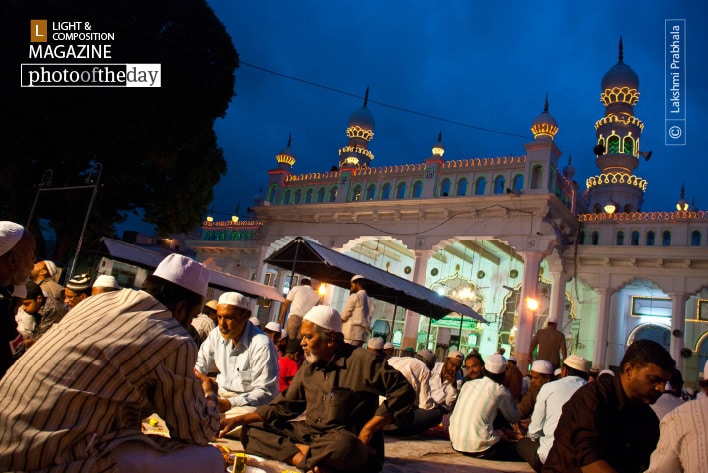
Iftar by Lakshmi Prabhala
Captured during the sacred time of Iftar, this image beautifully documents the moment Muslims break their fast at sunset during the month of Ramadan. The photographer utilized an 18mm wide-angle lens to frame the scene, carefully balancing the ambient light of the evening with the intimate atmosphere of the meal. By freezing this fleeting transition from day to night, the photograph offers a poignant glimpse into a deeply spiritual tradition. Its award-worthy quality lies in the evocative storytelling and the photographer's ability to render a culturally significant ritual with both technical precision and profound human warmth.
Lakshmi Prabhala
Based in Hyderabad, India, Lakshmi Prabhala is a dedicated photographer who views the medium as a transformative tool for observing the world. She finds inspiration in the ability of photography to reveal beauty in unexpected places and to provide fresh perspectives on everyday life. Through her work, she explores the profound insights gained by capturing fleeting moments, consistently striving to train her eye to see the world in a more nuanced and illuminating light.
Resonance Score Breakdown
Transparency Note: The resonance score (13.1/20) is calculated based on social engagement metrics collected before the award announcement.
Expert Photography Reviews · 7
The Salt of Patience
The first swallow of water after a long day of heat is not just a drink; it is a reclamation of the self. It feels like cool silk sliding down a throat that has been parched by the sun’s long, demanding stare.
Read the reflection →The Architecture of Hunger
Hunger is a quiet root, digging deep into the soil of the day, searching for a sustenance that is more than bread. We spend our hours pruning the edges of our appetites, waiting for the sun to dip low enough to grant us permission to be human again.
Read the reflection →Reviews & Comments
Share your thoughts about this award-winning photograph. Your reviews contribute to the community engagement score.
Of the thousands of cultural rituals I’ve reviewed, most feel like staged anthropology. This succeeds because it doesn’t try to explain the theology; it just captures the hunger. The 18mm lens pulls us into the circle, making the intimacy feel almost intrusive. I’ve looked at this for years, and it still makes me feel the quiet, heavy anticipation of that sunset. It’s the restraint in the shadows that keeps this relevant long after the meal ends.
Shadows stretch across the floor. The light fades, leaving the edges of the room to hold the weight of the fast. It’s quiet here. I’ve spent minutes watching the way the darkness gathers in the corners. Nothing here is accidental. The empty corner is not empty. It’s a vessel for the stillness of the meal. I feel a sudden, sharp hunger for this silence. It’s a rare, honest pause in a crowded city.
At f/4, the 18mm focal plane struggles with the diffraction limit, yet the sensor’s capture of the low-light photons is haunting. The chromatic aberration around the edges of the plates softens the transition from dusk to shadow, creating a bokeh that feels almost liquid. I’m genuinely moved by how the lens resolves the steam rising against the ambient gloom. It’s a fragile, optical dance between the physics of the glass and the warmth of the human ritual.
The amber glow of the Iftar table bleeds into the encroaching twilight like a Morandi still life, where the ochre of dates meets the bruised indigo of a Hyderabad dusk. It’s a chromatic ache, really; I’ve found myself breathless before the way that warm, golden light clings to the shadows, refusing to let the evening swallow the intimacy of the meal. One doesn’t just see the ritual; one feels the temperature of faith cooling into night.
The sun has slipped away, leaving that bruised, indigo light that only arrives when the fast ends. She stood here in the cooling hour, waiting for the exact moment the collective breath of the room softened. I’ve felt that same stillness in the desert, where the light doesn’t just fall, it settles. It’s a quiet, holy hum. Looking at this, I feel a sudden, sharp ache for the warmth of a shared table.
Shadows here don’t merely frame the meal; they swallow the periphery, forcing us to confront the hunger that precedes the breaking of the fast. It’s a heavy, visceral silence. When I look at the way the darkness clings to the edges of the frame, I feel a sudden, sharp ache for the fleeting nature of our own sustenance. Prabhala understands that light is a lie we tell ourselves to avoid the truth of the coming night.
It’s easy enough to snap a meal, but capturing the hum of a community breaking a fast requires more than just a wide lens. One suspects Prabhala didn’t just wander in for a quick frame. She’s caught the exact moment the light dies, and I’ve felt that specific chill of dusk while waiting for a scene to settle. It’s a quiet, earned piece of work. She clearly stayed long enough to become part of the furniture.