Drawn Life by Ali Berrada
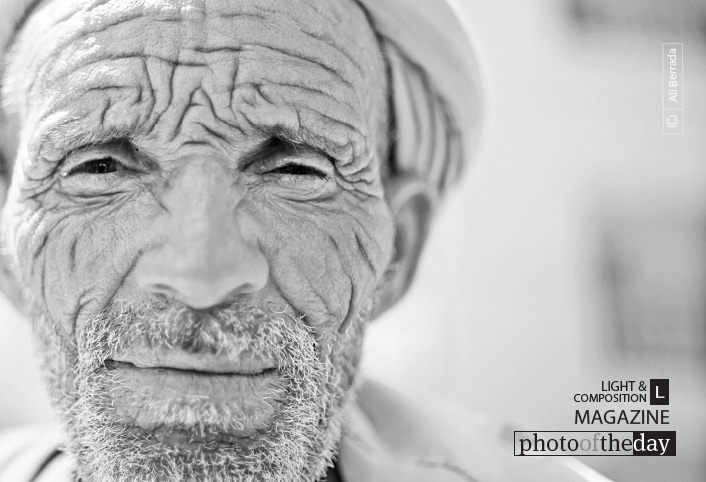
Captured amidst the unforgiving heat of the Moroccan desert, this portrait reveals the resilient spirit of a local man in Merzouga. Despite temperatures soaring to 52 degrees, the subject offered a warm, welcoming presence to travelers from afar. The photographer expertly utilized a 50mm lens to isolate the subject, capturing a moment of profound human connection against the stark, arid landscape. This image is award-worthy for its ability to distill the essence of hospitality and grace under extreme environmental conditions, transforming a fleeting encounter into a timeless, evocative narrative of the human experience.
Ali Berrada
Based in Casablanca, Morocco, Ali Berrada is a dedicated freelance photographer who views the world through a lens of simplicity and creative depth. Driven by a desire to capture fleeting moments that transcend time, he travels globally in pursuit of the perfect light, identifying as a citizen of the world rather than a product of a single region. His work reflects a deep passion for finding beauty in the void, aiming to preserve the essence of the human experience through his evocative and thoughtful portraiture.
Resonance Score Breakdown
Transparency Note: The resonance score (15.0/20) is calculated based on social engagement metrics collected before the award announcement.
Expert Photography Reviews · 8
The Geography of Patience
In the high desert, time does not move in a straight line. It behaves more like the shifting dunes, which are never truly still, yet never seem to go anywhere at all.
Read the reflection →The Weight of a Welcome
I spent an hour this morning trying to fix a leaky faucet. My hands were clumsy, the wrench kept slipping, and I felt that familiar, sharp irritation rising in my chest.
Read the reflection →Reviews & Comments
Share your thoughts about this award-winning photograph. Your reviews contribute to the community engagement score.
Most portraits from the desert rely on the heat to do the heavy lifting, but this one succeeds because of the man’s eyes. I’ve seen thousands of travel portraits, and they usually feel like transactions. Here, the 50mm focal length forces an intimacy that feels earned, not stolen. It’s the subtle curve of his smile that gets me; it’s genuinely disarming. In thirty years, we won’t care about the lens, but we’ll still feel his quiet grace.
Fifty-two degrees is a brutal price to pay for a portrait, yet Berrada didn’t settle for a quick snap. One senses he sat in that heat until the man’s guard dropped, turning a tourist encounter into something far more intimate. I’ve spent enough afternoons in the dunes to know that kind of stillness isn’t easy. It’s a rare, quiet dignity. He didn’t just find this moment; he clearly earned it. I find myself quite envious.
The 50mm focal length compresses the Merzouga horizon, forcing the subject into a rigid, central alignment. It’s a tight, unforgiving geometry. The negative space doesn’t breathe; it suffocates the frame. While the tonal contrast between skin and sand is technically precise, the composition lacks a necessary fulcrum. I’ve stared at this for an hour, yet the static placement of the head against the void leaves me cold. It’s structurally sound, but ultimately, it’s just empty.
The desert doesn’t offer hospitality; it demands surrender. Berrada’s subject exists in the friction between the sun’s violence and the deep, ink-black hollows of his own gaze. It’s here, in the heavy folds of the djellaba, that the image truly thinks. I’ve stared at those shadows until my own eyes ached, feeling the crushing weight of the Merzouga heat. It’s not a portrait of a man, but a confrontation with the darkness that sustains him.
The desert heat doesn’t crowd the frame. It recedes. The man sits in a vast, pale void. I’ve spent minutes watching the way his shadow anchors the sand. It’s quiet. He isn’t performing for the lens. He’s just existing in the stillness. Nothing here is accidental. The empty corner is not empty. It’s a breath held in the dunes. I feel a sudden, sharp ache for that silence. It’s rare to find such peace.
At 1/1600sec, the 50mm focal plane locks onto the subject’s skin with clinical precision, rendering the desert heat’s refraction almost tangible. The bokeh, a function of the wide aperture, isolates him beautifully against the Merzouga dunes. I’m genuinely moved by how the lens resolves the fine, parched texture of his skin; it’s a rare moment where optics meet raw humanity. It doesn’t just capture a portrait; it maps the very topography of a life lived under sun.
The heat in Merzouga doesn’t just burn; it hums. Ali stood there while the sun bleached the world, waiting for the light to soften its judgment. He didn’t force this portrait; he listened to the man’s stillness. I’ve felt that same desert silence, where time simply stops. Looking at those eyes, I feel a sudden, sharp ache of kinship. It’s a quiet grace, captured only because the photographer knew when to finally let the shutter fall.
The ochre of the Merzouga dunes, that parched, sun-bleached pigment reminiscent of a Morandi still life, doesn’t merely frame the subject; it consumes him in a feverish, golden embrace. I’m breathless at how the light clings to his skin, a warm, terracotta glow that feels like a Vermeer interior transposed into the desert’s brutal, shimmering heat. It’s a chromatic triumph, where the palette’s searing intensity creates a profound, aching intimacy I’ve rarely encountered.
woowww…!!!!!!!beautiful…a lesson for ebery man and woman who complaints…a real pic and right attitude towards life…REALY WONDERFUL…!