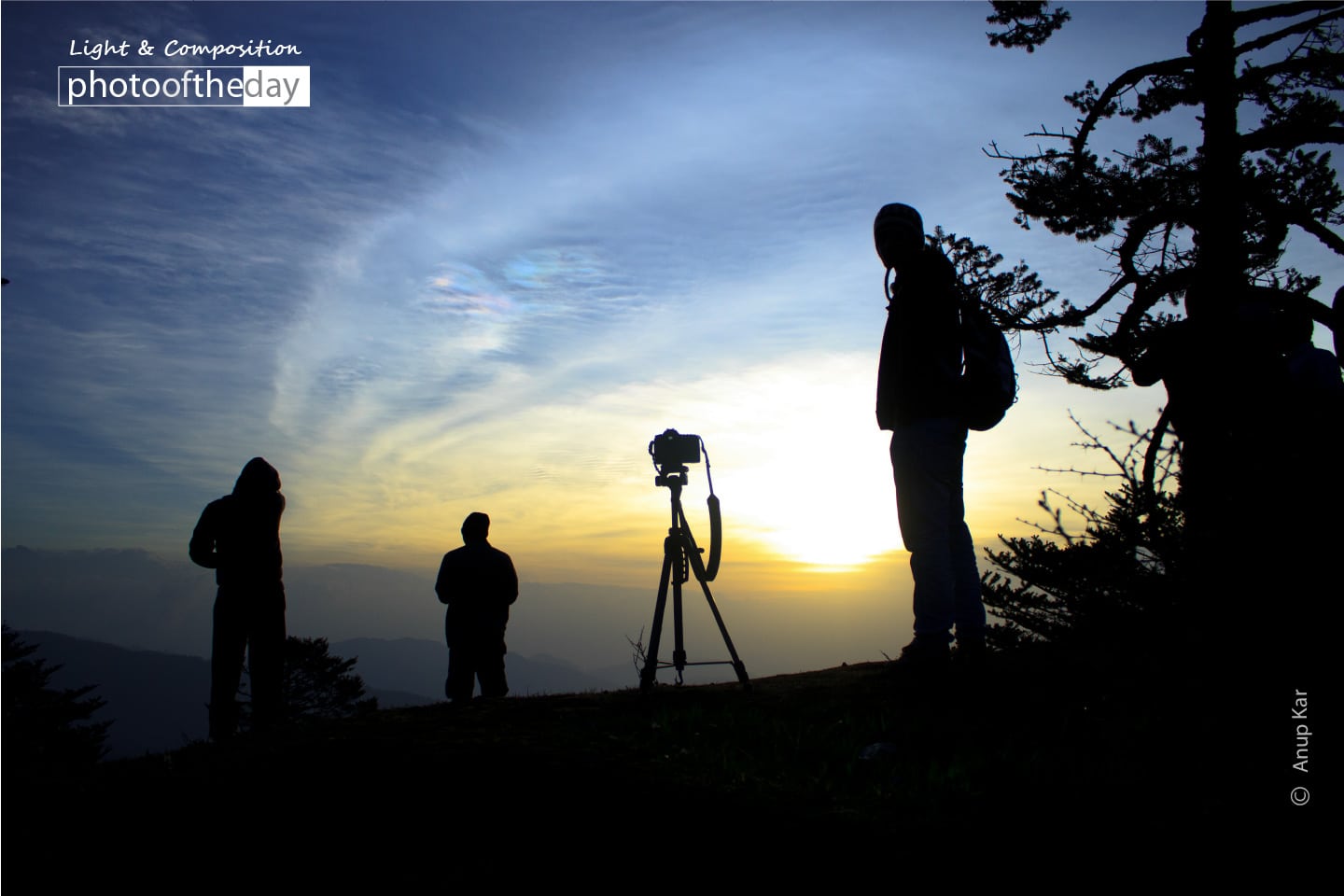
Waiting for Sunrise by Anup Kar
Captured at 4:30 am from the heights of Sandakphu, this photograph immortalizes the serene anticipation of dawn. As the first light touched the majestic peaks of Kanchenjunga and Mount Everest, the photographer observed a poignant scene: companions silhouetted against the horizon, their tripod-mounted gear mirroring the grandeur of the mountains. This composition succeeds by balancing the human element with the vast, ethereal scale of the Himalayas. The image is award-worthy for its masterful use of natural light and the evocative storytelling that transforms a simple moment of waiting into a profound connection between humanity and the natural world.
Anup Kar
Based in Cooch Behar, West Bengal, Anup Kar balances a professional career as a civil engineer with a dedicated pursuit of the photographic arts. Influenced by a circle of passionate peers, he has transitioned from a casual hobbyist to a serious practitioner of landscape, portrait, and street photography. His work reflects a deep appreciation for the natural beauty of India, often seeking to capture the quiet, atmospheric moments found within the rugged landscapes of the Himalayas.
Resonance Score Breakdown
Transparency Note: The resonance score (12.0/20) is calculated based on social engagement metrics collected before the award announcement.
Expert Photography Reviews · 7
The Architecture of Expectation
We are creatures of the threshold, forever standing on the edge of what has not yet arrived. There is a specific, hollow ache in the hours before the light breaks, a quietude that feels like holding one’s breath in a vast, empty cathedral.
Read the reflection →The Quiet Before the Light
I remember sitting on a rusted bench in a village outside of Leh, waiting for the first grey light to bleed over the jagged ridge of the mountains. It was four in the morning, and the air was thin enough to make your lungs ache.
Read the reflection →Reviews & Comments
Share your thoughts about this award-winning photograph. Your reviews contribute to the community engagement score.
At 1/4000th of a second, Kar has frozen the Himalayas into a static, clinical postcard. It’s technically precise, sure, but it’s also remarkably safe. I’m craving the grit of the cold or the blur of shivering hands. Why resolve every jagged peak so perfectly? I’d rather see the mountain dissolve into the dawn’s uncertainty. It’s a missed opportunity to let the light actually bleed into the frame, rather than just documenting it.
The frame holds its breath. At 4:30 am, the silence is heavy, almost cinematic. Those silhouettes against the Kanchenjunga peaks aren’t just figures; they’re the audience in a theater of stone and ice. I’ve spent years chasing this exact tension, where the gear mirrors the mountains. It’s a perfect cut. The shutter speed was a bold choice, freezing the anticipation before the light breaks. Honestly, it makes me want to pack my bags and just watch.
The horizon line bisects the frame with surgical intent, anchoring the Kanchenjunga massif against the encroaching light. The tripod-mounted silhouettes provide a necessary vertical counterweight to the expansive negative space. It’s a rigid geometry that keeps the composition from dissolving into mere sentimentality. I’ve grown weary of sunrise tropes, but the structural discipline here doesn’t falter. The tension between the human apparatus and the geological scale holds. It’s a rare instance where the frame actually works.
At 4:30 am, the air in Sandakphu bites. He stood there in the freezing dark, listening to the mountains breathe before the sun dared to arrive. I’ve felt that same ache in my own fingers, waiting for the peaks to ignite. It’s not just a silhouette; it’s a quiet surrender to the scale of the Himalayas. He didn’t capture a view; he waited until the light finally invited him into its sacred, fragile presence.
Cold air. The thin blue of pre-dawn. Sandakphu isn’t just a place; it’s a breath held in the throat. The silhouettes are small, anchored against the immense, jagged teeth of the horizon. They’ve surrendered to the scale. I’ve stood in that same biting wind, waiting for the light to break the silence. Nothing here is accidental. The empty sky isn’t empty. It’s the weight of anticipation. It’s the quiet before the world begins.
Silhouettes against Kanchenjunga feel like a tired trope, don’t they? Kar places these photographers as proxies for the viewer, but why must we always colonize the horizon with our gear? It’s a beautiful light, sure, but I feel a strange, cold distance here. Are these figures actually engaging with the landscape, or are they just consuming it for the sensor? Whose gaze are we prioritizing—the mountain’s ancient stillness or the photographer’s desperate need to capture it?
At 12,000 feet, the threshold between earth and sky dissolves. Kar captures the silhouettes of photographers as a human datum against the jagged, frozen mass of the Himalayas. It’s a rare moment where the equipment doesn’t feel like an intrusion, but an extension of the mountain’s own geometry. I’m struck by how the light barely grazes those peaks, defining depth through shadow. It’s not just a sunrise; it’s the architecture of anticipation itself.
I love the photo.
Thanks Light n composition