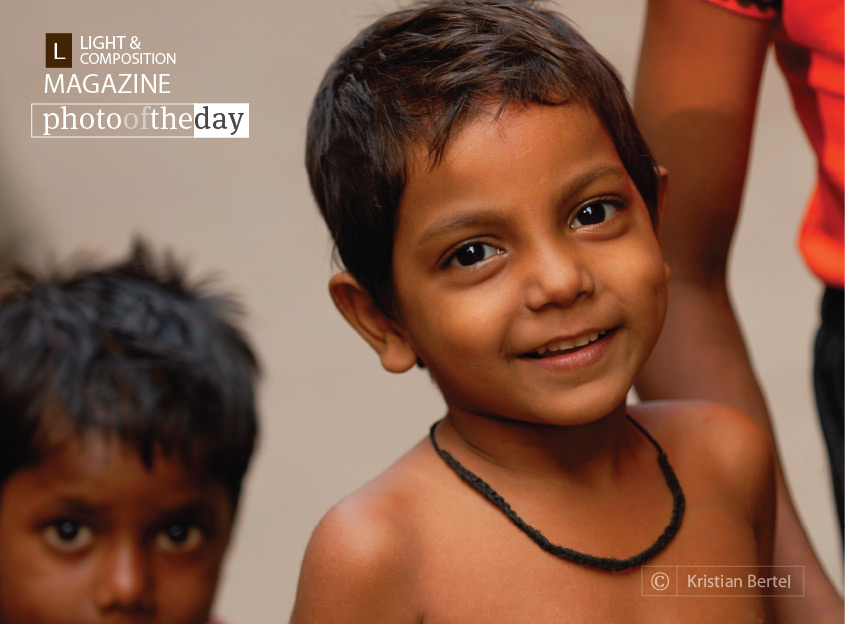
Boys in India by Kristian Bertel
Captured in the historic city of Varanasi, this poignant portrait features two young boys against the backdrop of a culture deeply intertwined with the sacred Ganges. The photographer utilized a shallow depth of field to isolate the subjects, emphasizing their expressions and the raw reality of their environment. This image is award-worthy for its masterful balance of technical precision and human empathy, offering a window into the daily lives of India’s youth. By focusing on the human condition, the photographer elevates a simple street encounter into a compelling narrative about resilience and the enduring spirit of life in North India.
Kristian Bertel
Based in Aarhus, Denmark, Kristian Bertel has dedicated his career to capturing the profound human narratives found within travel photography. Since beginning his practice in 2006, he has become widely recognized for his extensive, long-term documentation of life in India. His work serves as a powerful social commentary, focusing on the daily struggles, living conditions, and the resilience of street children, consistently blending technical skill with a deep, empathetic commitment to storytelling.
Resonance Score Breakdown
Transparency Note: The resonance score (12.9/20) is calculated based on social engagement metrics collected before the award announcement.
Expert Photography Reviews · 4
The Weight of Shared Silence
I remember sitting on a low stone wall in a small village in the Peloponnese, watching two brothers share a single piece of bread. They weren't talking, and they weren't looking at me. They were simply existing in that easy, unhurried rhythm that only children seem to master.
Read the reflection →The Unwritten Map of Youth
We are all born with a geography of wonder, a landscape that has not yet been mapped by the heavy hand of experience.
Read the reflection →Reviews & Comments
Share your thoughts about this award-winning photograph. Your reviews contribute to the community engagement score.
Most street portraits in Varanasi rely on the exoticism of the Ganges to do the heavy lifting. This one doesn’t. By pinning the focus strictly on the boys’ eyes at f/2.8, Bertel forces us to confront their specific, unvarnished gaze. It’s a quiet, unsettling intimacy that makes me look away, then look back. In thirty years, the background will be a historical footnote, but that look of guarded resilience will still be hauntingly relevant.
Varanasi isn’t just a place; it’s a furnace of existence. These boys emerge from the gloom like ghosts clinging to the threshold of the Ganges. I’m struck by how the shadows don’t just frame them; they consume the edges of their reality. It’s a heavy, suffocating darkness that forces us to confront what isn’t being said. When I look at their eyes, I don’t see resilience. I see the terrifying weight of time itself.
At f/2.8, the Nikon D200’s sensor captures a razor-thin focal plane that isolates these boys from the chaotic Varanasi backdrop. The bokeh, a function of that wide aperture, renders the background into a soft, chromatic wash, yet the boys’ eyes remain sharp enough to reveal the subtle refraction of the Ganges light. It’s physically precise, but honestly, the vulnerability in their gaze hits me harder than the optics. I’ve rarely seen such raw humanity resolved so perfectly.
1/180sec at f/2.8, ISO 125 on a D200. The sensor’s CCD architecture renders skin tones with a clinical accuracy modern CMOS sensors often lack. At f/2.8, the focal plane is razor-thin, forcing the viewer’s eye exactly where it belongs. It’s a calculated risk that paid off. I’ve stared at these boys for ten minutes, and the technical discipline here is undeniable. It’s rare to see such restraint in street portraiture. The math holds up.