Children in Nepal by Lothar Seifert
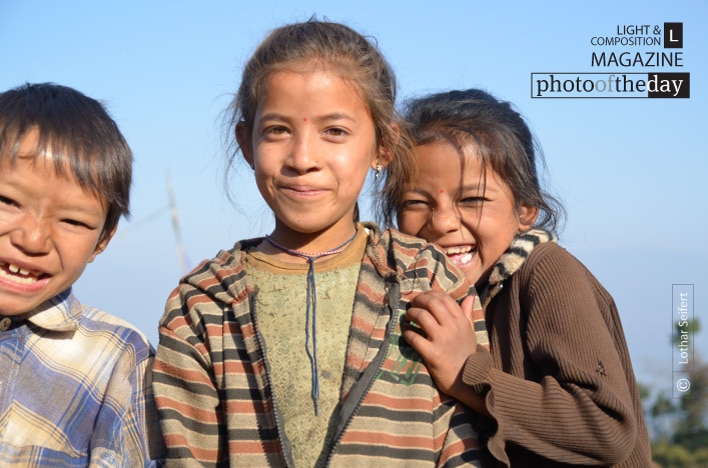
Captured in the rugged, high-altitude terrain of Dolkha, Nepal, this poignant portrait features children from the Tamang community. Lothar Seifert utilized a 34mm focal length to frame these subjects against the backdrop of the Himalayas, balancing a fast shutter speed of 1/1000sec to ensure crisp clarity in the mountain light. The image serves as a testament to the photographer’s deep connection with the region, reflecting his commitment to documenting the lives of those in remote, often impoverished areas. This photograph is award-worthy for its authentic portrayal of cultural heritage and the genuine, unposed spirit of the subjects, highlighting the intersection of humanitarian empathy and technical precision.
Lothar Seifert
Born in 1955 in Germany, Lothar Seifert resides in a small village in Upper Lusatia, where he balances his professional career as a design engineer with a profound passion for photography. His extensive travels across Asia—particularly Nepal, Kashmir, and India—have deeply influenced his work, fostering a specialized focus on portraiture and street photography that emphasizes solidarity with marginalized communities. Beyond his artistic pursuits, Seifert is dedicated to environmental conservation and humanitarian efforts, frequently integrating his photography with projects that support education and welfare for children in the Himalayan regions.
Resonance Score Breakdown
Transparency Note: The resonance score (13.5/20) is calculated based on social engagement metrics collected before the award announcement.
Expert Photography Reviews · 5
The Architecture of Roots
We are all born with a geography etched into our skin, a map of where we began that never quite fades, no matter how far we wander.
Read the reflection →The Weight of Unwritten Histories
In the high, thin air of the mountains, silence is not merely the absence of sound; it is a physical presence. It presses against the skin, demanding a different kind of listening.
Read the reflection →Reviews & Comments
Share your thoughts about this award-winning photograph. Your reviews contribute to the community engagement score.
Before the eye identifies the children, a sudden stillness settles in the chest. The thin, high-altitude light doesn’t just illuminate; it demands a physiological response, a tightening of the throat. I’ve returned to these faces three times today, and each time, their unblinking gaze pulls me into that rugged, silent expanse. It’s the vulnerability of their stillness that haunts me. When I close my eyes, I’m still standing there, shivering in that cold, thin Himalayan air.
The mountain air hits you first. It’s a wide 34mm gaze, catching the Tamang children in a moment of pure, unscripted stillness. That 1/1000 shutter speed freezes the grit of Dolkha, yet the frame breathes. I’ve spent hours staring at their eyes; there’s a quiet, cinematic weight here that makes me ache for the lives unfolding just off-screen. It’s the perfect cut. Seifert didn’t just take a photo; he held the scene until it became a film.
The 34mm focal length creates a jarring spatial disconnect between the subjects and the Himalayan backdrop. The foreground mass lacks a clear fulcrum, leaving the composition to drift into the negative space of the mountains. It’s technically sharp, yet the visual architecture fails to anchor the eye. I’ve seen this lack of structural discipline before; it’s frustrating. The frame doesn’t hold. Without a rigorous geometric logic, the subjects remain mere silhouettes against a chaotic, unmanaged horizon.
The rugged stone masonry here isn’t just a backdrop; it’s the datum for these children’s lives. That harsh, high-altitude light rakes across the rough textures, defining mass against the void of the valley. It’s a brutal, honest threshold. I’m struck by how the architecture of the landscape dwarfs them, yet they hold the frame with such presence. It’s a rare, visceral reminder that buildings are merely shells for the human spirit to inhabit.
One suspects Seifert didn’t just stumble upon these children while passing through. That 34mm focal length demands proximity, and you don’t get that kind of ease in a subject’s eyes without sitting in the dirt for a few hours first. It’s a quiet, honest bit of work. I’ve spent enough mornings shivering in the Himalayas to know that look; it’s earned. He clearly stayed long enough for them to forget he was even there.