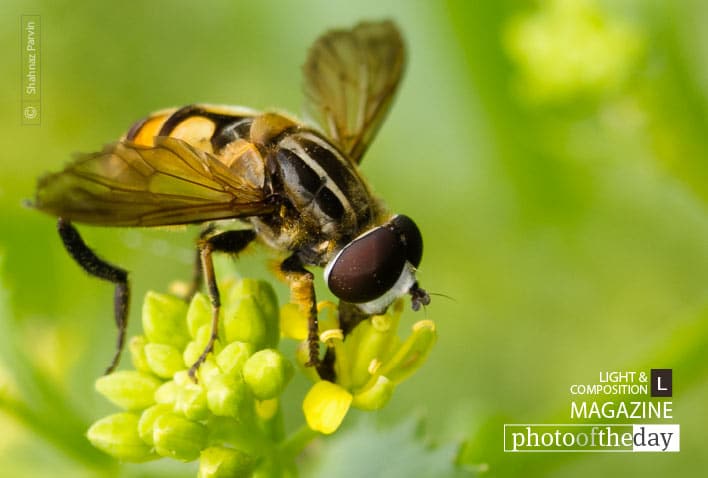
Bee in Shades of Green by Shahnaz Parvin
Captured during the photographer's early exploration of the natural world, this image highlights a bee amidst a vibrant, verdant landscape. The photographer was drawn to the intricate details of the insect’s pollination process, finding beauty in the lush, monochromatic shades of green that define the environment. Taken in the rural outskirts of Dhaka, the photograph reflects a deep appreciation for the quiet, rhythmic life of nature. It is an award-worthy study of macro photography, demonstrating a keen eye for color harmony and the ability to transform a fleeting, everyday moment into a serene and evocative visual narrative.
Luca Corsetti
He was born in 1975 and developed a passion for photography at a very young age. He experimented with various genres of photography, both as an amateur and a professional, until specializing in product photography, particularly in the food and beverage industry in 2007. His approach to photographing food aims to represent each individual element at its utmost beauty, conveying in a single image all the sensations he experiences in front of his subject. He loves sculpting and shaping light so that all his images reflect his experience and the technical adjustments needed to make every product beautiful. Speaking of technique, his photography is deeply infused with it, starting from lighting techniques, moving to shooting techniques, and ending with a methodical and significantly impactful post-production, using techniques borrowed from other photographic fields as well.
Resonance Score Breakdown
Transparency Note: The resonance score (14.9/20) is calculated based on social engagement metrics collected before the award announcement.
Expert Photography Reviews · 7
The Quiet Work
I spent an hour this morning trying to fix a loose button on my favorite coat. My hands felt clumsy and the thread kept knotting, but I didn't want to give up.
Read the reflection →The Weight of Small Things
We look for meaning in the grand movements of the world. We watch the horizon, the shifting of seasons, the slow retreat of the ice. But the world is held together by the small, the quiet, the things that do not ask to be seen.
Read the reflection →Reviews & Comments
Share your thoughts about this award-winning photograph. Your reviews contribute to the community engagement score.
That’s a fly, not a bee. Do your research.
Most macro shots of insects are clinical, sterile things I’d forget by morning. What separates this from the pack is the deliberate, suffocating density of the greens. It’s not just a bee; it’s a tiny, frantic life force struggling against a verdant tide. I find myself holding my breath, worried the insect might drown in that emerald light. In thirty years, we’ll still value this because it captures the quiet, persistent pulse of a vanishing world.
At f/5.6, the focal plane is razor-thin, yet Parvin’s capture of the bee’s thorax is remarkably sharp. The diffraction limit hasn’t softened the fine hairs, and the bokeh—a function of that wide aperture—dissolves the Dhaka foliage into a beautiful, monochromatic wash. I’m genuinely moved by how the lens resolves those microscopic textures against the green blur. It’s a rare, precise intersection of biology and glass that makes me feel like I’m finally seeing the insect’s secret world.
It’s a verdant fever dream, where the bee navigates a chromatic fugue of chartreuse and moss, reminiscent of a Morandi still life dissolved into the humid, chlorophyll-drenched air of Dhaka. I’m utterly breathless at how the insect’s golden fuzz cuts through that suffocating, lush emerald, creating a tension that feels like the very pulse of life itself. It doesn’t just exist; it breathes in a symphony of greens that one rarely finds so perfectly composed.
The air in Dhaka must have been thick with humidity when she knelt there. It’s a quiet, green world, isn’t it? I’ve spent hours waiting for such stillness. She didn’t force the bee; she listened to the rhythm of the leaves until the light felt right. My heart slows just looking at those emerald layers. It’s a rare, patient grace to find the infinite within a single, tiny life. She was truly present, and that’s everything.
One suspects the light cooperated on the first attempt. It often does, for the patient. While the monochromatic greens are pleasant, I find myself wondering if the photographer returned to this Dhaka patch until the bee felt like an old acquaintance. It’s a tidy shot, certainly, but macro work demands a certain obsession. I’ve spent enough damp mornings waiting for a wing to twitch to know that this one feels a bit too easy.
Green layers. A hum of life. The bee doesn’t demand the center. It rests in the blur of the leaves. I’ve spent minutes just breathing with this frame. It’s quiet here. The stillness isn’t a void; it’s a weight. Nothing here is accidental. The empty corner is not empty. It holds the rhythm of a Dhaka afternoon. I feel a sudden, sharp peace looking at it. Restraint is rare. Parvin found it.
The frame’s geometry relies on the bee’s placement at the intersection of the verdant diagonals. It’s a precarious balance. The monochromatic palette threatens to dissolve the subject, yet the sharp focus on the thorax anchors the composition. I’m genuinely unsettled by how the negative space pulls the eye toward the periphery. It doesn’t collapse under the weight of the green. The structure holds, even if the surrounding foliage feels dangerously close to overwhelming the frame.