From the Top of the Rock by Rodrigo Luft
Captured during a crisp, windy November evening in New York City, this photograph showcases the breathtaking perspective from the Top of the Rock. The photographer braved the biting cold to document the sprawling urban landscape as the city lights began to glow against the twilight sky. By selecting a wide 18mm focal length, the image captures the vast scale of the cityscape, emphasizing the architectural grandeur of the metropolis. This shot stands out for its ability to translate the raw, atmospheric energy of a clear, freezing night into a compelling visual narrative, earning recognition for its strong compositional balance.
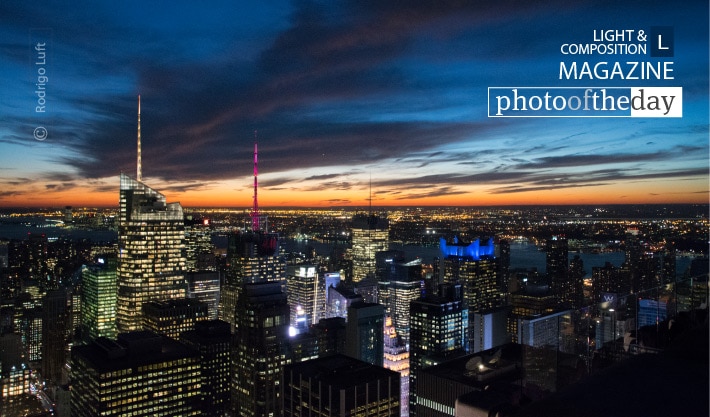
Exposure 1/30sec @ f/5.6 | ISO 9051 | Focal Length 18mm
Rodrigo Luft
Born in the south of Brazil, Rodrigo Luft is a dedicated photographer who balances his creative pursuits with a passion for capturing landscapes, architecture, and the beauty of everyday life. While he maintains a particular affinity for black-and-white imagery, his recent work increasingly explores a vibrant color palette. His talent has earned international recognition, including a 2013 exhibition at the 'History of Creative' showcase in New York. Luft continues to refine his artistic voice, sharing his evolving portfolio through prominent global photography platforms.
Resonance Score Breakdown
Transparency Note: The resonance score (12.0/20) is calculated based on social engagement metrics collected before the award announcement.
Expert Photography Reviews · 5
A Million Tiny Anchors
I spent an hour tonight trying to find my keys, only to realize they were in my coat pocket the whole time. It is funny how we look for things in the distance when they are sitting right against us. Standing by my window, I watched the streetlights flicker on one by one.
Read the reflection →The Architecture of Starlight
We are taught that roots belong to the earth, anchoring us to the dark, quiet soil. But perhaps we have roots that reach upward, too—tethered to the constellations and the electric hum of human ambition.
Read the reflection →Reviews & Comments
Share your thoughts about this award-winning photograph. Your reviews contribute to the community engagement score.
The biting November wind must have numbed his fingers, yet he waited for the city’s pulse to settle into that electric, twilight hum. I feel a shiver just looking at the way the lights bleed into the encroaching dark. It’s not just a skyline; it’s a vast, breathing organism. He didn’t rush the shutter. He stood in the cold, listening to the city’s silence, until the geometry of the grid finally found its quiet, luminous peace.
At f/5.6, the 18mm focal plane struggles against the diffraction limit, yet the sensor’s high ISO noise creates a granular texture that mimics the city’s electric hum. It’s a fascinating optical compromise. While the lens lacks the micro-contrast I’d prefer for such vast architecture, the way the light scatters across the cold, distant glass is haunting. I’m genuinely moved by how the city’s chaotic glow feels so fragile, almost like a dying star captured in silicon.
Standing on that observation deck in November is a miserable business, and I’ve certainly been miserable enough to appreciate the effort. Luft caught the city’s pulse, though the high ISO suggests he didn’t quite have the patience for a tripod. It’s a decent enough view, but one wonders if he’d have stayed another hour for the real light. It’s a respectable effort, yet it lacks the deep, earned stillness of a truly committed night.
The electric hum of the city’s amber veins bleeds into a bruised, indigo twilight, reminiscent of a Turner sky caught in a sudden, freezing exhale. It’s a chromatic dissonance that aches; I’m shivering just looking at those cold, metallic greys colliding with the artificial warmth of the grid. One finds the palette isn’t merely decorative, but a visceral, shivering language of light that captures the very marrow of a November night in Manhattan. It’s haunting.
The 18mm focal length stretches the urban grid into a rigid, geometric lattice. It’s a precarious balance of light against the void. The vertical thrust of the architecture anchors the frame, preventing the sprawling luminescence from dissolving into mere noise. I’m genuinely unsettled by the way the horizon line bisects the composition; it’s a sharp, unforgiving fulcrum. The frame holds, but only just. It’s a cold, calculated exercise in spatial tension that demands total visual obedience.