Cherry Tomatoes by Diep Tran
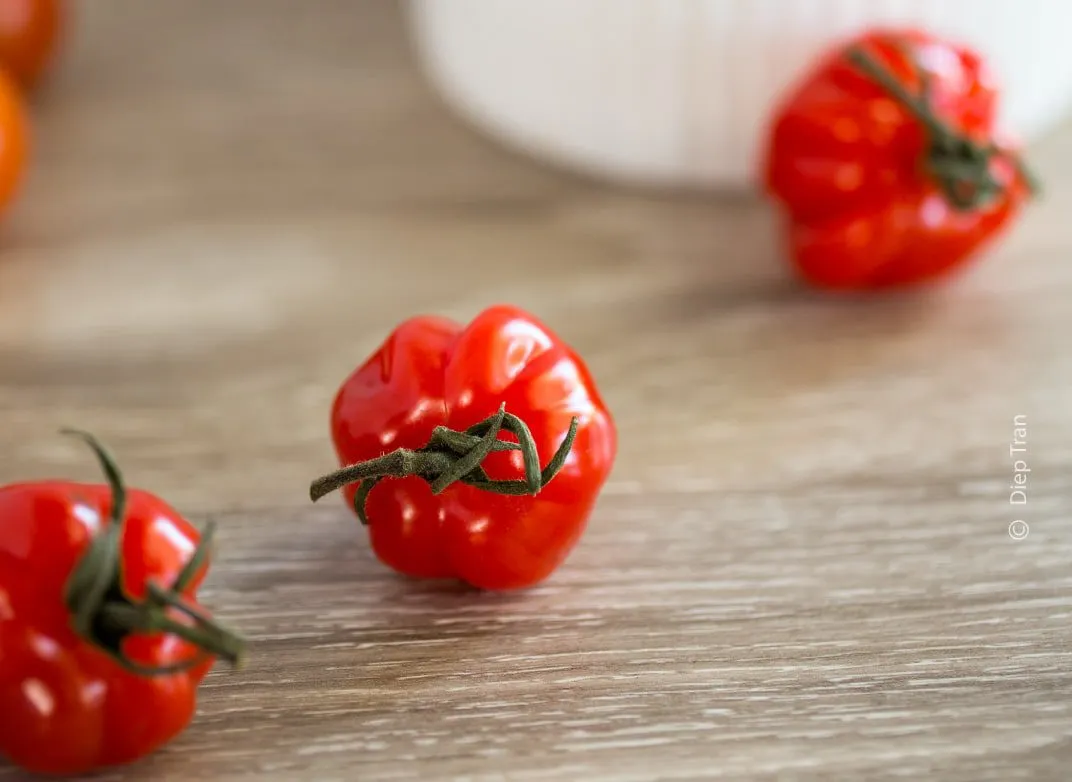
While preparing ingredients for a family birthday celebration, the photographer was struck by the vibrant color and organic shapes of cherry tomatoes resting on the table. Choosing a shallow depth of field at f/3.5, the photographer successfully isolated a single tomato, softening the background to emphasize the intricate, glistening texture of the subject. This image is award-worthy for its ability to elevate a mundane kitchen scene into a refined study of light and form, demonstrating a keen eye for finding artistic inspiration in the quiet, everyday moments of domestic life.
Diep Tran
Born in Vietnam and currently based in Brisbane, Australia, Diep Tran finds artistic inspiration in the simple, everyday objects found within her home and during her travels. Her photographic practice is deeply influenced by her Buddhist upbringing, which fosters a profound appreciation for the beauty and quality of life in both natural and man-made subjects. By exploring the interplay of light and shadow, she strives to present a thoughtful, global perspective that reflects her experiences across diverse climates and cultures.
Resonance Score Breakdown
Transparency Note: The resonance score (12.3/20) is calculated based on social engagement metrics collected before the award announcement.
Expert Photography Reviews · 6
The Quiet Weight of Harvest
There is a profound grace in the things we gather for our daily sustenance. Often, we move through our kitchens with a hurried mind, seeing only the tasks ahead, the clock ticking, or the hunger to be satisfied.
Read the reflection →The Weight of Small Things
I often find myself lingering in the produce markets of the city, not because I am hungry, but because there is a quiet dignity in the way nature presents itself before it is consumed.
Read the reflection →Reviews & Comments
Share your thoughts about this award-winning photograph. Your reviews contribute to the community engagement score.
We’re obsessed with isolating subjects, aren’t we? By pinning that tomato in a shallow f/3.5 slice, we’ve effectively lobotomized the kitchen’s context. It’s technically clean, sure, but it’s safe. I’d have loved to see the motion of the preparation—the blur of a knife or the chaos of the table. Why resolve the skin so perfectly while discarding the environment? It’s a missed opportunity to turn a mundane ingredient into something visceral, rather than just another polished culinary catalog shot.
It’s a technically sharp study of light, but I find myself searching for a pulse. Where’s the person behind the knife? A kitchen is a theater of human history, yet here, the subject is just a prop. I’ve spent my life looking for the messy, beautiful truth in a pair of hands, and this feels cold. It’s pretty, sure, but it doesn’t tell me a thing about the life being lived in that room.
Most food photography is just glossy advertising, but this shot avoids the trap of being merely appetizing. By isolating that single tomato at f/3.5, Tran forces us to confront the raw, glistening imperfection of the skin. It’s a quiet, honest study of light. I’ve seen thousands of kitchen scenes, but this one makes me crave the simplicity of a home-cooked meal. It’s a small, enduring reminder that beauty doesn’t require a grand stage to exist.
The saturated crimson of these tomatoes, reminiscent of the deep, bruised pigments found in a late-period Morandi still life, pulses with a visceral vitality that’s frankly intoxicating. One finds the light catching the skin like wet lacquer, a brilliant, glistening scarlet that vibrates against the muted, atmospheric blur of the kitchen’s background. It’s a quiet, luminous rapture; I’ve rarely seen such humble fruit possess the gravity of a Vermeer, turning a domestic moment into pure, chromatic poetry.
It’s a relief to see something that doesn’t demand a creature’s dignity for a frame. I’ve spent months in damp hides waiting for a single, honest movement, so looking at these tomatoes feels like a quiet exhale. There’s no deception here, no baiting, no forced proximity. It’s just light hitting skin. I find myself genuinely charmed by the simplicity. It’s refreshing to see a lens turned toward the kitchen instead of the wild.
At f/3.5, the 100mm focal plane is razor-thin, isolating the tomato’s epidermis with clinical precision. I’m genuinely moved by how the lens resolves those microscopic surface irregularities; it’s a masterclass in light refraction. The bokeh, a smooth function of the aperture, renders the background into a soft, chromatic wash that doesn’t distract from the fruit’s glistening, organic geometry. It’s rare to see such mundane kitchen light captured with this level of optical honesty. It’s simply beautiful.