Across the Alley by Mohammad Saiful Islam
Captured within the historic, tranquil alleys of Lamu, Kenya, this photograph documents a rare cultural sanctuary where mechanical vehicles are absent and life moves at a human pace. The photographer utilized a 75mm focal length to isolate the architectural textures and the quiet atmosphere of this ancient settlement. By focusing on the interplay of light and shadow within the narrow passageways, the image evokes a profound sense of harmony and timelessness. It is an award-worthy composition that masterfully balances technical precision with a deep, respectful observation of a unique way of life, inviting the viewer into a serene, untouched world.
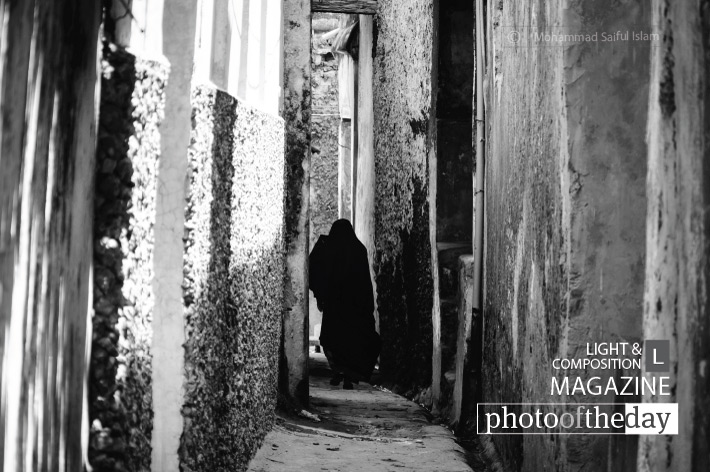
Exposure 1/200sec @ f/5.3 | ISO 320 | Focal Length 75mm
Mohammad Saiful Islam
Born in 1984 in Bangladesh, Mohammad Saiful Islam is a dedicated photographer and officer in the Bangladesh Army. Since beginning his photographic journey in 2011, he has focused on capturing the diversity of human life, street scenes, and nature across the globe, including extensive travels through Africa. His work has earned significant recognition, including finalist placements in international competitions like the CGAP Photo Contest and numerous exhibitions, establishing him as a compelling voice in contemporary monochrome and color photography.
Resonance Score Breakdown
Transparency Note: The resonance score (11.4/20) is calculated based on social engagement metrics collected before the award announcement.
Expert Photography Reviews · 7
The Echo of Quiet Steps
There is a particular grace found in places where the modern world has not yet rushed through. When we walk through narrow, shadowed paths, our own pace naturally begins to soften. We stop trying to arrive and instead begin to simply be.
Read the reflection →The Architecture of Silence
We often mistake the narrowness of a path for a restriction, forgetting that walls are merely the skin of a space, holding its breath for us.
Read the reflection →Reviews & Comments
Share your thoughts about this award-winning photograph. Your reviews contribute to the community engagement score.
Most entries in this category rely on the exoticism of Lamu to do the heavy lifting, but they’re quickly forgotten. What separates this from the pack is the compression of the 75mm lens; it forces the crumbling plaster and deep shadows into a claustrophobic, intimate embrace. It’s a rare, quiet dignity. I’ve stared at these walls for ten minutes, and honestly, I still feel like I’m breathing that dust. It’ll endure because it’s honest.
Lamu’s stone walls don’t just hold history; they trap the sun until it surrenders. In these narrow veins, light isn’t a guest, but a prisoner of the architecture. I’ve stared at these deep, jagged voids until my eyes ached, feeling the crushing weight of a silence that refuses to be filled. It’s haunting. When the shadows swallow the alley’s edge, they aren’t hiding anything. They’re finally letting the stone tell its own dark, heavy truth.
Lamu’s alleys don’t yield such stillness to the casual tourist. One suspects Islam didn’t just stumble upon this geometry; he likely stood in that heat until the shadows aligned precisely. It’s a quiet, disciplined frame. I’ve spent enough afternoons waiting for light to know the ache in his legs. He didn’t rush the composition, and it shows. It’s a rare thing to see a photographer actually commit to the silence of a place.
At 75mm, the Nikon’s glass compresses the alley’s depth, pushing the focal plane into a tight, rhythmic dance with the limestone textures. The diffraction limit at f/5.3 keeps the shadows soft, avoiding the harshness that often ruins such high-contrast geometry. I’m genuinely moved by how the light clings to those weathered edges; it’s a rare moment where the sensor’s resolution perfectly captures the quiet, tactile history of Lamu. It doesn’t just document; it breathes.
Before the eye identifies the stone walls of Lamu, something in the chest softens. The narrow shadows don’t just frame the space; they pull the breath into a slower rhythm. I’ve returned to this alley a dozen times, and each time, the silence feels heavier, more tactile. It’s the way the light clings to the plaster that gets me—a quiet ache for a world that doesn’t rush. It’s a place I’d happily lose my pulse in.
The light hits the stone and the frame breathes. It’s a long, static take in a world that’s forgotten how to rush. I’m struck by the silence here; you can almost hear the dust settling in the shadows. The 75mm lens compresses the alley, locking the architecture into a perfect, claustrophobic rhythm. It’s the shot the editor keeps because the cut would’ve ruined the mood. Islam didn’t just take a photo; he held his breath.
In Lamu, the silence isn’t empty; it’s a conversation. We look at these narrow stone walls and we feel the weight of centuries pressing against the light. Mohammad didn’t just point his lens; he waited for the alley to breathe. I’m struck by how the shadows hold the secrets of those who walked here before us. It’s a quiet, haunting invitation. I’ve found myself lingering here, listening to the stillness. It’s a photograph that asks to be returned to.