Third Encounters by Mark Paulda
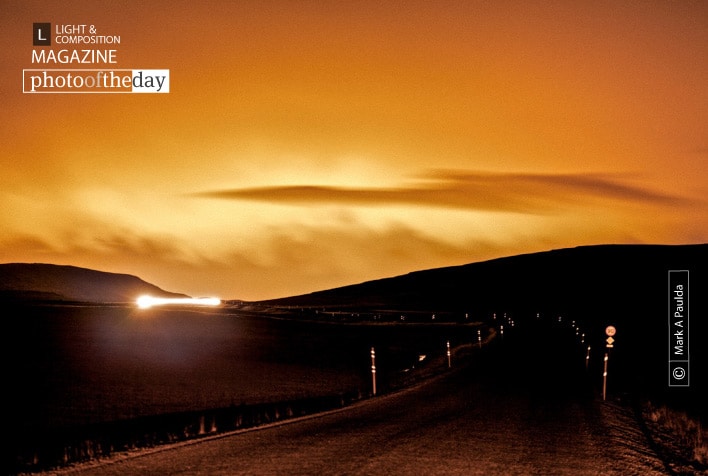
Captured along the Ring Road in Iceland’s Golden Circle, this night photograph masterfully balances the stark isolation of the landscape with the distant, warm glow of Reykjavik. The photographer utilized a long 30-second exposure to draw out the subtle ambient light, creating a surreal, dreamlike atmosphere. A single vehicle moving through the frame adds a sense of narrative tension and human presence against the vast, dark horizon. The image is award-worthy for its technical precision in low-light conditions and its ability to transform a quiet, nocturnal scene into a poetic exploration of light, movement, and solitude.
Mark Paulda
Dividing his time between London, UK, and Texas, USA, Mark Paulda is a multifaceted photographer celebrated for his dark, evocative, and intensely illuminated imagery. His work transcends traditional travel photography, blending intuitive technical skill with a mystical, Renaissance-inspired sensibility to transform everyday environments into abstracted, visceral experiences. An accomplished author and award-winning artist, Paulda is recognized for his profound ability to capture the paradoxes of life, imbuing his sparse, lyrical compositions with a sense of memory, longing, and spiritual depth.
Resonance Score Breakdown
Transparency Note: The resonance score (11.4/20) is calculated based on social engagement metrics collected before the award announcement.
Expert Photography Reviews · 7
The Quiet Between Us
I was driving home late last night, the kind of late where the radio stations turn to static and the road feels like it belongs only to me.
Read the reflection →The Architecture of Distance
In the deep winter of the northern latitudes, the concept of a boundary begins to fray. We are taught that a horizon is a line, a clean division between the earth we know and the sky we cannot reach.
Read the reflection →Reviews & Comments
Share your thoughts about this award-winning photograph. Your reviews contribute to the community engagement score.
The darkness here isn’t empty; it’s a heavy, velvet silence. He stood in the biting Icelandic chill, waiting for that single streak of light to carve a path through the void. I feel a shiver looking at it—the way the distant glow of the city hums against the vast, indifferent night. It’s a lonely, beautiful vigil. He didn’t just capture a road; he listened to the quiet pulse of the earth breathing in the dark.
Shadow isn’t merely the absence of light; it’s the silence where the landscape breathes. In this Icelandic void, the thirty-second exposure doesn’t just capture motion, it traps time itself. That solitary streak of light feels like a ghost haunting the abyss. I’ve stared at it for an hour, and it’s unsettling how the darkness refuses to yield. It’s a cold, existential ache. Paulda understands that we are only ever visitors in the night’s vast, unblinking eye.
The obsidian void of the Icelandic night doesn’t merely frame the scene; it devours it, save for that singular, trembling ribbon of amber light—a hue reminiscent of a dying ember in a Vermeer interior—that cuts through the gloom like a desperate, lonely pulse. It’s haunting, really, how the cold, bruised violet of the horizon clashes with that warmth, creating a chromatic ache I’ve felt in my own bones while wandering through the dark.
Thirty seconds in an Icelandic night is a long time to stand still, especially when the wind is trying to peel the skin from your face. I’ve spent enough nights shivering in that exact latitude to know the ache in Paulda’s fingers. He didn’t just stumble upon this; he waited for that single set of headlights to cut the dark. It’s a cold, lonely frame, but one I’d happily stand in myself. Well earned.
Most night photography relies on the crutch of a vibrant aurora, but Paulda ignores the sky to focus on the road. That single, blurred streak of light isn’t just movement; it’s a heartbeat in the void. I’ve seen thousands of Icelandic landscapes, yet this one haunts me because it feels like a memory of being truly alone. It’s the restraint that wins here. In thirty years, we won’t remember the gear, but we’ll remember this silence.
Before the eye identifies the road, a sudden stillness settles in the chest. That single, bleeding streak of light against the Icelandic dark triggers a primal ache for movement in isolation. It’s the silence that gets me; I feel my own pulse slow to match the shutter’s long, patient breath. When I return to this, I’m not looking at a landscape anymore. I’m just waiting for that car to finally arrive, somewhere in the dark.
The horizon doesn’t end. It dissolves. Thirty seconds of exposure have turned the road into a ghost. I feel a sudden, sharp chill looking at that single streak of light. It’s a fragile pulse against the dark. The vastness isn’t just space; it’s a weight. Nothing here is accidental. The empty corner is not empty. It’s the sound of breath held in the cold. I’ve never seen silence look so heavy. It’s beautiful.