Hawk’s Eye by Prasanta Singha
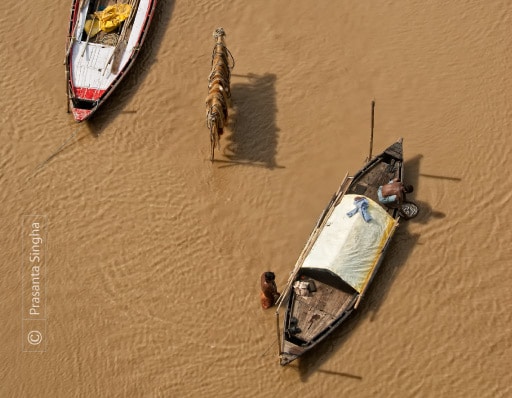
Captured from a bridge overlooking the Ganges in Varanasi, India, this striking image offers a unique perspective on the city's rhythmic life. The photographer utilized a 48mm focal length to isolate a precise moment, balancing the complex textures of the riverfront with the sharp clarity of the scene. The composition reflects a keen eye for aerial storytelling, transforming a bustling urban environment into a singular, contemplative frame. This photograph is award-worthy for its ability to distill the chaotic beauty of Varanasi into a clean, evocative visual narrative that captures the essence of the location with technical precision.
Prasanta Singha
Based in Kolkata, India, Prasanta Singha is a dedicated travel photographer with a profound commitment to documenting the human experience. His work focuses on capturing the authentic lives of local inhabitants and the intricate details of their surroundings, driven by a deep-seated passion for the craft. Singha continues to refine his artistic vision, aiming to make a meaningful contribution to the global photographic community through his evocative portraits and environmental studies.
Resonance Score Breakdown
Transparency Note: The resonance score (13.9/20) is calculated based on social engagement metrics collected before the award announcement.
Expert Photography Reviews · 6
The Geometry of Being
To look down from a great height is to see the world as a map of intentions. From the clouds, the frantic pulse of the street becomes a slow, rhythmic breathing; the individual becomes a thread in a tapestry that is constantly being woven and unraveled.
Read the reflection →The Geometry of Distance
There is a peculiar comfort in looking down from a great height. When we stand on the ground, we are caught in the friction of the everyday—the uneven pavement, the sudden gust of wind, the voices of strangers pressing against our own.
Read the reflection →Reviews & Comments
Share your thoughts about this award-winning photograph. Your reviews contribute to the community engagement score.
Varanasi isn’t just a city; it’s a slow erosion of the self. Singha’s frame captures the Ganges not as water, but as a dark, heavy shroud swallowing the shore. I’ve stared at these shadows for an hour, and they don’t offer comfort. They demand an accounting. It’s a brutal, honest geometry of loss. When the light hits those ghats, it doesn’t reveal; it interrogates. It’s haunting, really. I find myself shivering in the heat of it.
Most aerials of Varanasi drown in the city’s frantic sprawl, but Singha’s frame succeeds by resisting the urge to show everything. By choosing a 48mm focal length, he forces a claustrophobic intimacy that feels rare. It’s the tension between the river’s rhythmic flow and the rigid geometry of the ghats that keeps me coming back. I’ve stared at this for years, and honestly, it still makes my heart ache for a place I’ve never truly known.
Varanasi from a bridge is a chaotic, humid affair. One suspects most would have snapped a dozen frames and retreated to the shade. Yet, Singha clearly lingered until the river’s rhythm aligned with his frame. It’s a disciplined bit of work, resisting the urge to clutter the shot. I’ve spent enough mornings shivering in damp gear to respect that kind of restraint. He didn’t just find this; he sat there until the city finally behaved.
Varanasi’s chaos is here disciplined by a rigid, vertical geometry. The riverfront’s textures don’t bleed; they’re contained by the frame’s sharp, unforgiving edges. It’s a rare instance where the negative space doesn’t feel empty, but rather acts as a necessary fulcrum for the urban mass. I’ve spent years looking for this kind of structural restraint. It’s cold, yes, but the composition holds. It’s a precise, architectural triumph that finally silences the noise of the Ganges.
Varanasi’s riverfront dissolves into a palette of bruised ochre and the dusty, sun-bleached terracotta of a Morandi still life, where the Ganges flows not as water, but as a ribbon of liquid slate. It’s a chromatic ache that catches in one’s throat, a quietude I’ve rarely felt in such chaos. The light doesn’t just illuminate; it stains the stone with a sepia warmth that feels like a fading memory of a long-lost summer afternoon.
Varanasi doesn’t yield its secrets to the hurried. Prasanta waited on that bridge, letting the Ganges dictate the rhythm of the frame. It’s a quiet geometry of life unfolding below. When I look at those textures, I feel a sudden, sharp ache for the stillness he found amidst the chaos. He didn’t just capture a scene; he listened to the river’s hum until the light settled into that perfect, honest clarity. It’s a rare, patient grace.