Looking over the Edge by Munish Singla
Captured at the iconic Horseshoe Bend in the Arizona desert, this photograph explores the profound mysteries hidden within the rugged mountain landscape. The image features a lone figure standing at the precipice, gazing into the vast expanse below. By framing the human element against the immense scale of the geological formation, the photographer emphasizes the awe-inspiring nature of the wilderness. The composition is award-worthy for its dramatic sense of perspective and the way it captures a moment of quiet contemplation amidst the raw, untamed beauty of the American Southwest.
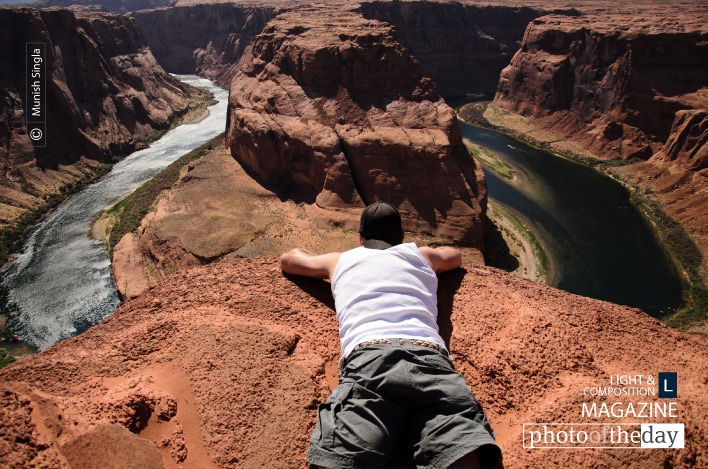
Exposure 1/1000sec @ f/4.5 | ISO 100 | Focal Length 18mm
Munish Singla
Based in Los Angeles, California, Munish Singla is a software engineer who balances his professional career with a burgeoning passion for photography. As a self-taught artist, he views the camera as a powerful medium to explore the human experience, ranging from joy and beauty to emotion and madness. He remains committed to a versatile approach, refusing to limit his work to a single genre as he continues to learn, grow, and push the boundaries of his creative imagination.
Resonance Score Breakdown
Transparency Note: The resonance score (11.6/20) is calculated based on social engagement metrics collected before the award announcement.
Expert Photography Reviews · 8
The Weight of the Void
Why do we feel the need to stand at the very brink of things? Perhaps it is because the edge is the only place where the world stops pretending to be solid.
Read the reflection →The Architecture of the Brink
There is a particular gravity to the edge, a magnetic pull that asks us to measure the distance between our own small heartbeat and the vast, silent history of the earth. To stand where the ground simply decides to stop is to confront the fragility of our own footing.
Read the reflection →Reviews & Comments
Share your thoughts about this award-winning photograph. Your reviews contribute to the community engagement score.
The ochre of these canyon walls, reminiscent of a sun-scorched Morandi palette, bleeds into the river’s turquoise—that haunting, glacial blue of shallow tidal water at dusk. It’s a chromatic collision that leaves me breathless, as if the desert itself were exhaling. One finds the human silhouette merely a dark, necessary punctuation against such geological grandeur, where the light doesn’t just illuminate the stone; it sings of an ancient, arid silence I’ve longed to touch.
Before the eye identifies the canyon, a sudden, sharp constriction hits the chest. It’s the vertigo of the precipice, that visceral pull toward the void. I’ve felt this exact, hollow ache before, standing where the earth simply stops. When you return to this, the figure’s stillness doesn’t feel peaceful; it feels like a held breath. It’s a reminder that we’re only ever one step away from the immense, indifferent silence of the stone.
Horseshoe Bend is a cliché, yet Singla avoids the postcard trap. Most photographers here let the river dominate, but he anchors the frame with that lone figure. It’s the tension between the human silhouette and the sheer, terrifying drop that makes me hold my breath. I’ve seen thousands of shots of this canyon, but this one lingers because it captures the exact moment a person realizes how small they truly are. It’s a keeper.
The canyon floor pulls the eye down. It’s a gravity I feel in my own chest. A single figure occupies the edge. They aren’t fighting the scale. They’re breathing with it. The rock curves, leaving vast, ochre silence. Nothing here is accidental. The empty corner is not empty. It’s the weight of the void. I’ve spent minutes just watching that stillness. It’s rare to find a frame that knows when to stop.
The curvature of the Colorado River dictates the frame’s geometry. It’s a rigid arc that anchors the composition, forcing the eye toward the precipice. The lone figure provides necessary scale, yet it’s the negative space of the canyon floor that creates the true spatial tension. I’ve grown weary of such landscapes, but the sheer mathematical precision of this horizon line holds my attention. It’s a disciplined study of mass and void. The frame doesn’t fail.
1/1000sec at f/4.5, 18mm, ISO 100. A wide-angle choice that demands precision, yet f/4.5 leaves the background softness I find irritating. At 18mm, you’ve got the depth to keep the entire canyon sharp; why waste it? The shutter speed is overkill for a static subject, wasting potential for a lower ISO. It’s technically lazy. I’ve seen this canyon a thousand times, and this execution doesn’t respect the scale. It’s just another snapshot.
At 18mm, the Nikon’s glass struggles with the extreme peripheral distortion inherent in such wide-angle geometry. Yet, the focal plane holds the sandstone’s stratification with surprising clarity. I’m genuinely moved by how the diffraction of light across that jagged precipice renders the human figure as a mere optical speck. It’s a stark reminder that our eyes can’t resolve this scale, but the sensor’s photon capture doesn’t miss a single, terrifying detail of the abyss.
The sun is high, casting that harsh, unforgiving glare across the Colorado River’s curve. I’ve spent enough hours on these canyon rims to know the heat radiating off that sandstone. The lone figure isn’t just looking; they’re listening to the silence of the abyss. It’s a dizzying, humbling perspective. My own stomach tightens just looking at that drop. He waited for the right breath of wind, capturing a moment where the earth finally spoke.