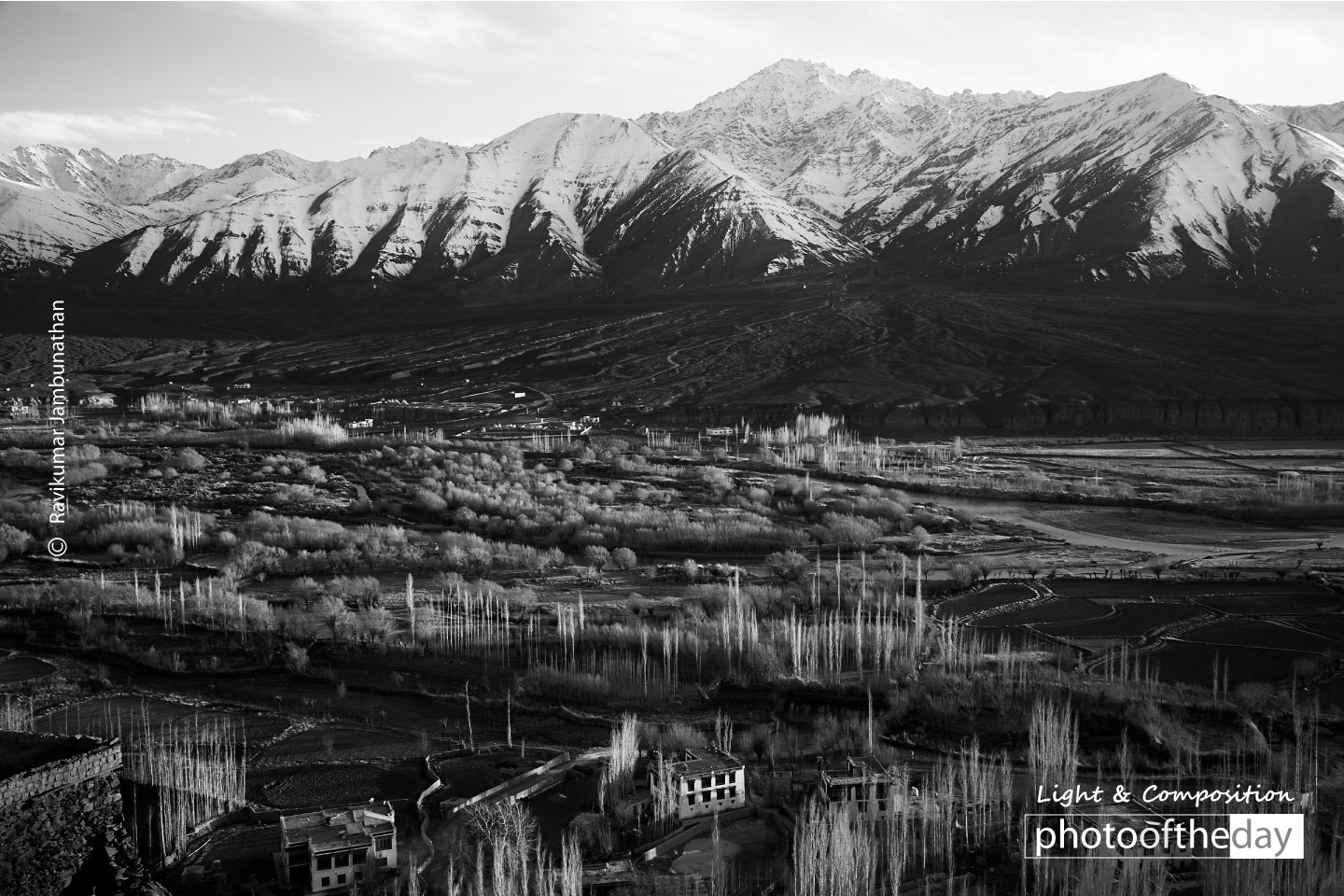
Dusk over Himalayan Village by Ravikumar Jambunathan
Captured from the heights of the Spituk monastery, this photograph depicts the serene dusk settling over the Himalayan village of Leh. As the sun dipped below the horizon, the photographer braved biting winds and freezing temperatures, seeking shelter behind a stone wall to frame the vast, astonishing landscape. The resulting image masterfully balances the rugged, high-altitude terrain with the soft, fading light of evening. This work is award-worthy for its technical resilience and the photographer’s ability to transform a challenging, exposed environment into a tranquil, evocative composition that captures the profound stillness of the northern Himalayas.
Ravikumar Jambunathan
Born in India and currently based in Singapore, Ravikumar Jambunathan is a self-taught photographer who balances a professional career in banking with a deep-seated passion for the visual arts. Specializing in the black and white medium, he views photography as a vital tool for self-expression and communication. His work is driven by the philosophy that a great photograph serves as a timeless document, meticulously capturing the interplay between light and the fleeting moments of the human experience.
Resonance Score Breakdown
Transparency Note: The resonance score (10.9/20) is calculated based on social engagement metrics collected before the award announcement.
Expert Photography Reviews · 7
The Weight of Silence
It is 3:14 am. The house is holding its breath, and for once, I am not trying to fill the silence with noise. We spend our lives running from the quiet, terrified that if we stop moving, we will finally hear what we have been burying.
Read the reflection →The Weight of Quiet
When I was seven, my grandfather took me to the edge of the valley behind our house just as the light began to bruise into purple. He told me to stop talking and to stop moving my feet.
Read the reflection →Reviews & Comments
Share your thoughts about this award-winning photograph. Your reviews contribute to the community engagement score.
You waited behind that stone wall while the world turned cold, and I can feel that stillness in my own bones. It’s a lonely, beautiful ache. Most people would’ve packed up when the wind bit, but you stayed for the light. Because you didn’t rush, the village feels like it’s breathing. There’s something honest happening here. You weren’t just taking a picture of a mountain; you were listening to the silence of the Himalayas.
Leh at dusk is a brutal place to stand still, yet Jambunathan clearly didn’t rush for the warmth of the monastery. I’ve spent enough nights shivering behind stone walls to recognize that particular stillness. It’s not just a view; it’s a photograph that cost him a few layers of skin and a great deal of patience. One can almost feel the thin air. He earned this light, and frankly, I’m quite envious of the result.
The bruised indigo of the Ladakh sky bleeds into the ochre of the valley, a tonal transition that recalls the muted, dusty stillness of a Morandi canvas. It’s a haunting, glacial light that I’ve felt in my own bones, shivering as the warmth retreats from the stone. One finds a profound, aching harmony here; the way the shadows cling to the village, it’s as if the earth itself is exhaling, finally surrendering to the coming night.
Before the eye identifies the jagged horizon of Leh, something in the chest tightens. It’s the cold—I can feel the thin, biting air of the Spituk heights settling into my own lungs. The fading light doesn’t just illuminate the valley; it demands a physiological stillness. When I return to this, I’m not looking at a village anymore. I’m feeling that specific, hollow ache of solitude that only high-altitude dusk can pull from the marrow.
Most landscape photography from Ladakh feels like a postcard, but this frame avoids that trap. By anchoring the composition against the cold, jagged stone of the Spituk monastery, Jambunathan forces us to feel the altitude. It’s the way the fading light clings to the valley floor that gets me; I can almost feel the temperature dropping. It’s a quiet, enduring document of a place that’s disappearing, and that’s why it’ll still matter in thirty years.
The light is dying, and the frame is holding its breath. It’s a wide shot that feels like the final beat of a long, arduous sequence. I can almost feel the biting wind against my own skin. Jambunathan didn’t rush the cut; he let the shadows settle into the valley floor. It’s a quiet, heavy stillness that makes me want to stay here, watching the blue hour bleed into the stone. A perfect, frozen edit.
The composition relies on a rigid horizontal axis, bisecting the frame with a 1:2 ratio of village density to mountain mass. The jagged peaks create a series of intersecting triangles that anchor the visual gravity. I’m genuinely struck by how the negative space in the upper quadrant balances the chaotic texture of the dwellings below. It’s a perfectly solved spatial equation where the light’s decay acts as the final variable, stabilizing the entire geometric structure.