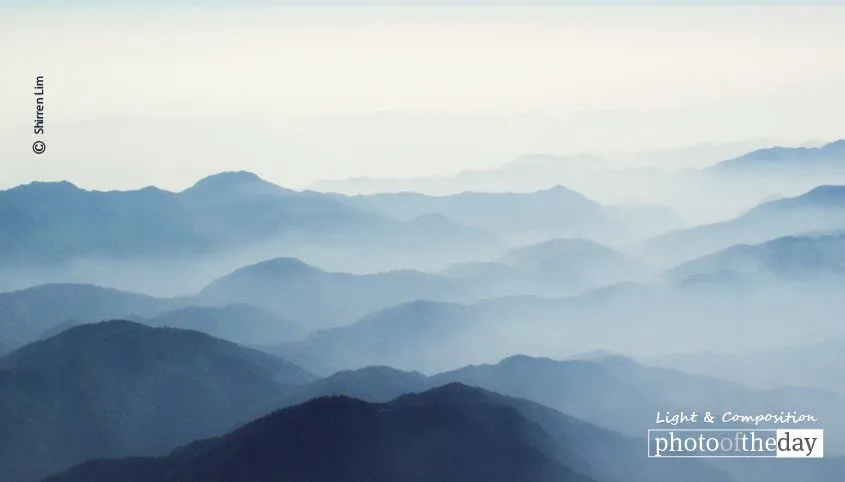
Layers by Shirren Lim
Captured from the window of a departing aircraft, this image showcases the breathtaking scale of the Himalayan range. The photographer utilized the unique vantage point to highlight the dramatic, layered topography of the mountains, which transition through a mesmerizing spectrum of blue hues. By choosing to document this fleeting aerial perspective, the photographer transformed a travel moment into a study of atmospheric depth and geological grandeur. The image is award-worthy for its masterful use of natural light and composition, effectively conveying the immense, serene majesty of one of the world's most iconic landscapes.
Shirren Lim
Born in Penang Island, Malaysia, in 1970, Shirren Lim is a Jakarta-based photographer who discovered her true passion for the craft in 2009. While she is particularly celebrated for her intense and earthy portraiture, which seeks to capture the sincere expressions of humanity, her work spans diverse subjects with a focus on simple, impactful compositions. Inspired by the iconic imagery of Steve McCurry, Lim strives to capture profound, world-changing moments, and her evocative photography has been featured in various international web and printed publications.
Resonance Score Breakdown
Transparency Note: The resonance score (11.6/20) is calculated based on social engagement metrics collected before the award announcement.
Expert Photography Reviews · 6
The Weight of the Clouds
I remember sitting in the middle seat of a flight over the Andes, watching a man in the window seat press his forehead against the cold glass for three hours straight. He didn't look at his book or his screen.
Read the reflection →The Weight of Ancient Breath
There is a rhythm to the earth that exists far above our daily concerns, a slow, tectonic pulse that has been beating since long before we arrived. When we look down from a great height, the world loses its sharp edges.
Read the reflection →Reviews & Comments
Share your thoughts about this award-winning photograph. Your reviews contribute to the community engagement score.
(y)
Thanks for post about the nepali mountains or himalays there is so many natural things are aviliable….
High above the clouds, she caught the mountains in a breath of blue. It’s a quiet, cold geometry. I’ve spent enough dawns waiting for the light to settle on stone to recognize that stillness; she didn’t force this, she simply surrendered to the altitude. Looking at these jagged, frozen layers, I feel a sudden, sharp ache for the silence of that cockpit. It’s a rare, fleeting grace, captured before the world rushed back in.
Snapping a shutter from a departing aircraft is hardly the same as shivering on a ridge for three days, is it? It’s a convenient perspective, lacking the grit of a proper ascent. While the blue gradients are undeniably pleasant, one can’t help but feel the lack of a personal toll. It’s a pretty view, certainly, but I’ve spent too many nights in frozen tents to mistake a lucky window seat for a hard-won photograph.
Of the thousands of aerial shots I’ve reviewed, most are just snapshots from a window. What separates this is the compression of those blue ridges; it’s a geological study, not a travelogue. The G10’s sensor shouldn’t have captured this much atmospheric depth, yet it did. I find myself wanting to trace those jagged lines with my finger. It’s a rare, quiet document of scale that will still feel vast and cold thirty years from now.
At f/5, the G10’s sensor captures the Himalayan strata with surprising fidelity. The atmospheric scattering of blue light creates a Rayleigh effect that softens the distant ridges, yet the focal plane remains sharp enough to resolve the geological texture. It’s a rare instance where the diffraction limit doesn’t stifle the scale. Looking at these jagged, icy layers, I’m genuinely breathless; it’s as if the lens has finally peeled back the veil of the troposphere itself.
1/2000sec at f/5, ISO 100, 13.8mm. The G10’s sensor is small, yet this shutter speed freezes the vibration of the airframe perfectly. Stopping down to f/5 was the right call to avoid diffraction blur. It’s sharp. I’ve spent years looking at aerial shots that are just mushy, but this holds the geological strata with clinical precision. It’s cold, detached, and technically sound. Honestly, the clarity of those blue ridges actually makes me miss the mountains.
The shutter snaps at 1/2000sec, freezing the mountain range in a breathless, jagged sequence. It’s a tracking shot from the clouds, where the blue gradients bleed into one another like a slow dissolve. I’m struck by the sheer vertigo of it; it’s a frame the editor keeps because the cut would have been a mistake. Lim caught the rhythm of the earth’s crust. It’s a film that refused to move, and I’m still watching.
Love the tones in this this photo!