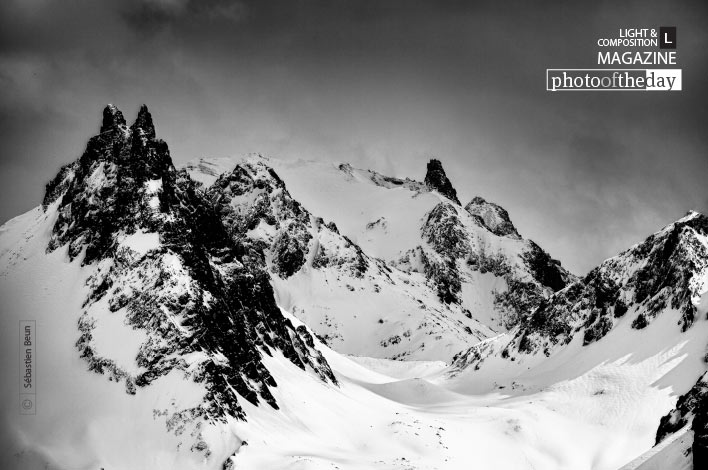
L’Aiguille Noire by Sébastien Beun
Captured above the Massif du Crey du Quart, this striking image features L'Aiguille Noire, a formidable peak in the French Alps. Sébastien Beun utilized a telephoto lens to isolate the rugged, dramatic textures of the mountain against the vast alpine landscape near Valloire. The composition emphasizes the sheer scale and imposing presence of the peak, which stands near the iconic Col du Galibier. By carefully balancing the exposure to highlight the intricate rock formations, the photographer successfully conveys the raw, majestic atmosphere of the Savoie region, earning recognition for its technical precision and evocative portrayal of high-altitude terrain.
Sébastien Beun
Born in 1981, Belgian photographer Sébastien Beun developed a passion for the craft at age twelve after discovering his father’s darkroom equipment. His journey evolved from traditional black-and-white film development to modern digital techniques, reflecting a deep appreciation for both the history and the future of the medium. Currently based in Leers-et-Fosteau, Beun captures a diverse range of subjects that resonate with him personally, maintaining a commitment to the art form that he hopes to pass on to the next generation.
Resonance Score Breakdown
Transparency Note: The resonance score (14.2/20) is calculated based on social engagement metrics collected before the award announcement.
Expert Photography Reviews · 6
The Architecture of Silence
We often mistake stillness for an absence of movement, forgetting that the mountain is a slow, tectonic breath. It rises not in a sudden leap, but in a patient accumulation of centuries, pressing its heavy roots into the cooling crust of the earth.
Read the reflection →The Weight of Ancient Stone
The air at high altitude has a specific, metallic bite, like licking a cold iron spoon left out in the frost. It tastes of nothing and everything—a thin, sharp clarity that makes the lungs feel like they are expanding against a corset of ice.
Read the reflection →Reviews & Comments
Share your thoughts about this award-winning photograph. Your reviews contribute to the community engagement score.
Nice !!
Most mountain photography is just postcard filler, but Beun’s choice to compress the frame at 260mm forces a confrontation with the rock’s brutal, jagged geometry. It’s not just a peak; it’s a geological threat. I’ve stared at this for years, and it still makes my chest tighten with that specific, thin-aired alpine dread. What separates this from the thousands of other Alps shots is the refusal to soften the stone. It’s honest, cold, and enduring.
At f/9, the 260mm focal length avoids the diffraction limit, allowing the sensor to resolve the micro-contrast of L’Aiguille Noire’s fractured schist with startling fidelity. It’s a rare pleasure to see such sharp edge-acutance across the entire focal plane. The light’s interaction with those jagged ridges creates a tactile depth that makes me want to reach out and touch the stone. It’s physically exhilarating to see the mountain’s raw geology rendered with such clinical, breathtaking precision.
The mountain doesn’t yield its secrets to the hurried. Standing above the Massif du Crey du Quart, Sébastien waited for the light to carve those jagged, obsidian edges from the stone. It’s a quiet, cold clarity that makes me shiver, remembering the thin air of the Savoie. He didn’t just capture a peak; he listened to the silence of the rock. I’ve felt that same stillness, where the shutter is merely a breath held in reverence.
One suspects Beun didn’t just stumble upon this view while out for a stroll. Isolating L’Aiguille Noire at 260mm requires a steady hand and a long, shivering morning spent waiting for the light to catch those jagged textures just so. It’s a cold, sharp piece of work. I’ve spent enough hours at that altitude to know the biting wind he endured to get it. It’s a proper photograph. He clearly earned the summit.
The slate-grey of L’Aiguille Noire, reminiscent of a Morandi still life stripped of its domestic warmth, vibrates against the thin, glacial air with a severity that makes one’s breath hitch in the throat. It’s a chromatic austerity, a bruising violet-charcoal that doesn’t merely sit upon the rock but defines its very geological soul. I’m utterly haunted by how the light bleeds into the stone, turning cold, jagged shadows into a profound, silent meditation on alpine solitude.
The frame doesn’t collapse under the weight of the granite. It’s a rigid exercise in verticality. The telephoto compression flattens the depth, forcing the jagged peak into a singular, unforgiving plane. It’s cold, sharp, and entirely devoid of sentimentality. I’ve rarely seen such brutal geometry in the Savoie. The negative space surrounding the summit acts as a necessary fulcrum. It’s a disciplined study of mass. The structure holds. It’s exactly the kind of austerity I crave.