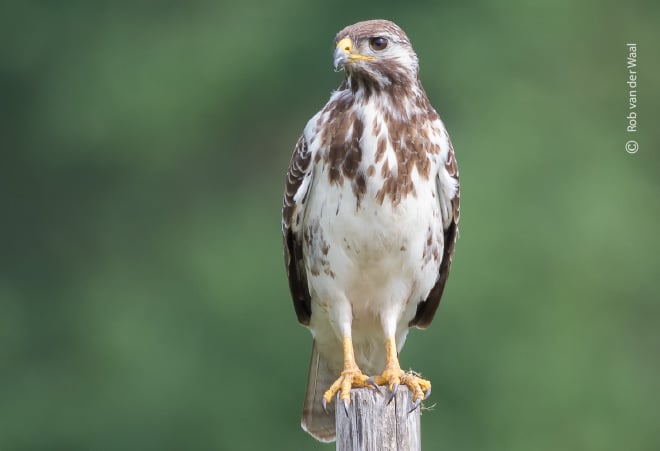
Geduldig by Rob van der Waal
Capturing a Common Buzzard requires immense patience, as these elusive birds of prey often flee at the slightest disturbance. Rob van der Waal managed to secure this striking portrait while the bird remained perched on a pole, alert yet briefly still. By utilizing a long telephoto setup, the photographer successfully isolated the subject against the environment, emphasizing its intense gaze and intricate plumage. This image is award-worthy for its technical precision and the rare, fleeting connection established between the photographer and a notoriously shy wild subject, showcasing the beauty of nature in a moment of quiet stillness.
Rob van der Waal
Born in Rotterdam in 1957, Rob van der Waal was introduced to the craft of photography by his father, a dedicated enthusiast who maintained a home darkroom. Though largely an autodidact, Van der Waal refined his creative vision through years of practice, developing a style defined by honesty and purity. He finds his greatest inspiration in the natural world, particularly along the maritime landscapes of the Netherlands. His work reflects a deep respect for wildlife and a persistent desire to explore the interplay of light and narrative in every frame.
Resonance Score Breakdown
Transparency Note: The resonance score (12.7/20) is calculated based on social engagement metrics collected before the award announcement.
Expert Photography Reviews · 7
The Art of Waiting
There is a particular kind of grace found in the act of waiting. We often mistake stillness for inaction, yet to wait is to be fully engaged with the rhythm of the world. It is the quiet surrender of our own agenda to the pace of the wild.
Read the reflection →The Architecture of the Edge
We often mistake the periphery for emptiness. In our rush to define the city by its density and its concrete, we forget that the most vital borders are those where the built environment yields to the wild.
Read the reflection →Reviews & Comments
Share your thoughts about this award-winning photograph. Your reviews contribute to the community engagement score.
Before the eye identifies the buzzard, the chest tightens. It’s that sudden, predatory stillness that triggers a primal, held-breath response. I find myself freezing, afraid to break the creature’s focus. When I return to this a year later, the intensity of that gaze hasn’t softened; it still demands a quiet, uncomfortable accountability. It’s a rare, piercing encounter that follows me into sleep, leaving me feeling watched by something far more patient than I’ll ever be.
The pole holds the bird. The bird holds the horizon. I’ve spent minutes just breathing with it. The background isn’t a blur; it’s a soft, grey exhale. It’s the silence between heartbeats. Nothing here is accidental. The empty corner is not empty. It’s the space where the buzzard’s gaze lands. I feel a sudden, sharp ache for that stillness. It’s rare to find a frame that doesn’t demand anything back. It just waits.
The buzzard’s gaze recalls the piercing, predatory intensity captured by Eric Hosking, yet van der Waal’s isolation of the subject against the soft, painterly bokeh of the Overijssel landscape feels distinctly contemporary. It’s a sharp departure from the clinical, taxonomic bird studies of the nineteenth century. I’m genuinely struck by the way the plumage detail holds up at 550mm; it’s a rare, quiet intimacy that makes me forget the glass between us. It’s quite a feat.
You waited. I can feel it in the way that buzzard holds its ground. Most people would have spooked the bird, but you stayed invisible, quiet enough to let that gaze lock onto yours. It’s not just a sharp shot of feathers; it’s a standoff. I’ve spent enough time in the field to know that stillness is the hardest thing to capture. You didn’t just take a picture; you earned a moment of mutual respect.
At 550mm, the focal plane is razor-thin, yet van der Waal has pinned the buzzard’s nictitating membrane with surgical precision. The bokeh, a function of that f/5.6 aperture, renders the Overijssel background into a soft, chromatic wash that doesn’t distract from the plumage’s micro-contrast. I’m genuinely moved by the way the lens resolves the individual barbules; it’s a rare moment where the diffraction limit hasn’t compromised the bird’s fierce, crystalline gaze. It’s simply breathtaking.
The buzzard doesn’t care for our presence, yet here it remains, anchored to the wood. I feel a sudden, sharp ache in my own shoulders just looking at it; I’ve spent enough hours in the damp cold to know the stillness required for this. The light is soft, almost forgiving, catching the intricate feathers. It’s a quiet communion. He didn’t force this moment. He simply waited until the bird decided he was part of the landscape.
Geduldig doesn’t merely capture a bird; it traps a predator in the architecture of its own vigilance. The shadow beneath the wing isn’t just darkness, it’s the bird’s internal silence, a heavy, unyielding weight. I’ve stared at that gaze until my own eyes burned. It’s an unsettling, cold confrontation. Van der Waal understands that light is a lie we tell to hide the void. Here, the darkness is where the buzzard finally begins to think.
Very beautiful composition, and awesome colors. I love this. Congratulations.