Olive-backed Pipit by Saniar Rahman Rahul
Captured amidst the vast, tranquil landscapes of Bhutan’s Chele La, this portrait of an Olive-backed Pipit highlights the delicate beauty of a species known for its remarkable long-distance migrations. The photographer, having previously encountered the bird in the winter plains of Bangladesh, found the serene mountain environment of Bhutan offered a unique opportunity to document the species in a more expansive, calm setting. By utilizing a 300mm lens at f/7.1, the photographer achieved a sharp, intimate focus on the bird, isolating it against the natural backdrop. This image is award-worthy for its technical precision and the quiet, respectful observation of a high-altitude traveler.
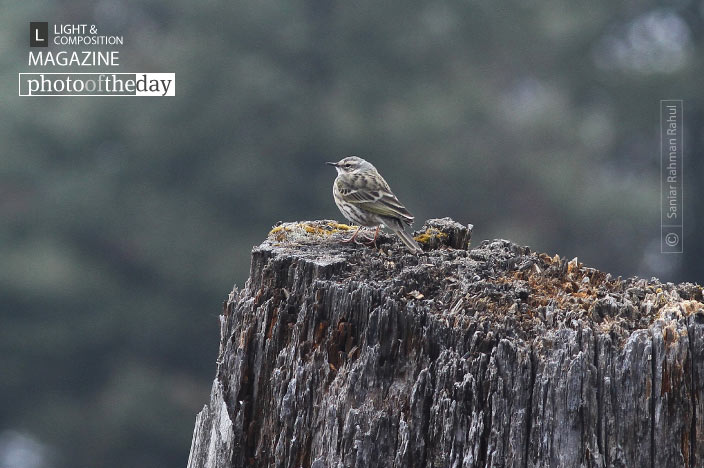
Exposure 1/250sec @ f/7.1 | ISO 400 | Focal Length 300mm
Saniar Rahman Rahul
Based in Dhaka, Bangladesh, Saniar Rahman Rahul is an accomplished Art Director and photographer whose creative journey began in childhood while observing his father’s photographic pursuits. With a professional background rooted in graphic design and advertising, he brings a refined aesthetic sensibility to his wildlife photography, which he rediscovered in 1997. As a seasoned professional in the global advertising industry, Rahul balances his career at Grey Worldwide with a dedicated passion for capturing the natural world, a commitment that has earned him international recognition, including multiple honors from Light & Composition.
Resonance Score Breakdown
Transparency Note: The resonance score (14.8/20) is calculated based on social engagement metrics collected before the award announcement.
Expert Photography Reviews · 7
The Weight of a Wing
To travel is to leave pieces of yourself in the places you pass through. We measure distance in miles, but the bird measures it in endurance. There is a quiet exhaustion in the act of migration, a persistent rhythm that ignores the borders we draw on maps.
Read the reflection →The Weight of the Traveler
In the study of migration, we often focus on the destination—the map, the coordinates, the arrival. We speak of birds as if they are merely biological machines programmed to cross continents, ignoring the profound stillness required to sustain such movement.
Read the reflection →Reviews & Comments
Share your thoughts about this award-winning photograph. Your reviews contribute to the community engagement score.
Chele La is a brutal, wind-scoured pass; I’ve spent enough shivering hours there to know it doesn’t yield subjects easily. Rahul clearly didn’t just stumble upon this pipit. He’s tracked the bird from the plains to the peaks, a commitment that commands my respect. The isolation at f/7.1 is clean, but it’s the patience required to get that close in such thin air that truly impresses. It’s a quiet, hard-won victory over the elements.
The bird sits. It doesn’t crowd the frame. The mountain air feels thin here, held in the blur of the background. I’ve spent minutes just watching the stillness of its perch. It’s a quiet breath in a loud world. Nothing here is accidental. The empty corner is not empty. It’s the weight of the distance traveled. I feel a sudden, sharp ache for that silence. It’s a rare, honest pause.
At Chele La, the air thins until it’s almost prayer. Saniar waited here, letting the mountain silence settle into his bones before the shutter clicked. The Pipit isn’t just a subject; it’s a traveler resting in the thin, high-altitude light. I find myself holding my breath looking at it, feeling the cold wind of Bhutan against my own skin. He didn’t chase this moment; he simply let the bird decide when to be seen.
The subject’s placement within the lower quadrant creates a precarious spatial tension. It’s a calculated risk. The negative space above the pipit doesn’t collapse; it breathes, anchoring the bird against the blurred mountain geometry. I’d argue the diagonal branch provides the necessary fulcrum to balance the frame’s weight. It’s rare to see such disciplined isolation in wildlife work. The composition holds its own, even if the bird’s gaze remains slightly detached from the lens.
Most wildlife shots are just trophies, but this one lingers. I’ve seen thousands of bird portraits, yet the way Rahul placed this Pipit against the muted, high-altitude blur of Chele La feels different. It’s not just sharp; it’s quiet. The f/7.1 choice keeps the environment present without letting it swallow the subject. Honestly, I felt a strange sense of peace looking at it. It’s a rare, enduring document of a traveler finding its place.
The ochre of the Pipit’s breast, a shade reminiscent of Morandi’s dustiest pigments, vibrates against the cool, slate-grey atmosphere of Chele La with such aching precision that I’m left breathless. It’s a quiet, chromatic dialogue where the bird’s tawny plumage doesn’t merely exist; it breathes, anchored by the muted, atmospheric silver of the Bhutanese heights. One finds here a rare, shivering harmony, where the light doesn’t just illuminate, it caresses the very soul of the traveler.
At f/7.1, the 300mm lens avoids the diffraction limit, rendering the Pipit’s plumage with startling micro-contrast. The focal plane is razor-thin, yet it captures the keratin structure of the beak perfectly. I’m genuinely moved by how the bokeh, a function of that specific aperture, dissolves the Chele La landscape into soft, chromatic harmony. It’s rare to see such optical discipline; the lens has resolved details the human eye would simply blur into the mountain air.