A Man in Varanasi by Kristian Bertel
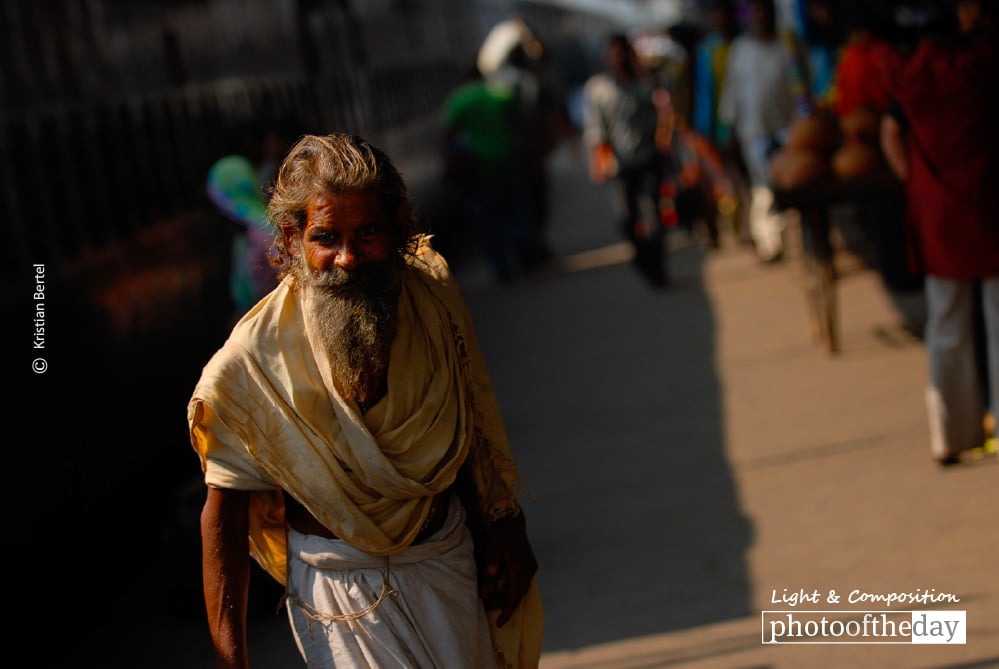
Captured at the bustling Varanasi Junction, this evocative portrait highlights the human spirit amidst one of India's most significant rail hubs. The photographer expertly isolates his subject against the chaotic backdrop of the station, utilizing natural light to emphasize the textures and expressions that define life in Uttar Pradesh. This image is award-worthy for its profound storytelling and the photographer's ability to transform a fleeting moment in a crowded transit space into a poignant, intimate study of an individual, reflecting the complex social tapestry of contemporary India.
Kristian Bertel
Based in Aarhus, Denmark, Kristian Bertel has dedicated his career to documenting the human condition through the lens of travel photography. Since beginning his practice in 2006, he has become widely recognized for his long-term photographic projects in India, where he explores themes of poverty, urban life, and the experiences of street children. His work serves as a powerful narrative tool, blending technical precision with a deep, empathetic commitment to revealing the authentic stories of the people he encounters.
Resonance Score Breakdown
Transparency Note: The resonance score (11.5/20) is calculated based on social engagement metrics collected before the award announcement.
Expert Photography Reviews · 6
The Stillness Within the Current
There is a rhythm to the world that exists beneath the surface of our movement. We often mistake the rush of a crowd or the noise of a station for the whole of reality, forgetting that at the center of every storm, there is a point of absolute quiet.
Read the reflection →The Weight of Transit
In the nineteenth century, the arrival of the railway was often described as the shrinking of the world. It was a mechanical triumph, a way to fold distance until the far-flung felt like the near-at-hand.
Read the reflection →Reviews & Comments
Share your thoughts about this award-winning photograph. Your reviews contribute to the community engagement score.
f/2.8 at 50mm, 1/125s, ISO 400. A standard portrait configuration, yet it’s executed with clinical precision. The shallow depth of field successfully isolates the subject from the station’s visual noise. It’s a calculated choice that forces focus where it belongs. I’ve spent years looking at chaotic street shots, but this one actually holds my attention. The exposure is balanced, the sharpness is surgical. It’s a correct technical execution. The numbers finally justify the intent.
Varanasi Junction isn’t just a station; it’s a threshold. He stood there, amidst the frantic blur, waiting for the light to settle on this man’s face. It’s that soft, diffused glow that reveals the soul in the skin. I’ve felt that same stillness in the desert, where the noise of the world simply drops away. It’s a quiet, holy patience. I find myself holding my breath, just looking into those tired, knowing eyes.
Varanasi Junction serves as a backdrop, but does it belong to the man or the lens? Bertel isolates him, yet I feel a sharp discomfort in how he’s framed as a static relic of the station. Why must his poverty be the primary texture here? It’s a polished aesthetic, but it leaves me cold. Does this portrait grant him agency, or does it simply consume his presence to satisfy a Western gaze? I’m truly unsettled.
Varanasi Junction is a graveyard for mediocre street photography, yet this portrait survives. Most photographers here get lost in the chaos, but Bertel isolates the man’s gaze, turning a transit hub into a private sanctuary. It’s the weary, heavy set of his eyes that stops me cold; I’ve looked at thousands of faces, but this one feels like a secret. It’s not just a snapshot; it’s a quiet, enduring anchor in a frantic world.
Varanasi Junction isn’t just a transit point; it’s a crucible of existence. Bertel’s subject emerges from the gloom, skin etched by the relentless friction of time. I’m struck by how the shadows don’t merely frame him—they consume his edges, forcing us to confront the void he inhabits. It’s a heavy, suffocating beauty. When light fails to penetrate the darkness here, it doesn’t mean the man is hidden. It means he’s finally thinking.
You didn’t just snap a portrait at Varanasi Junction; you found a quiet center in that madness. I’ve spent enough time in stations to know how hard it is to isolate a soul from the crowd, but you did it. There’s a weariness in his eyes that hit me right in the chest. You waited for the light to catch his face just right. And you didn’t look away. That’s the truth I’m looking for.