Signage by Anthony Dell’Ario
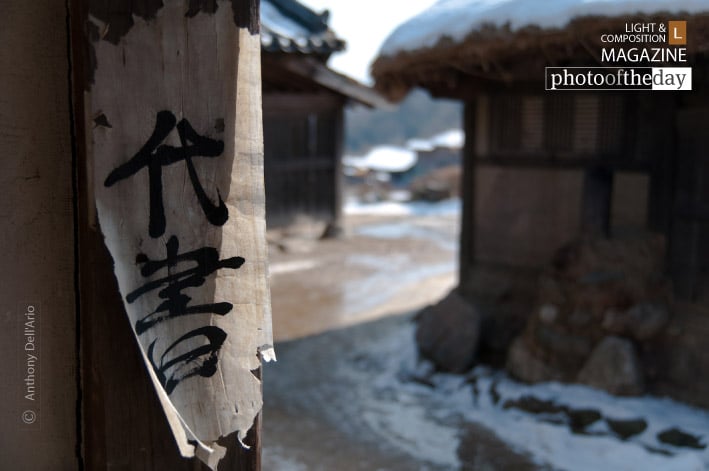
Captured at the historic Namyangju Film Studios, this photograph explores the evocative atmosphere of a site where cinematic history meets political tension. By focusing on the signage within the meticulously crafted replica of Panmunjeom, the photographer highlights the surreal experience of standing at a mock border crossing. The image captures the quiet, eerie stillness of the set, effectively blurring the lines between reality and artifice. It is award-worthy for its ability to transform a film location into a poignant commentary on the division of Korea, utilizing precise framing to evoke a sense of place that feels both authentic and hauntingly staged.
Anthony Dell'Ario
Originally hailing from Seattle, Washington, Anthony Dell'Ario is a photographer currently based in Seoul, South Korea. While his professional life is dedicated to the design and creation of educational materials, his true creative pursuit lies in photography. He travels extensively throughout Korea and the globe, driven by a desire to craft compelling imagery that resonates with viewers and captures the inherent worth of the subjects he encounters.
Resonance Score Breakdown
Transparency Note: The resonance score (12.4/20) is calculated based on social engagement metrics collected before the award announcement.
Expert Photography Reviews · 4
The Weight of Stilled Air
The smell of damp concrete always brings me back to the basement of my childhood home, where the air felt thick and heavy, like a wool blanket left out in the rain. There is a specific silence in places that were built to hold people but now hold only echoes.
Read the reflection →The Architecture of Echoes
In the quiet corners of old museums, one often finds replicas of things that no longer exist in their original form. We build these stage sets to hold onto a history that feels too heavy to carry, or perhaps too dangerous to leave behind.
Read the reflection →Reviews & Comments
Share your thoughts about this award-winning photograph. Your reviews contribute to the community engagement score.
The ochre of these weathered signs, a shade reminiscent of Morandi’s dust-choked still lifes, bleeds into the cold, slate-grey atmosphere of a divided peninsula. It’s a haunting, chromatic dissonance that makes my heart ache for the artifice of borders. One finds the palette doesn’t merely describe a film set; it captures the suffocating, muted tension of a history suspended in amber, where the light itself feels like a lie told in shades of bruised, industrial melancholy.
It’s a curious thing, photographing a fake border. One wonders if Mr. Dell’Ario spent the afternoon shivering in the damp, waiting for the tourists to vanish so the silence could finally settle. The framing is precise, almost clinical. I’ve spent enough time in desolate places to recognize that particular, hollow stillness. It’s a cold, calculated effort. He didn’t just stumble upon this; he clearly waited until the artifice felt heavy enough to be real.
Most travel photography is just sightseeing, but this hits differently. By framing the Panmunjeom signage against the artificial backdrop of a film set, Dell’Ario captures the absurdity of a divided nation better than any documentary shot I’ve seen. It’s haunting because it’s fake, yet it feels entirely real. I’ll admit, looking at those signs gives me a genuine chill. In thirty years, we’ll still be trying to decode this strange, staged tension. It’s earned its place.
Shadows here aren’t merely absent light; they’re the heavy, suffocating silence of a border that doesn’t exist. Dell’Ario captures the Panmunjeom replica not as a set, but as a tomb for history. It’s unsettling. When I look at those stark, artificial signs bleeding into the encroaching dark, I feel a cold shiver of existential dread. We’re staring into a void where truth has been staged, and frankly, it’s a haunting, necessary confrontation with our own fragility.