The Grey Bearded Man by Ryszard Wierzbicki
Captured in the vibrant streets of Pushkar, India, this portrait documents a fleeting encounter with an elderly man whose weathered features tell a profound story of time and tradition. The photographer seized the moment as the subject paused during his walk, utilizing a tight focal length to isolate the man against the bustling backdrop. The image is award-worthy for its raw, authentic character study, demonstrating a keen eye for human connection and the ability to transform a spontaneous street interaction into a timeless, evocative portrait that resonates with cultural depth.
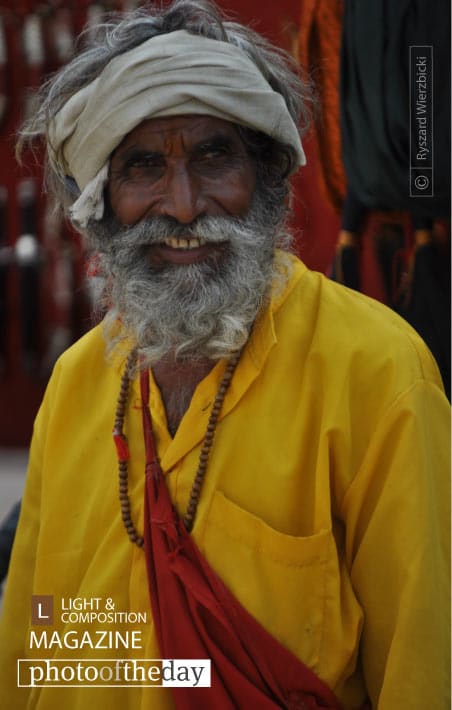
Exposure 1/750sec @ f/6.7 | ISO 200 | Focal Length 200mm
Ryszard Wierzbicki
Born in Poland in 1963, Ryszard Wierzbicki relocated to the United Kingdom in 2006, where he established himself as a dedicated travel photographer. His work is defined by a deep curiosity for human culture, with a particular specialization in portraiture that captures the essence of children and the elderly. Through his extensive travels, particularly across South-East Asia, he focuses on observational storytelling that highlights the dignity and unique character of the individuals he encounters.
Resonance Score Breakdown
Transparency Note: The resonance score (12.9/20) is calculated based on social engagement metrics collected before the award announcement.
Expert Photography Reviews · 7
The Map of Years
We carry our history on the surface. It is written in the lines around the eyes, the way the skin folds like dry earth after a long drought. We think we are hiding our age, but the body is a traitor.
Read the reflection →The Geography of a Face
In the study of geology, we are taught that the earth is a record of its own trauma. A mountain range is not merely a feature of the landscape; it is the result of tectonic plates colliding, of immense pressure exerted over eons, of heat and upheaval.
Read the reflection →Reviews & Comments
Share your thoughts about this award-winning photograph. Your reviews contribute to the community engagement score.
The dust of Pushkar settles behind him. He doesn’t look at the lens. He looks at the space beside me. I feel a sudden, sharp ache in my chest. It’s the weight of his stillness against the blur of the street. Nothing here is accidental. The empty corner is not empty. It holds the years he’s carried. Wierzbicki didn’t capture a man. He captured the pause between breaths. It’s enough.
Most portraits from Pushkar are cluttered with tourist kitsch, but Wierzbicki’s choice to compress the frame at 200mm isolates the man’s exhaustion from the chaos. It’s the texture of that beard—the way it holds the dust of the desert—that stops me cold. I’ve seen thousands of street portraits, yet this one persists because it doesn’t romanticize the subject. It’s a brutal, honest record of a life that will be gone, but won’t be forgotten.
The dust of Pushkar clings to his skin like a memory. I’ve stood in that heat, where the light doesn’t just fall; it presses against you, heavy and golden. Ryszard didn’t rush this. He waited for the man to settle into the stillness of his own history. Looking at those deep, etched lines, I feel a sudden, quiet ache for the time he’s seen. It’s a portrait of the earth itself, weathered and enduring.
A decent enough capture, though it feels like a tourist’s lucky strike rather than a hard-won portrait. At 200mm, one suspects the photographer kept a safe, comfortable distance. It’s sharp, certainly, but I’ve spent enough hours in the dust to know that true character requires a conversation, not a long lens. I’d have preferred to see the grit of the street in his eyes, not just a blurred backdrop. It’s a pleasant snapshot, nothing more.
At 200mm and f/6.7, the focal plane is razor-thin, isolating the man’s skin textures with clinical precision. The diffraction limit hasn’t softened the fine, grey hairs of his beard, which resolve with startling clarity against the compressed bokeh. I’m genuinely moved by how the lens captures the topography of his face; it’s a cartography of age. It’s rare to see such optical honesty. The light’s behavior here doesn’t just document; it reveals the man’s very essence.
The deep furrows of this man’s face aren’t just age; they’re trenches where light goes to die. Wierzbicki doesn’t shy away from the harsh Pushkar sun, yet it’s the encroaching darkness in the hollows of his eyes that haunts me. I’ve stared at these shadows for an hour, feeling the crushing weight of a life lived in silence. It’s a brutal, honest confrontation. When light fails to penetrate, the soul finally begins to speak.
The ochre dust of Pushkar clings to his skin like the parched pigments of a Morandi still life, yet it’s the startling, bruised violet of his turban that truly arrests one’s breath. I’m utterly undone by how that regal, shadowed indigo quarrels with the sun-bleached terracotta of the background, creating a chromatic tension that feels ancient, almost sacred. It’s a gorgeous, dusty dissonance that makes me ache for the heat of that Rajasthan afternoon.