Autumn Vineyards by Dawid Theron
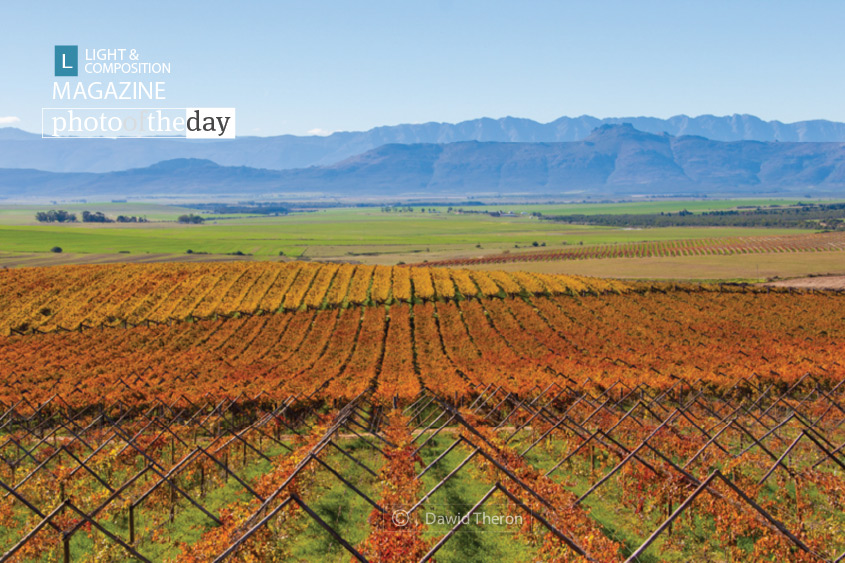
Autumn Vineyards captures the rhythmic geometry of a vineyard during the harvest season, where the interplay of vibrant colors and textures draws the viewer into the landscape. The photographer utilized the natural lines of the trellises to create a compelling sense of depth, guiding the eye across the rows of vines. By selecting a mid-range focal length and a narrow aperture, the image achieves a sharp, balanced perspective that emphasizes the structural beauty of the terrain. This photograph is award-worthy for its masterful composition and the ability to transform a functional agricultural space into a sophisticated, artistic study of light and form.
Dawid Theron
Based in Tulbagh, South Africa, Dawid Theron approaches photography as a fine artist, utilizing his camera to document the hidden aesthetic potential of his surroundings. His work spans from the intricate details of nature to the structured lines of man-made architecture, always seeking to highlight textures and shapes that often escape the casual observer. By viewing the environment as his canvas, Theron creates evocative images that reflect his personal vision, establishing himself as a dedicated observer of the world's natural and structural artistry.
Resonance Score Breakdown
Transparency Note: The resonance score (13.6/20) is calculated based on social engagement metrics collected before the award announcement.
Expert Photography Reviews · 5
The Geometry of Patience
I remember sitting on a low stone wall in Tuscany with an old man named Marco. He spent his days tending to vines that had been in his family for three generations.
Read the reflection →The Earth’s Quiet Exhale
There is a wisdom in the way the earth prepares for rest. We often mistake the turning of the leaves for an ending, a fading of vitality, but it is actually a profound act of surrender.
Read the reflection →Reviews & Comments
Share your thoughts about this award-winning photograph. Your reviews contribute to the community engagement score.
The ochre of these dying leaves, a shade reminiscent of Morandi’s dustiest pigments, vibrates against the cool, bruised violet of the distant mountains, creating a chromatic tension that’s frankly intoxicating. One feels the crisp, thinning air of the Western Cape in the way the light clings to the trellises, turning the rows into a rhythmic, golden pulse. It’s a gorgeous, melancholic symphony of decay, and I’m utterly breathless watching the shadows stretch across that parched, sun-drenched earth.
At f/11, the Sigma’s optics push toward the diffraction limit, yet the focal plane remains remarkably crisp across these trellises. It’s a delicate balance; the sensor’s resolution captures the vine textures with a clinical precision that’s almost startling. I’m genuinely moved by how the light renders the autumn foliage—it’s not just a vineyard, but a complex study in refractive geometry. The lens doesn’t just record the landscape; it dissects the very physics of the harvest.
The rhythmic repetition of the trellises establishes a rigid, mathematical cadence. It’s a disciplined grid that anchors the frame, forcing the eye into a predictable, linear migration. The depth of field is handled with clinical precision; the foreground rows don’t collapse into the horizon. I’ve rarely seen such structural austerity in a vineyard. It’s cold, it’s precise, and it’s entirely necessary. The composition holds because it refuses to succumb to the chaos of the harvest.
The rows pull the eye toward a horizon that doesn’t exist. It’s quiet here. The trellises act as ribs, holding the earth together. I’ve spent minutes watching the light settle between the vines. It’s a rare stillness. Nothing here is accidental. The empty corner is not empty. It’s a breath. I feel a sudden, sharp ache for the harvest’s end. The silence is heavy. It’s exactly what the landscape needed to say.
The geometry here is tidy, perhaps a bit too tidy. One wonders if the photographer simply pulled over, snapped the shutter, and left before the wind could ruffle a leaf. It’s a pleasant enough view of Riebeeck West, but it lacks the grit of a long vigil. I’ve spent enough mornings shivering in vineyards to know that light like this is usually a gift, not a conquest. It’s decent, but it hasn’t cost enough.