Arena di Verona by Daniele Lembo
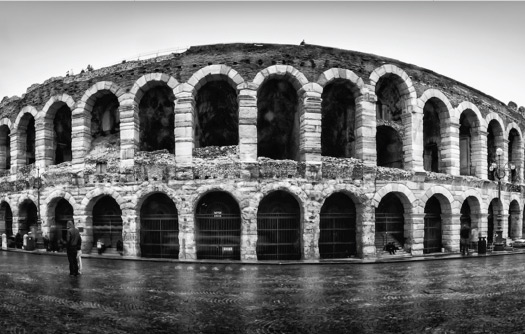
Captured on a rainy November day, this panoramic view of the Arena di Verona transforms a historic landmark into a moody, atmospheric masterpiece. The photographer utilized a long exposure to emphasize the stillness of the scene, allowing the wet surfaces to reflect the ambient light of the ancient amphitheater. By choosing a wide-angle perspective, the image captures the vast scale and architectural grandeur of the structure against the soft, diffused light of the overcast sky. This photograph is award-worthy for its masterful control of light and composition, turning a familiar tourist site into a contemplative, timeless study of urban architecture.
Daniele Lembo
Based in Rome, Italy, Daniele Lembo draws constant inspiration from the beauty and chaos of his historic home city. His photographic journey began in childhood, sparked by watching his father capture images, which eventually evolved into a dedicated pursuit of visual storytelling. Through years of rigorous theoretical study and practical application, Lembo has cultivated a distinct expressive style that seeks to reveal his unique vision of the world. He remains a committed student of the craft, continuously exploring new techniques to refine his artistic voice.
Resonance Score Breakdown
Transparency Note: The resonance score (12.5/20) is calculated based on social engagement metrics collected before the award announcement.
Expert Photography Reviews · 7
The Echo of Stone
If a structure could remember the voices that once filled it, would it eventually grow heavy with the weight of all that has been said? We build monuments to permanence, carving our ambitions into rock and mortar, hoping to defy the inevitable erosion of the years.
Read the reflection →The Echo of Stone
History is not a line drawn in the dust, but a sediment that settles in the marrow of a place. We walk over the ghosts of voices, over the layers of applause and silence that have soaked into the masonry like rain into thirsty soil.
Read the reflection →Reviews & Comments
Share your thoughts about this award-winning photograph. Your reviews contribute to the community engagement score.
I really like this way. Looks like a wide lens and beautifully captured.
The Arena’s stone dissolves into a bruised, melancholic violet, reminiscent of a Morandi still life where the light has been drained of all vanity. It’s the grey of wet slate under a weeping November sky that truly captures me; I’ve found myself shivering before these slick, reflective surfaces. One feels the weight of centuries in that muted, dampened ochre, a palette so restrained it’s almost breathless, turning history into a quiet, chromatic ache.
The wide-angle distortion doesn’t compromise the structural integrity here. It’s a rigid geometry. The wet stone creates a mirror plane that anchors the amphitheater’s mass, preventing the frame from drifting into atmospheric fluff. I’m genuinely unsettled by how the curvature pulls the eye toward the center, forcing a confrontation with the void. It’s a disciplined exercise in spatial tension. The architecture holds its weight perfectly. It’s a rare instance where the frame doesn’t collapse under its own scale.
At 10mm, the EF-S 10-22mm pushes the focal plane to its limits, yet Lembo’s f/3.5 aperture keeps the diffraction limit at bay. The rain-slicked stone acts as a diffuse reflector, scattering ambient light into a soft, coherent glow. I’m genuinely moved by how the lens resolves the subtle micro-contrast in those wet surfaces. It’s a rare moment where the optics don’t just capture the Arena; they translate its ancient, heavy silence into pure, luminous data.
The shutter stays open for four seconds, and the rain turns the Verona stone into a mirror. It’s a long take that breathes. I feel the damp chill of that November air just looking at it. The wide lens pulls the amphitheater’s weight into the frame, holding the silence perfectly. Any faster, and the mood breaks. This is the shot the editor keeps, the one where the rhythm of the city finally stops moving.
Before the eye identifies the stone, something in the chest tightens. It’s the damp, heavy silence of the Arena that hits first, a physical weight pressing against the ribs. The long exposure turns the wet ground into a dark, obsidian mirror, pulling my gaze downward into a cold, liquid depth. I’ve returned to this frame a dozen times, and each time, I feel that same shiver—the sudden, lonely ache of standing in an empty, ancient place.
4 seconds at f/3.5, 10mm, ISO 100. Wide open on an ultra-wide lens is a gamble, but here it’s calculated. The 10mm focal length stretches the stone, yet the 4-second exposure flattens the rain into a cohesive, reflective surface. It’s technically sound. I’ve spent enough time in Verona to know the light there is unforgiving, but this exposure captures the damp stillness perfectly. It’s a cold, precise execution. I actually find the geometry quite satisfying.
Rain slicked the stone, and we find ourselves standing in the silence of Verona’s ghost-filled heart. Daniele didn’t just capture architecture; he listened to the echoes of thousands who once cheered here. It’s a portrait of a monument that’s finally catching its breath. I feel a strange, heavy ache in my chest looking at these wet, reflective curves. It’s a photograph that asks to be returned to, because it’s finally telling us its own long, lonely story.