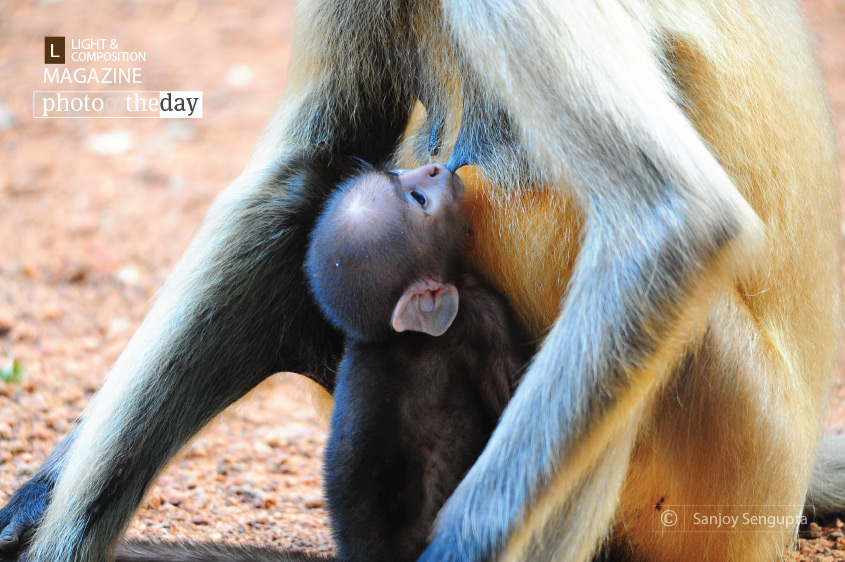
Mother’s Care by Sanjoy Sengupta
Captured on the journey to the Kanakdurga temple in India, this poignant wildlife photograph depicts a baby monkey clinging tightly to its mother. The photographer utilized a long 500mm focal length to observe this intimate, tender moment from a respectful distance, ensuring the natural behavior remained undisturbed. The image highlights the universal bond of maternal protection, framing the mother as the safest sanctuary for her offspring. This photograph is award-worthy for its emotional resonance and the technical precision required to capture such a fleeting, delicate interaction in the wild.
Robbie Kaye
As a classically trained pianist, Robbie comes to photography looking for visual melodies. Just as music can take you on a journey, make you laugh and cry and touch the deepest part of your soul so can a photograph. She is a storyteller and looks for visual narratives that define a place in time. She is also drawn to finding beauty in unexpected places, hoping to intrigue, inspire, and evoke a reaction from the viewer. Robbie is a champion of the overlooked and sees her photography as a way to create change, giving exposure to societal issues that need to be addressed. Robbie is from New York and resides in Southern California. Her work has been published in Gourmet and Allure Magazines, and The L.A. Art Magazine. Online she has been published in Lensculture, Lenscratch and Bob Killen Fine Art Photography Blog.
Resonance Score Breakdown
Transparency Note: The resonance score (12.5/20) is calculated based on social engagement metrics collected before the award announcement.
Expert Photography Reviews · 8
The Weight of Being Held
I remember sitting on a rusted bench in a park in Lisbon, watching a woman adjust her daughter’s coat against the biting wind. The child didn't look up; she simply leaned into the movement, eyes closed, trusting the hands that were busy securing her against the cold.
Read the reflection →The Architecture of Holding On
We often speak of independence as the ultimate human achievement, a solitary peak to be climbed. Yet, if we look closely at the earliest chapters of any life, we find that survival is rarely a solo act.
Read the reflection →Reviews & Comments
Share your thoughts about this award-winning photograph. Your reviews contribute to the community engagement score.
The diagonal axis formed by the mother’s spine dictates the frame’s geometry. It’s a rigid, structural anchor against the chaotic bokeh of the forest floor. The infant’s grip provides the necessary counter-tension, balancing the composition’s weight. I’ve seen countless wildlife shots fail by prioritizing sentiment, but here, the spatial tension holds. It doesn’t rely on the narrative of care. The architecture of the primate bodies creates a singular, locked form that demands total visual attention.
Before the eye identifies the fur or the temple shadows, something in the chest tightens. It’s the visceral recognition of a grip—that desperate, primal hold of the infant against the mother’s spine. I’ve returned to this frame for years, and it still triggers a phantom ache in my own shoulders. It doesn’t just document a primate; it maps the architecture of safety. When I look away, I’m left with the quiet, heavy weight of being held.
The shutter clicks, and the world stops. It’s a tight, breathless close-up. That 500mm lens isolates the pair, turning the forest into a soft, painterly blur. The baby’s grip is everything; it’s the tension that holds the frame together. I’ve spent years watching frames like this, but the raw, frantic pulse of that tiny hand against the mother’s fur gets to me. It’s a perfect cut. The editor wouldn’t change a single frame here.
The fur’s ochre warmth, reminiscent of a Morandi still life, anchors this tender embrace against the forest’s cool, mossy gloom. It’s the way the light catches the infant’s grip—a pale, dusty amber—that truly undoes me. One finds a profound chromatic intimacy here; the shadows don’t merely swallow the subjects, they cradle them in a velvet, verdant silence, proving that maternal protection is, at its core, a symphony of earth-toned grace.
At 500mm, the focal plane is razor-thin, yet Sengupta holds the mother’s fur with clinical sharpness. The Sigma’s glass struggles slightly at f/6.3, showing minor longitudinal chromatic aberration in the bokeh, but it doesn’t matter. The diffraction of light across the infant’s grip is, in the strictest physical sense, extraordinary. I’ve spent years analyzing optics, but seeing that tiny, desperate tension in the fingers—it’s enough to make me forget the physics and just feel the ache.
We look at this face and we understand something ancient. It’s not just a monkey in the woods of Chilka Garh; it’s a story of survival whispered through fur and grip. Sanjoy kept his distance, listening to the forest before he dared to look. I feel a sudden, sharp ache in my own chest seeing that tiny hand clutching tight. It’s a portrait of sanctuary. This is a photograph that asks to be returned to.
Five hundred millimetres of glass is a heavy burden to haul through the heat of West Bengal. One suspects Sengupta didn’t just stumble upon this. He’s clearly sat in the dust long enough for the troop to forget he existed. It’s a quiet, tender bit of work. I’ve spent enough hours waiting for a subject to ignore me to know the cost of this intimacy. It’s a rare, honest moment, earned by simply staying put.
Most wildlife shots are just trophies, but this one hits differently. At 500mm, Sengupta captured a vulnerability that usually vanishes the second a lens appears. The way the infant’s hand grips the mother’s fur isn’t just biology; it’s a universal anchor. I’ve seen thousands of animal portraits, yet this quiet, desperate intimacy makes me want to reach out. It’s the rare frame that’ll still feel vital in thirty years because it captures a feeling, not just fur.