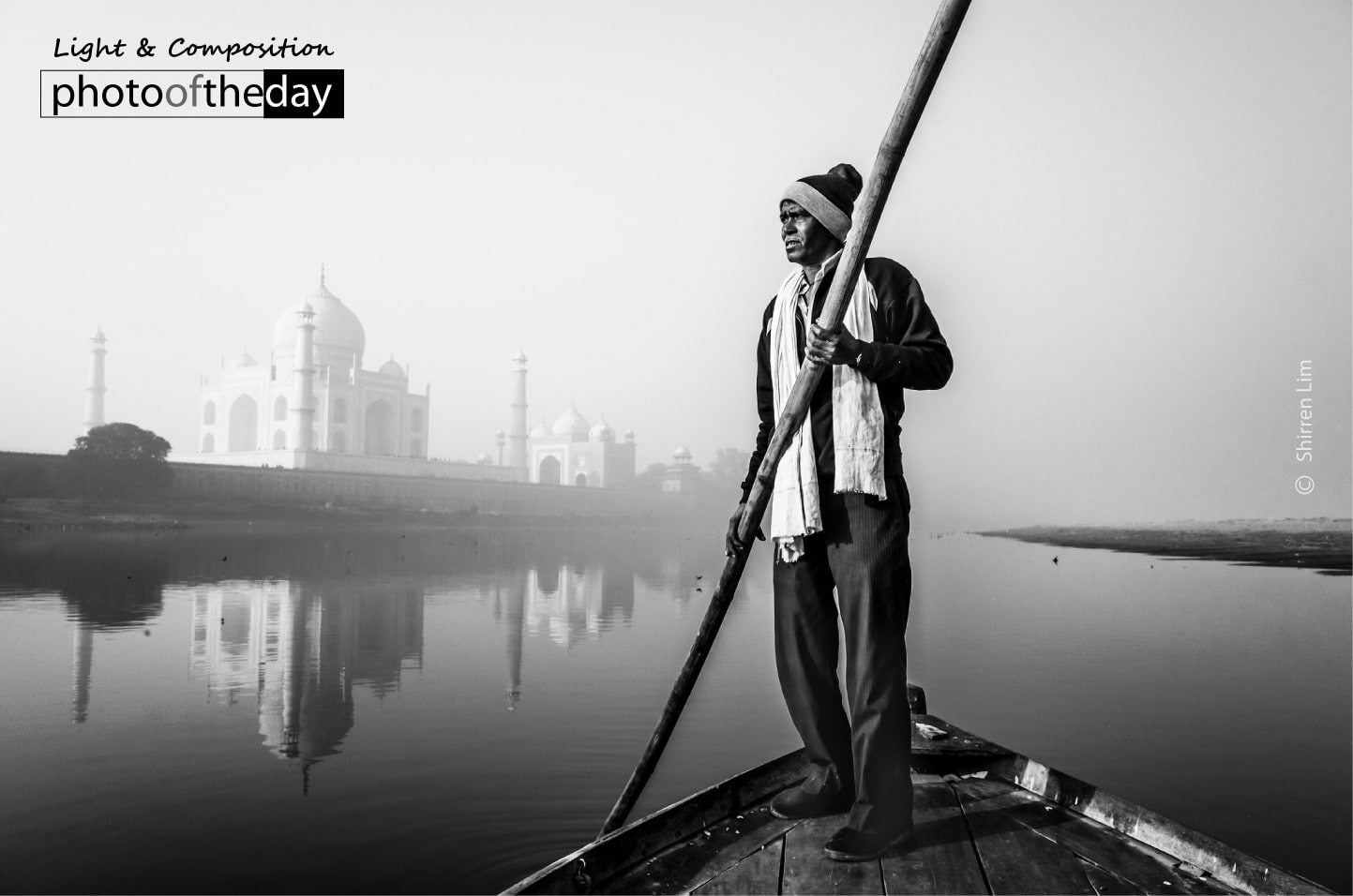
Boatman from Agra by Shirren Lim
Captured during an early morning excursion to the river behind the Taj Mahal, this image depicts a boatman navigating the mist-shrouded waters. The photographer patiently waited for the perfect alignment, positioning the iconic monument directly behind the subject as he maneuvered his boat. The resulting portrait is a masterclass in composition, utilizing the ethereal morning light and the historical backdrop to create a sense of timelessness. This photograph is award-worthy for its ability to transform a simple moment of daily labor into a poignant, atmospheric narrative that bridges the gap between human activity and architectural grandeur.
Shirren Lim
Born in Penang Island, Malaysia, in 1970, Shirren Lim is a Jakarta-based photographer who discovered her true passion for the craft in 2009. Specializing in portraiture, she seeks to capture the sincere and uncovered expressions of humanity, producing work often described as intense and earthy. Deeply inspired by the iconic imagery of Steve McCurry, Lim strives to create photographs that resonate with the same emotional depth and global impact. Her evocative work has been featured in various international web and printed publications.
Resonance Score Breakdown
Transparency Note: The resonance score (11.7/20) is calculated based on social engagement metrics collected before the award announcement.
Expert Photography Reviews · 7
The Weight of the Mist
There is a particular density to the air just before the sun fully asserts itself, a heavy, silver-grey suspension that turns the world into a series of silhouettes.
Read the reflection →The Weight of the Horizon
We often mistake the city for its monuments. We look at the grand stone gestures, the towering legacies of empires, and we assume these are the anchors of our collective identity.
Read the reflection →Reviews & Comments
Share your thoughts about this award-winning photograph. Your reviews contribute to the community engagement score.
You waited for the mist to settle, and it paid off. I’ve seen a thousand shots of the Taj, but this one feels different. It’s not about the marble; it’s about the man’s back, the weight of his oar, and that quiet, early morning solitude. I felt a sudden, sharp chill looking at his hands. You didn’t just frame a landmark. You caught a man living his life while history looms behind him. That’s honest work.
The mist here isn’t merely atmospheric; it’s a veil of bruised, pearlescent grey, reminiscent of a Turner sky, which softens the Taj Mahal into a ghost of itself. I’m utterly breathless at how the boatman’s ochre tunic cuts through that cool, humid haze like a dying ember. It’s a chromatic dissonance that feels almost sacred, grounding the ethereal architecture in the raw, humid reality of the Yamuna, where the light doesn’t just fall—it sighs.
The Taj Mahal is a heavy backdrop, but it doesn’t drown this man out. I’ve spent enough mornings on the water to know that look—he’s working, not posing. Shirren didn’t just take a picture; she waited for the mist to settle so he could exist in his own space. It’s a quiet, honest moment. Looking at his weathered hands, I feel a sudden, sharp ache for the simplicity of his labor. He’s truly present here.
The mist swallows the river. It’s a quiet erasure. The boatman drifts, a dark shape against the marble ghost behind him. I’ve spent minutes watching him row into the void. It’s heavy. The space around his oars isn’t just water. It’s breath. Nothing here is accidental. The empty corner is not empty. It’s the weight of the morning. I feel a sudden, sharp ache for that stillness. It’s rare to find such peace in Agra.
The mist clinging to the Yamuna is beautiful, but I’m struck by the boatman’s posture. He’s clearly accustomed to tourists, yet he holds his oars with a stillness that suggests he’s forgotten the camera entirely. It’s a rare, quiet dignity. I’ve spent enough dawns waiting for wildlife to know when a subject is being performed for and when they’re simply existing. Here, the distance feels earned, not coerced. It’s a haunting, honest frame.
Agra’s mist recalls the soft, atmospheric diffusion of early pictorialists like Steichen, yet here it’s harnessed for a precise, geometric alignment. Placing the Taj Mahal directly behind the boatman risks becoming a postcard cliché, but the tonal separation saves it. It’s a delicate dance between labor and icon. I’ve seen this river photographed a thousand times, but the way the boatman’s silhouette cuts through that morning haze genuinely caught my breath. It’s a quiet, hauntingly familiar triumph.
The mist clings to the Yamuna, but we see the boatman first. He isn’t just navigating water; he’s carrying the weight of history on his oars. Shirren Lim didn’t just frame the Taj Mahal; she waited until the man’s quiet labor became the center of the world. I feel a profound ache in his steady gaze. It’s a portrait that asks to be returned to, reminding us that every monument is built by human hands.