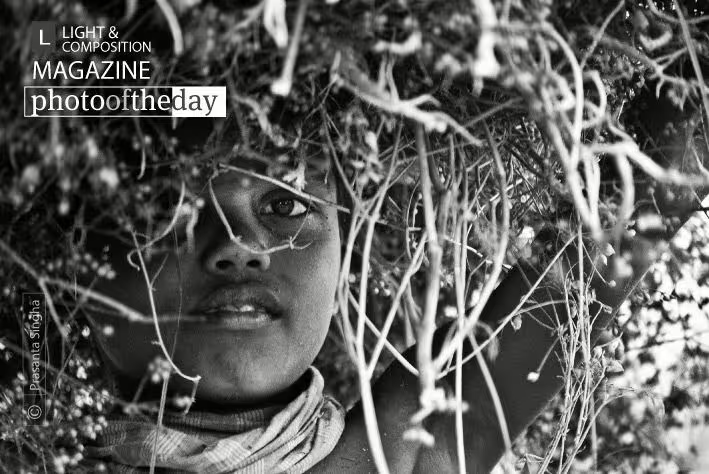
Childhood by Prasanta Singha
Captured in the remote village of Guptipara, India, this poignant portrait documents a young child returning home at the end of a long day in the fields. Balancing a massive load of harvested vegetation upon his head, the child embodies the quiet resilience of rural life. The photographer utilized a telephoto perspective to isolate the subject against the soft, ambient light of dusk, emphasizing the textures of the burden and the child's weary yet stoic expression. This image is award-worthy for its raw, empathetic storytelling and its ability to elevate a simple, everyday moment into a powerful visual narrative of endurance and childhood innocence.
Natalie Laflamme
Born in small town Olds, Alberta Natalie decided it was time for a change and moved to downtown Calgary where she is a freelance photographer. Once a drug addict in the streets she decided it was time for a change when she once heard a quote “Art is not supposed to be nice, art should make you feel something.” And hasn't turned back. Current Location Calgary, Alberta Instagram https://instagram.com/natalielaflammer/ Website https://www.natalie.laflamme.7 Best Achievements & Exhibitions Won an award for best photograph proven to show the effects of smoking on the environment. Award Winner Photo of the Day Camera iPhone 6 Lenses and Gears None
Resonance Score Breakdown
Transparency Note: The resonance score (12.3/20) is calculated based on social engagement metrics collected before the award announcement.
Expert Photography Reviews · 6
The Weight of Green
We are taught that childhood is a season of lightness, a time when the spirit is meant to drift like dandelion seeds on a summer breeze.
Read the reflection →The Weight of Green
The smell of damp earth always clings to the back of my throat, a sharp, metallic sweetness that reminds me of roots pulled from the dark. I remember the scratch of dry stalks against my bare arms, the way the fibers would fray and leave tiny, stinging dust on my skin.
Read the reflection →Reviews & Comments
Share your thoughts about this award-winning photograph. Your reviews contribute to the community engagement score.
The weight upon that small head isn’t merely vegetation; it’s the crushing gravity of existence. Singha’s shadows don’t hide the boy; they define the threshold where his innocence begins to fray. I’ve stared at these dark, hollowed eyes until my own chest tightened. It’s a brutal, quiet geometry. He isn’t just walking home; he’s carrying the dusk itself. When light fails to penetrate the burden, we finally see the truth of the labor. It’s haunting.
One wonders how many evenings Singha spent in those fields before the boy stopped looking at the lens and started looking at the horizon. It’s a heavy burden, both for the child and the frame. I’ve spent enough damp afternoons waiting for a subject to forget I’m there to know the cost of this patience. It’s a quiet, weary triumph. I find myself wanting to set down my own gear and help him carry the load.
The light in Guptipara doesn’t just fall; it settles, heavy and tired, much like the boy’s burden. He stood there in the cooling hour, the dusk air softening the edges of his harvest. I’ve felt that same stillness, where the shutter waits for the land to exhale. It’s a quiet, aching grace. Looking at his weary eyes, I find myself wanting to set his load down for him. It’s a beautiful, heavy silence.
The ochre of the harvested stalks, a shade reminiscent of Morandi’s dustiest pigments, bleeds into the bruised, indigo twilight of Guptipara, creating a chromatic tension that aches in one’s chest. It’s a haunting, tonal collision; I’m genuinely moved by how the child’s skin, glowing with the pale, muted warmth of a Vermeer highlight, anchors this heavy, atmospheric gloom. One finds here a rare, fragile harmony where the light doesn’t just fall—it breathes, exhausted and golden.
Of the thousands of portraits I’ve reviewed, most rely on forced emotion. This one doesn’t. The weight of that vegetation isn’t just a prop; it’s a physical anchor pinning the boy to his reality. I find myself wanting to reach out and steady him. What separates this from typical rural documentation is the way the dusk light flattens the background, forcing us to confront his exhaustion. It’s a haunting, quiet endurance that will definitely survive thirty years.
The frame’s verticality is its salvation. The mass of vegetation creates a precarious fulcrum, forcing the subject’s gaze into a necessary, rigid alignment with the picture plane. It’s a tight, claustrophobic geometry that keeps the composition from collapsing under the weight of its own narrative. I’ve grown weary of such sentimentality, yet the tension here holds. The negative space doesn’t offer relief; it merely traps the child within the discipline of the frame. It’s structurally sound.