Call of the Wild by Manoj K G
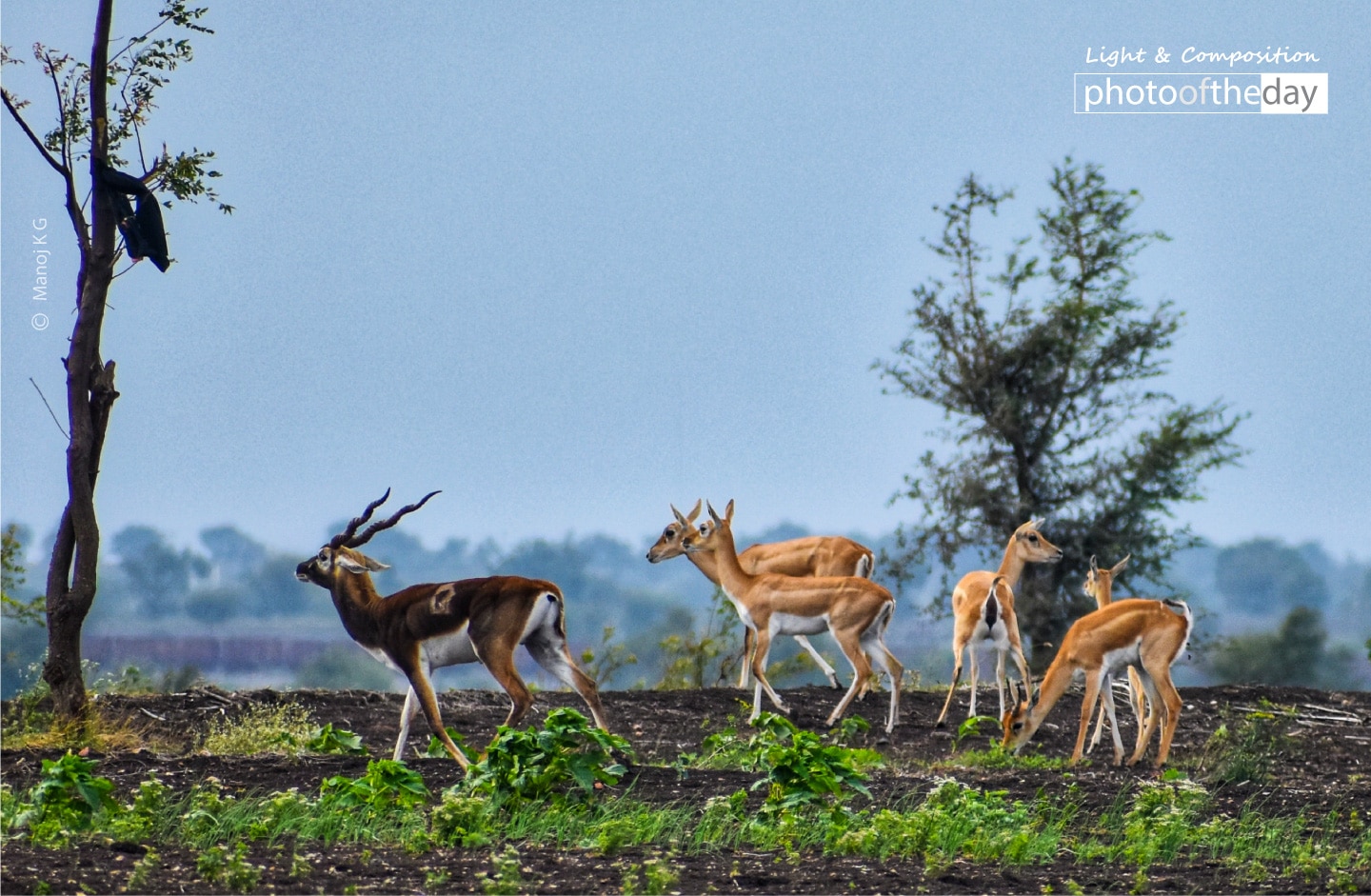
Captured during a road trip through the agricultural landscapes of Bagalkot, India, this striking wildlife image documents a herd of deer in motion as they navigate toward the safety of a nearby forest. The photographer, traveling with friends, seized the fleeting moment to frame the animals against their natural environment. The image is award-worthy for its candid portrayal of wildlife in transit, demonstrating a keen eye for timing and the ability to transform a spontaneous travel encounter into a compelling narrative of nature in motion.
Manoj K G
Born in March 1990 in Dakshina Kannada, Karnataka, Manoj K G is an accountant who pursues photography as a passionate creative outlet. While he balances his professional career with his love for the lens, he frequently explores the world through road travel, documenting wildlife, landscapes, architecture, and historical sites. Currently based in Bangalore, he continues to refine his artistic perspective, finding inspiration in the diverse natural and cultural beauty encountered during his travels.
Resonance Score Breakdown
Transparency Note: The resonance score (9.9/20) is calculated based on social engagement metrics collected before the award announcement.
Expert Photography Reviews · 8
The Grace of Transit
Seneca once observed that we are like travelers on a ship; whether we sit or stand, whether we pace the deck or remain still, the vessel carries us forward regardless of our posture.
Read the reflection →The Rhythm of the Unseen
I often find myself standing at the edge of the city, where the pavement begins to fray into dust and the sharp, rhythmic hum of traffic gives way to the low, ancient murmur of the wild. There is a strange comfort in watching things that do not belong to our schedules.
Read the reflection →Reviews & Comments
Share your thoughts about this award-winning photograph. Your reviews contribute to the community engagement score.
Why are these deer running? The motion blur suggests urgency, yet I’m struck by how the frame treats their flight as a mere travel souvenir. Is this truly a narrative of nature, or just an intrusion into a landscape already fractured by agriculture? It’s unsettling to see wildlife framed as a fleeting roadside attraction. Whose safety are they actually seeking? I find myself wishing the photographer had put the phone down and simply let them be.
The Samsung’s sensor struggles at ISO 1600, yet the diffraction at f/4.0 captures the deer’s kinetic energy with surprising clarity. It’s a raw, noisy rendering of light, but the focal plane holds the herd’s movement against the Bagalkot scrub beautifully. I’m genuinely moved by how the lens resolves those fleeting silhouettes; it’s a fragile, imperfect optical moment that feels more honest than any clinical, high-resolution capture. It doesn’t need perfection to be profoundly alive.
Most wildlife shots are just trophies, but this one captures the frantic, dust-choked urgency of survival. Of the thousands of submissions I’ve reviewed, few manage to make a smartphone sensor feel this vital. The motion blur isn’t a technical failure; it’s the heartbeat of the herd. I actually felt my own breath hitch watching them vanish into that scrub. It’s not perfect, but thirty years from now, it’ll still feel like a desperate, beautiful escape.
The deer are mid-leap, suspended in that frantic, beautiful scramble toward the treeline. It’s raw. You can feel the dust rising. If Manoj had waited a heartbeat longer, the herd would’ve vanished into the brush, the frame collapsing into static. It’s the kind of kinetic energy Winogrand chased his whole life. I’m genuinely breathless looking at this. He caught the exact fraction of a second where nature stops being scenery and starts being a story.
The dry, golden grasses of Bagalkot ripple like a textured canvas, grounding these deer in a landscape that feels almost tactile. I’m struck by how the parched earth dictates their frantic, rhythmic movement; it’s a desperate choreography. The environment isn’t just a backdrop here—it’s the very reason for their flight. Watching them navigate that harsh, sun-drenched terrain, I feel a sudden, sharp ache for the wild. It’s a beautiful, raw dialogue between creature and dust.
We look at these deer and we don’t just see animals; we see a frantic, silent conversation between the herd and the encroaching forest. They’re fleeing, yet they’re tethered to the landscape of Bagalkot. I’ve spent my life listening to stories, and here, the motion tells me everything about the fear of being watched. It’s a fleeting, breathless moment that makes my own heart race. This is a photograph that asks to be returned to.
There’s a raw, kinetic urgency here that recalls the blurred motion in Muybridge’s zoopraxiscope studies, yet it’s grounded in the dusty, sun-bleached reality of Bagalkot. Using a Galaxy S5 to capture such fleeting transit is a bold subversion of the high-end wildlife canon. It’s not polished, but it’s alive. I’ve spent decades looking at pristine telephoto captures, yet this grainy, spontaneous scramble of deer genuinely made me catch my breath. It’s a rare, honest fragment of nature.
It’s a pleasant enough snap, but one suspects it was captured between sips of tea on a road trip. The deer are moving, certainly, but they haven’t been earned. I’ve spent weeks shivering in tall grass for a single frame, so I find this lack of commitment rather jarring. It’s a lucky encounter, not a pursuit. When you stop chasing the light and start waiting for it, you’ll find the results are far less fleeting.