Emperors on Abbey Road by Claudio Bacinello
Captured within the vast penguin colonies of Chilean Patagonia, this image documents a serendipitous moment of natural behavior. The photographer observed a group of penguins breaking away from the main colony, marching in a deliberate, evenly spaced line that mirrored the iconic silhouette of the Beatles on their Abbey Road album cover. This striking alignment, combined with the raw, untamed environment of the Patagonian coast, transforms a routine wildlife observation into a whimsical and memorable composition. The image is award-worthy for its perfect timing and the clever, humanizing narrative it draws from the natural world.
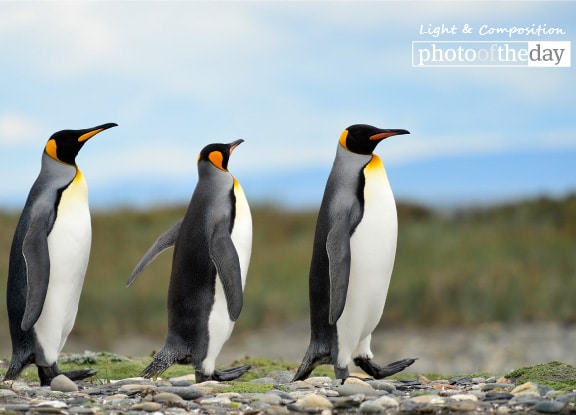
Claudio Bacinello
Born in Italy, Claudio Bacinello is a seasoned photographer currently based in Thornhill, Canada. With a distinguished career spanning three decades, he has mastered diverse disciplines ranging from corporate and wedding photography to his current passion for wildlife, nature, and travel. Claudio frequently traverses the globe to document stories in Africa and South America, contributing to an extensive stock library while offering his work as fine art for private and corporate collections worldwide.
Resonance Score Breakdown
Transparency Note: The resonance score (12.1/20) is calculated based on social engagement metrics collected before the award announcement.
Expert Photography Reviews · 7
The Rhythm of the March
I remember walking through a crowded terminal in Berlin, feeling entirely out of step with the rush of commuters. Everyone seemed to be moving to a different, invisible tempo—some frantic, some dawdling, all of them caught in the friction of getting somewhere else.
Read the reflection →The Rhythm of the March
The smell of wet salt and cold, crushed stone clings to my skin long after the tide has retreated. It is a sharp, metallic scent, the kind that makes the back of your throat ache with the memory of winter.
Read the reflection →Reviews & Comments
Share your thoughts about this award-winning photograph. Your reviews contribute to the community engagement score.
It’s easy to mistake a lucky shutter press for a triumph. I’ve spent enough freezing hours in Patagonian mud to know that penguins don’t march in lines for the sake of a Beatles reference. They’re indifferent to our whims. Bacinello clearly sat there until his toes went numb, waiting for the colony to reveal this geometry. It’s a rare, witty bit of patience. I’d have likely given up an hour sooner. Well earned.
The light here is flat, honest, and unforgiving, the way it often is on the Patagonian coast. Claudio waited for the land to dictate this rhythm. Watching these penguins march, I’m struck by a sudden, quiet joy—it’s a reminder that nature doesn’t care for our human icons, yet it mirrors them all the same. He stood in the cold, listening to the wind, until the earth finally offered up this perfect, fleeting alignment.
The horizon line pulls the eye toward a vast, grey stillness. Five penguins march. They don’t know they’re mimicking a record cover. They just exist in the cold. I’ve spent minutes watching their rhythm. It’s quiet. The space surrounding them isn’t void; it’s the weight of the Patagonian wind. Nothing here is accidental. The empty corner is not empty. It’s a breath held in the frost. I feel a sudden, sharp peace looking at them.
Why do we insist on forcing human narratives onto wild creatures? Bacinello frames these penguins as a pop culture punchline, stripping them of their autonomy to satisfy our need for a clever reference. It’s a cute composition, sure, but it makes me feel deeply uncomfortable. Are we so bored by nature that we must turn it into a Beatles cover? Whose gaze are we serving here? Certainly not the penguins’. They deserve better than our projections.
The slate-grey sky of Patagonia bleeds into the muted, bruised ochre of the earth, creating a tonal austerity that reminds one of Morandi’s hushed still lifes. It’s a chromatic restraint that makes the penguins’ stark, tuxedoed silhouettes pulse with an almost rhythmic, musical vitality. I’ve found myself quite breathless at how the cold, desaturated light elevates these creatures, turning a simple march into a sublime, monochromatic symphony that feels both ancient and deeply, unexpectedly human.
We watch these penguins marching across the Patagonian coast and we don’t just see birds; we see a procession. They’ve stepped out of the colony with such deliberate, rhythmic purpose that it’s impossible not to hear the faint echo of a drumbeat. I’ve spent my life listening to stories, and here, the silence tells me everything. It’s a whimsical, rhythmic dance of nature. Honestly, it makes me smile every single time I look at it.
The jury calls this whimsical, but I find it haunting. These penguins aren’t mimicking a pop album; they’re traversing a void where light dies against the jagged Patagonian stone. It’s a march toward an inevitable, silent end. I’ve stared at these shadows for an hour, and they don’t invite a smile—they demand a reckoning. When the light fails, the animal remains. It’s a cold, stark reminder that we’re all just walking through the dark, alone.