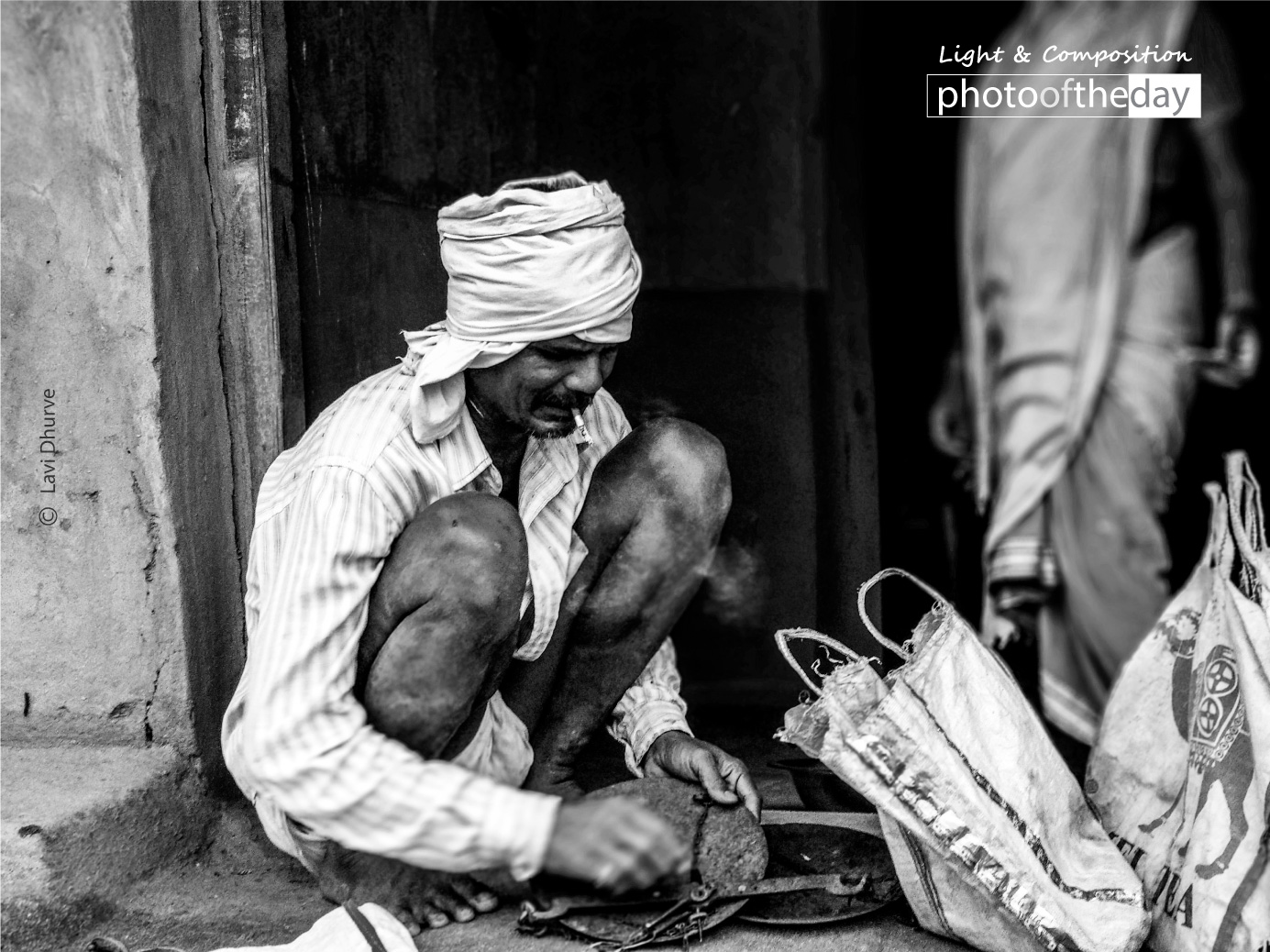
Greengrocer by Lavi Dhurve
Captured on a crisp October day, this portrait features Vidhya, a curious and spirited young girl from the photographer’s home village. Drawn to the child’s natural charm and her eagerness to pose whenever a camera appears, the photographer seized a candid moment of connection. The image stands out for its authentic documentary quality, highlighting the simple joy of village life. By focusing on the genuine interaction between the subject and the lens, the photographer creates an intimate, award-worthy portrait that celebrates the beauty found in everyday human encounters within a rural setting.
Lavi Dhurve
Hailing from a small village in Madhya Pradesh, the ‘Heart of India,’ Lavi Dhurve finds profound inspiration in the simplicity of rural life. Her work is deeply rooted in a love for art, culture, and the natural world, with a particular focus on capturing the spirit of children and the people of her community. Currently based in Indore, she approaches photography as a means to experience and document the inherent beauty of her surroundings, from the quiet majesty of a sunrise to the vibrant lives of those around her.
Resonance Score Breakdown
Transparency Note: The resonance score (11.8/20) is calculated based on social engagement metrics collected before the award announcement.
Expert Photography Reviews · 8
The Weight of a Name
In the village of my childhood, there was a woman who kept a ledger of every seed planted in the valley. She did not write for the sake of history, but for the sake of memory.
Read the reflection →The Weight of October Gold
There is a specific quality to the light in mid-autumn, when the sun loses its vertical intensity and begins to graze the earth at a slant. It is a thinning light, one that strips away the heavy, humid opacity of summer and replaces it with a clarity that feels almost fragile.
Read the reflection →Reviews & Comments
Share your thoughts about this award-winning photograph. Your reviews contribute to the community engagement score.
Vidhya’s gaze echoes the unvarnished directness of August Sander’s portraits, yet there’s a modern, mobile-sensor softness here that feels entirely distinct. While the Xiaomi’s f/2.6 aperture lacks the clinical precision of a large-format lens, it renders the village background with a painterly, impressionistic blur that I find genuinely moving. It’s a quiet, honest dialogue between a child and a digital tool, avoiding the ethnographic tropes we’ve seen since the nineteenth century. It’s a refreshing, human-scale triumph.
Vidhya stands in the soft, diffused light of a Bhogaikhapa morning, her presence grounding the frame. I’ve spent enough hours waiting for the sun to settle on a face to recognize that stillness. She isn’t posing; she’s simply existing in the quiet rhythm of her village. It’s a rare, honest grace. Looking at her eyes, I feel a sudden, sharp ache for the simplicity of a life lived entirely in the present. She’s truly listening.
Most portraits of children in rural settings rely on forced sentimentality, but this one avoids that trap. The Xiaomi’s slight distortion on Vidhya’s face actually grounds the image in a specific, unvarnished reality. I’ve seen thousands of village portraits, yet this one lingers because of her direct, unblinking gaze. It’s a rare, honest connection that doesn’t feel staged. I find myself genuinely rooting for her future. That’s why it’ll still matter in thirty years.
You waited for that look, and it pays off. There’s a quiet, electric tension in Vidhya’s eyes that tells me you weren’t just taking a picture; you were listening to her. I’ve spent years in rural corners, and it’s rare to see a child look back at a lens with such unvarnished curiosity. And because you didn’t force the moment, it feels like she’s sitting right here with us. You caught something true. Respect.
Vidhya doesn’t just pose; she invites us into the quiet rhythm of Bhogaikhapa. We look at her eyes and we see a conversation already finished before the shutter clicked. It’s that rare, honest spark of a child who knows she’s being truly heard. I’ve found myself lingering on her expression, feeling a sudden, sharp ache for the simplicity of her world. This is a portrait that asks to be returned to, again and again.
Vidhya’s grin is infectious, but I’m unsettled by the curator’s insistence on her eagerness to pose. Does a child truly consent to being a symbol of rural joy, or is she just performing for the lens? The Xiaomi’s shallow depth of field isolates her, yet it also strips away the context of her labor. Why must we romanticize her poverty as simple charm? It’s a beautiful portrait, but I find myself wanting to look away.
That spark in her eyes is electric. It’s the kind of raw, unscripted connection that makes me stop dead in my tracks. Lavi caught the exact micro-second where curiosity meets the lens. A tenth of a second later and the light would’ve shifted, the magic gone. It’s not just a portrait; it’s a heartbeat. I’ve seen thousands of shots, but this one feels alive. You didn’t hesitate, and that’s why it works. Pure, honest, decisive.
Vidhya’s face occupies the golden ratio’s intersection, anchoring the frame’s vertical axis. The produce crates create a rhythmic, repeating grid that stabilizes the composition’s left quadrant, balancing the subject’s soft gaze. I’m genuinely struck by how the diagonal lines of the wooden stall pull the eye directly toward her expression. It’s a perfectly solved spatial equation; the geometry doesn’t just contain the girl, it elevates her presence. It’s rare to see such precise structural harmony in candid documentary work.