Annapurna South by Ryszard Wierzbicki
Captured during a challenging trek through the Annapurna Circuit, this image showcases the majestic Annapurna South peak rising above 4,000 meters. The photographer navigated the grueling high-altitude terrain to document the breathtaking scale of the Himalayas, balancing the physical demands of the climb with a keen eye for the mountain's snowy grandeur. This photograph is award-worthy for its ability to convey both the immense, humbling presence of the 101st-highest mountain in the world and the profound personal reflection that accompanies such an arduous journey, effectively translating the raw, thin-aired beauty of the Nepalese landscape into a compelling visual narrative.
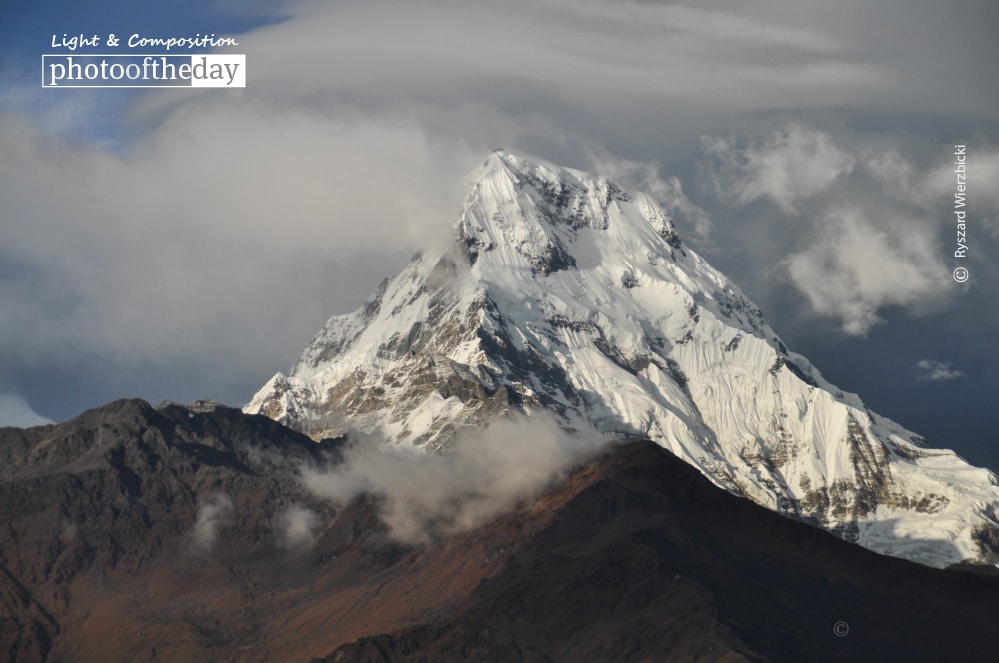
Exposure 1/750sec @ f/6.7 | ISO 200 | Focal Length 100mm
Ryszard Wierzbicki
Born in 1963 and a graduate of the University of Gdańsk, Ryszard Wierzbicki transitioned from a diverse career in social services and marketing to a life defined by global exploration. After relocating to the United Kingdom in 2006, he dedicated himself to photography, scuba diving, and humanitarian work, notably supporting orphans in Thailand and Burma. As a self-employed marketing advisor and tour organizer, he manages his creative pursuits through his established travel forums, Instant Travelling and World Around, documenting his extensive journeys across South-East Asia and beyond.
Resonance Score Breakdown
Transparency Note: The resonance score (13.1/20) is calculated based on social engagement metrics collected before the award announcement.
Expert Photography Reviews · 8
The Weight of Silence
I spent this morning trying to organize my bookshelf, pulling out old journals that I haven't touched in years. I found a note tucked into a page from a trip I took a long time ago.
Read the reflection →The Weight of Silence
In the high, thin air of the world, sound behaves differently. It does not travel so much as it dissolves, swallowed by the vast, unmoving presence of stone and ice.
Read the reflection →Reviews & Comments
Share your thoughts about this award-winning photograph. Your reviews contribute to the community engagement score.
Most mountain photography is just a postcard of a climb. I’ve seen thousands of peaks, but this one hits differently. The 100mm compression forces the jagged rock and snow into a claustrophobic, vertical confrontation that feels genuinely breathless. It’s not just the scale; it’s the way the light clings to the ridge, making the thin air feel palpable. I’d hang this in thirty years because it captures the quiet, terrifying isolation of being that high up.
Before the eye identifies the jagged, snow-dusted ridge, something in the chest tightens. It’s the thin-aired silence of the Annapurna range, a physiological response to altitude I’ve felt only in dreams. When I return to this, the scale doesn’t just humble me; it makes my own pulse feel frantic, almost intrusive. It’s a quiet, cold ache that follows me into sleep, reminding me how small we are against that indifferent, towering white stone.
The mountain’s icy crest, rendered in the brittle, chalky whites of a Morandi still life, breathes against a sky of such thin, piercing cerulean that it’s almost painful to behold. One feels the oxygen deserting the lungs, replaced by the cold, metallic ache of high altitudes. It’s a chromatic austerity that humbles the soul, stripping away the world’s noise until only the stark, shivering resonance of light against frozen stone remains. I’m truly breathless here.
One doesn’t reach four thousand meters without a bit of misery, and it’s clear Wierzbicki paid the toll. The light on that peak isn’t a gift; it’s a wage earned through thin air and frozen fingers. I’ve spent enough nights shivering in a tent to recognize the look of a man who didn’t just snap a frame and keep walking. He stayed. He waited. It’s a cold, honest piece of work. Well done.
1/750sec at f/6.7, 100mm, ISO 200. It’s a safe, conservative aperture choice for a D5000 sensor. The 100mm focal length compresses the scale, forcing the peak into the frame. It’s technically competent, though I’d have preferred a tighter stop to sharpen the distant rock faces. Still, the clarity is undeniable. I’ve spent enough time at those altitudes to know the air is thin, but this crispness makes my own lungs ache just looking at it.
The air up there is thin, and it’s stolen the breath right out of my lungs just looking at this. He stood in the biting cold, waiting for the light to graze those jagged, frozen ridges. It’s not just a mountain; it’s a silence that’s been waiting centuries to be heard. I can feel the ache in his legs and the stillness in his heart. He didn’t take this; he simply let it happen.
Annapurna South looms, yet I feel a cold detachment. Why does the frame flatten this sacred peak into a mere trophy of a trek? It’s a classic tourist gaze, consuming the Himalayas without acknowledging the people who call these slopes home. Does the mountain exist only to humble the climber, or does it have a life beyond our lens? I’m left wanting more than just thin-aired beauty. Where is the humanity in this vast, silent altitude?
The peak cuts the sky. It’s a sharp, cold geometry. I’ve stood in that thin air, and my lungs ache just looking at this. Wierzbicki doesn’t crowd the frame with the climb. He lets the white slope breathe. The vast, pale void isn’t a lack of detail. It’s the weight of the mountain itself. Nothing here is accidental. The empty corner is not empty. It’s the silence I’ve been searching for. It’s enough.