A Beach of Snow White by Marissa Tejada
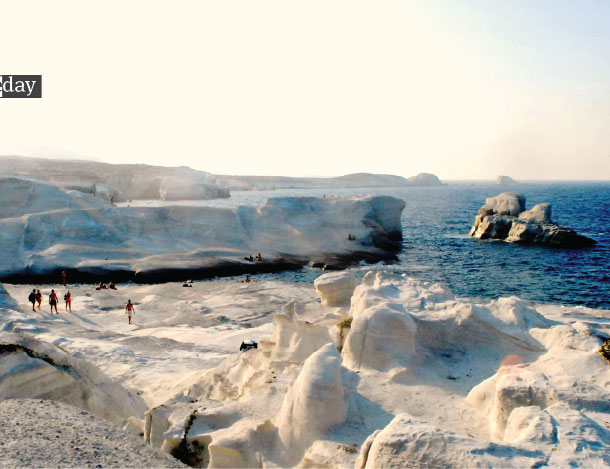
Captured at the surreal, moon-like landscape of Sarakiniko Beach, this photograph highlights the striking contrast between the deep blue Aegean Sea and the brilliant, snow-white volcanic rock formations. By utilizing a wide-angle perspective, the photographer emphasizes the vast, otherworldly topography of the Greek coastline. The image is award-worthy for its ability to transform a familiar travel destination into an ethereal, dreamlike scene, showcasing a keen eye for natural geometry and the dramatic interplay of light and texture against the stark, bleached stone of Milos Island.
Marissa Tejada
Born in Brooklyn, New York, Marissa Tejada is an award-winning freelance journalist and travel writer currently based in Athens, Greece. With a diverse career spanning international news bureaus and television reporting across the United States and Europe, she brings a narrative depth to her visual storytelling. Her work is deeply influenced by her life abroad, which inspired her debut novel, Chasing Athens, and continues to fuel her ongoing travel insights and photography projects shared through her blog, My Greece, My Travels.
Resonance Score Breakdown
Transparency Note: The resonance score (11.8/20) is calculated based on social engagement metrics collected before the award announcement.
Expert Photography Reviews · 8
The Bone of the Earth
There is a silence that belongs only to stone. It is not the silence of a room or a forest, but a stillness that has outlasted the wind and the salt.
Read the reflection →The Silence of Stone
In the quiet hours of the morning, before the kettle whistles or the house begins its daily creaking, I often think about the nature of absence.
Read the reflection →Reviews & Comments
Share your thoughts about this award-winning photograph. Your reviews contribute to the community engagement score.
The shutter snaps, and the Aegean freezes into a jagged, lunar silence. It’s a wide-angle cut that refuses to blink. I’ve seen Sarakiniko a thousand times, but here, the white volcanic curves feel like a film set waiting for a protagonist who never arrives. The contrast is sharp, almost violent. It’s a frame the editor keeps because the tension between the stone and the deep blue water is perfect. I’d give anything to walk through it.
1/400sec at f/16, ISO 1600, 18mm. Why ISO 1600 in broad daylight? It’s a baffling technical oversight that introduces unnecessary noise into the shadows of those volcanic rocks. You’ve traded image integrity for a shutter speed you didn’t need. The composition works, but the sensor data irritates me. I’m genuinely frustrated by the lack of discipline here. You had the light, the subject, and the gear. You just didn’t check your settings. A wasted opportunity for clarity.
At f/16, the diffraction limit begins to soften the micro-contrast of those volcanic ridges, yet it’s exactly what the scene demands. The 18mm focal length stretches the Aegean horizon, pulling the eye across the bleached stone’s texture. I’m genuinely moved by how the sensor handles that harsh, reflective glare without losing the subtle tonal shifts in the rock. It’s a clinical, cold beauty, but I’ve rarely seen the physics of light feel so hauntingly lunar.
The Aegean light here doesn’t just fall; it carves. Standing on that bleached volcanic stone, Marissa must have felt the silence of the moon. I’ve spent hours waiting for such clarity, where the white rock meets the blue void. It’s a stark, lonely geometry that makes my own breath hitch. She didn’t rush the shutter. She waited for the island to reveal its true, quiet skin. It’s a rare, patient stillness I deeply admire.
The volcanic curvature of Sarakiniko creates a brutal, tectonic geometry. It’s a rigid architecture of bleached stone that forces the eye toward the Aegean’s sharp horizon. The frame holds because the negative space isn’t wasted; it’s a calculated void. I’m genuinely unsettled by how the wide-angle lens distorts the rock’s mass into such an aggressive fulcrum. It’s cold, precise, and entirely devoid of sentiment. The composition doesn’t just work; it demands total visual submission.
Sarakiniko is a cliché, yet this frame avoids the usual postcard trap. Most photographers here get lost in the blue, but Tejada focuses on the volcanic curves. The way she anchors the composition against that harsh, f/16 light gives the stone a tactile, bone-like quality. I’ve seen thousands of Aegean shots, but this one makes me want to reach out and touch the rock. It’s a rare, quiet study of texture that will actually endure.
Before the eye identifies the volcanic curve, something in the chest tightens. It’s the silence of that blinding white stone, a visual vacuum that pulls the breath right out of you. I’ve returned to this frame a dozen times, and each time, the Aegean blue feels colder, more absolute. It’s a strange, lunar loneliness. Looking at it, I feel a sudden, sharp ache for a place I’ve never actually stood. It’s hauntingly still.
The white stone curves. It’s a silence carved by salt and wind. I’ve stood on these rocks, and here, the stillness returns. The blue water doesn’t fight the bleached earth; it waits. It’s a breath held in the heat. Nothing here is accidental. The empty corner is not empty. It’s the weight of the horizon. I feel my own pulse slow down. It’s rare to find a frame that lets the world simply be.