The Third Dimension by Avishek Das
Captured during the vibrant Durga Puja festival in West Bengal, this image highlights a stunning piece of temporary art suspended within a ceremonial Pandal. By positioning himself on the ground, the photographer captured the intricate geometric installation from a unique perspective, emphasizing its striking three-dimensional quality. The composition transforms a traditional religious decoration into a modern abstract study, showcasing the photographer's ability to find profound artistic depth in fleeting cultural moments. This image is award-worthy for its masterful use of low-light conditions and its creative framing, which elevates a transient festival structure into a compelling, timeless geometric form.
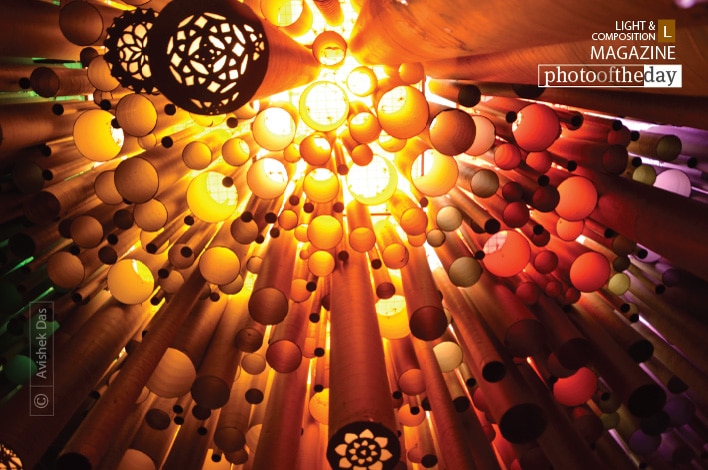
Exposure 1/20sec @ f/3.5 | ISO 1600 | Focal Length 18mm
Avishek Das
Born in 1986 in Baruipur, India, Avishek Das is a dedicated photographer whose work captures the rich tapestry of Indian visual arts and culture. An active member of the Indian Visual Arts Foundation, he balances a professional career in human resources with a deep-seated passion for street, nature, and monochrome photography. Trained under eminent photographer Sayan Sarkar, Das travels extensively, documenting the emotions of the streets and the people he encounters. His evocative images have earned national recognition, reflecting his philosophy of capturing the essence and feeling of a scene rather than merely its surface appearance.
Resonance Score Breakdown
Transparency Note: The resonance score (11.5/20) is calculated based on social engagement metrics collected before the award announcement.
Expert Photography Reviews · 6
The Geometry of Breath
The air in a crowded room has a specific weight, a thickness that clings to the back of the throat like damp wool. It tastes of incense, of cooling wax, and the metallic tang of thousands of exhaled breaths mingling in the dark.
Read the reflection →The Geometry of Grace
We often walk through the world looking for solid ground, forgetting that the air itself is woven with invisible threads. There is a quiet architecture to our days—a rhythm in the way light bends around a corner or how shadows stretch to meet the evening.
Read the reflection →Reviews & Comments
Share your thoughts about this award-winning photograph. Your reviews contribute to the community engagement score.
beautiful! fantastic capture!
Most festival photography is just noise, but this caught me off guard. By shooting upward into the geometric lattice, the photographer strips away the religious context, leaving only pure, dizzying structure. It’s a rare instance where a transient decoration feels permanent. I’ve seen thousands of Durga Puja shots, yet this is the only one that makes me want to look up at the ceiling for an hour. It’s a quiet, structural triumph that’ll still hold weight decades from now.
The low-angle perspective forces a rigid geometry upon the frame. The converging lines of the installation create a sharp, central fulcrum that anchors the chaotic light. It’s a rare moment where the spatial tension doesn’t collapse under the weight of its own complexity. I’ve spent years looking for this kind of structural discipline in festival photography, and frankly, it’s refreshing. The frame holds. The negative space provides the necessary silence for the form to breathe.
At f/3.5, the Nikon’s 18mm focal plane is razor-thin, forcing the lens to resolve complex geometric intersections against a soft, atmospheric falloff. I’m genuinely moved by how the diffraction of light across those suspended surfaces creates such tactile depth. It’s a rare moment where the sensor’s ISO 1600 noise doesn’t distract, but instead adds a granular texture to the light. You’ve captured the physics of the Pandal’s geometry perfectly; it’s a brilliant, precise optical study.
The ochre of sun-scorched earth bleeds into the bruised, electric violet of a twilight sky, creating a chromatic tension that feels like a Morandi still life caught in a fever dream. It’s a dizzying, saturated collision of pigments that makes my heart race; one finds the geometry isn’t merely structural, but a visceral, pulsating vibration of light that defies the ephemeral nature of the Pandal, anchoring this fleeting ritual in a permanent, haunting, and deeply resonant hue.
The air in the Pandal must have been thick with incense and anticipation. He knelt on the floor, waiting for the geometry to settle into a rhythm. It’s not just an installation; it’s a prayer suspended in the dark. I feel a sudden, quiet ache in my knees looking at this, remembering the hours spent waiting for the light to align. He didn’t rush the chaos. He listened until the structure finally breathed.
1/20sec at f/3.5, ISO 1600, 18mm. A precarious gamble. At 18mm, f/3.5 barely holds the geometry together. The motion blur at 1/20sec is an engineering failure, yet it somehow softens the harshness of the D7000’s sensor noise. It’s technically sloppy, but I’ll admit, the resulting abstraction feels intentional. He’s pushed the hardware to its breaking point. It doesn’t hold up under scrutiny, but it’s a rare instance where the technical flaws actually serve the composition.