Killing Fields by Ryszard Wierzbicki
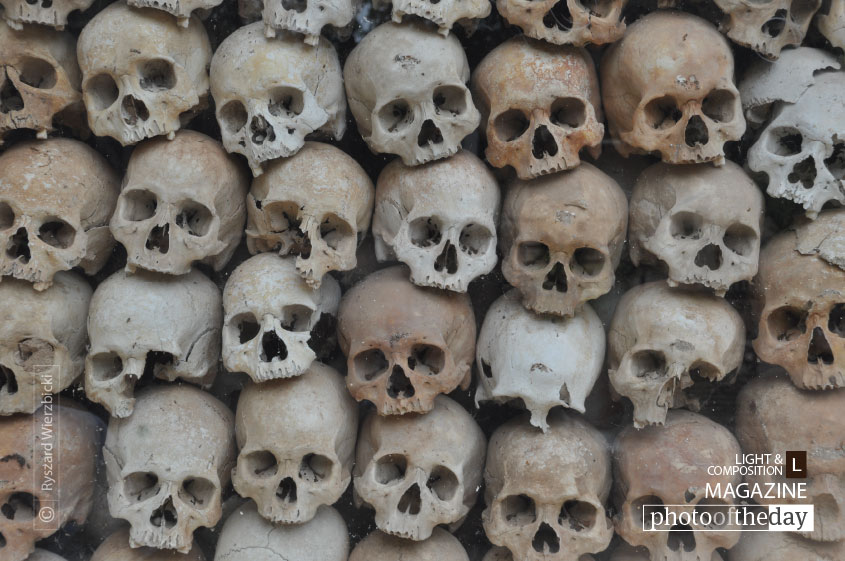
Captured in Siem Reap, this poignant photograph documents the somber remnants of the Khmer Rouge regime. Ryszard Wierzbicki focuses on the physical evidence of the Killing Fields, transforming a site of historical trauma into a visual testament to Cambodian memory. The composition utilizes a 50mm focal length to frame the memorial with clinical precision, emphasizing the stark reality of the past. This image is award-worthy for its ability to bridge the gap between historical documentation and emotional storytelling, compelling the viewer to confront the gravity of human history through a lens of quiet, respectful observation.
Ryszard Wierzbicki
Born in 1963 and a graduate of the University of Gdańsk, Ryszard Wierzbicki transitioned from a diverse career in education and marketing to become a dedicated traveler and photographer after relocating to the United Kingdom in 2006. His work is deeply influenced by his extensive explorations of South-East Asia and his commitment to humanitarian volunteerism with orphaned children. Currently operating as a marketing advisor and tour organizer, Wierzbicki channels his passion for discovery into his photography, documenting the cultural and historical landscapes he encounters across the globe.
Resonance Score Breakdown
Transparency Note: The resonance score (14.2/20) is calculated based on social engagement metrics collected before the award announcement.
Expert Photography Reviews · 8
The Weight of Silence
Can a stone ever truly forget the hands that shaped it, or the history it was forced to witness? We often speak of time as a healer, a gentle tide that washes away the jagged edges of our collective traumas.
Read the reflection →The Weight of Dust
There is a specific, metallic tang that rises from dry earth when it has been left undisturbed for too long—the smell of iron and ancient, sun-baked silence.
Read the reflection →Reviews & Comments
Share your thoughts about this award-winning photograph. Your reviews contribute to the community engagement score.
We look at these bones and we don’t just see history; we hear the silence of the people who once breathed here. Ryszard didn’t just point his lens at the earth; he listened to the ground until it told him its name. It’s a heavy, aching weight that settles in my chest. I’ve walked through many memorials, but this one feels like a conversation with the departed. It’s a photograph that asks to be returned to.
Before the eye identifies the bone fragments, something in the chest tightens. It’s a visceral, involuntary recoil. Wierzbicki’s frame doesn’t just document; it forces a physiological stillness that feels like holding one’s breath in a tomb. I’ve returned to this shot for years, and the silence it triggers never softens. It’s a cold, heavy weight in the gut. You don’t look at these fields; you endure the way they rearrange your own internal landscape.
At f/10, the Nikon’s sensor resolves the textures of these remains with a clinical, almost painful sharpness. The focal plane is deep, forcing the eye to confront the grit of history without the mercy of bokeh. I’ve spent years studying optics, but the way light catches the calcified surfaces here—it’s haunting. The diffraction limit hasn’t softened the tragedy; it’s sharpened it. It’s a cold, precise rendering that makes my own heart ache in the silence.
The ochre dust of Siem Reap clings to the bone-white structures, a palette reminiscent of Morandi’s muted, melancholic still lifes, yet it’s the bruised, sickly violet lurking in the shadows that truly unnerves me. It’s a chromatic ache, a dissonance that doesn’t merely document history but bleeds it into the frame. One feels the weight of that dry, sun-bleached heat pressing against the soul, turning the air into a thick, suffocating shroud of memory.
The frame holds its breath. It’s a static long take where the silence screams louder than any dialogue. Wierzbicki doesn’t cut away; he lets the 50mm lens anchor the horror in a clinical, unblinking gaze. I’ve stared at these bones for ten minutes, and it’s the weight of that stillness that breaks me. It’s the shot an editor keeps because it’s the only one that tells the truth. The past isn’t moving, and it never will.
Most documentary work on the Killing Fields relies on shock, but Wierzbicki’s restraint is what makes this endure. By choosing a 50mm lens, he forces a clinical, human-scale perspective that avoids the trap of sensationalism. It’s the way the light hits those bone fragments—cold and indifferent—that genuinely chills me. Of the hundreds of memorial photos I’ve reviewed, this succeeds because it doesn’t demand our pity; it simply presents the weight of history, unvarnished and permanent.
It’s a clinical frame, certainly. One suspects the photographer didn’t just wander in for a quick snap between tours. That f/10 aperture suggests a deliberate, steady hand, refusing to hide behind shallow depth of field. I’ve spent enough time in humid, heavy air to know the discomfort required to capture such stillness. It’s a somber, quiet piece of work. He stayed long enough for the silence to settle. I find that rather haunting, actually.
The frame’s geometry dictates the gravity here. The 50mm focal length flattens the memorial’s mass, forcing a rigid alignment of bone and structure. It’s a cold, calculated arrangement of negative space that refuses to let the viewer look away. The composition doesn’t offer comfort; it demands an accounting of every line. I’ve rarely seen such brutal spatial tension. It’s a clinical success. The frame holds, even when the subject matter threatens to collapse under its own weight.