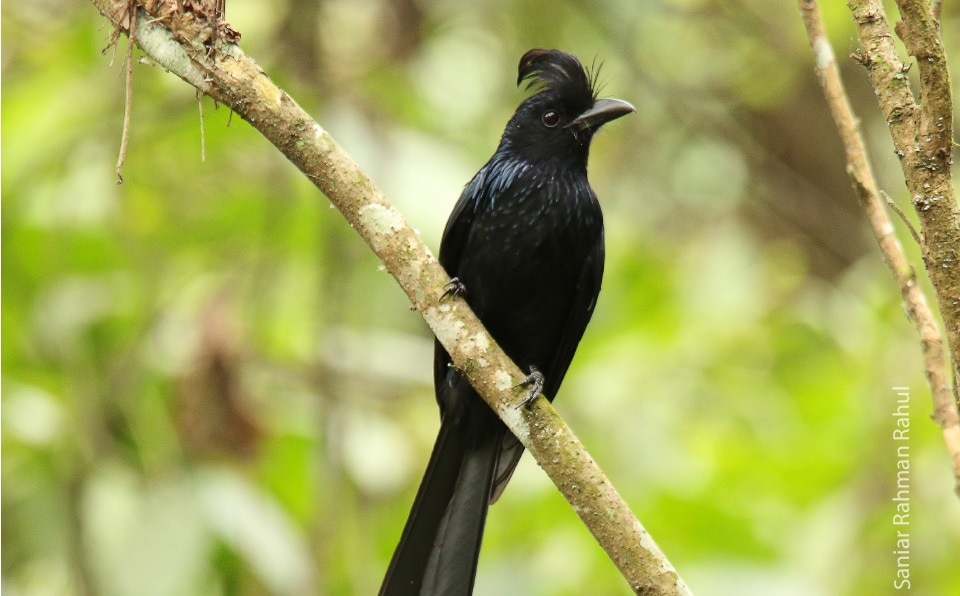
Greater Racket-tailed Drongo by Saniar Rahman Rahul
Captured within the lush landscape of Kaptai National Park, this portrait of a Greater Racket-tailed Drongo highlights the bird's striking, elongated tail feathers and distinctive silhouette. The photographer utilized a long telephoto lens to isolate the subject against the dense foliage, carefully balancing the exposure to capture the intricate textures of the plumage. This image is award-worthy for its technical precision and the photographer's ability to document the elusive beauty of Asian wildlife in its natural habitat, offering viewers a rare, intimate look at a species renowned for its complex vocal mimicry.
Saniar Rahman Rahul
Based in Dhaka, Bangladesh, Saniar Rahman Rahul is an accomplished Art Director at Grey Worldwide with a deep-rooted passion for visual storytelling. His photographic journey began in childhood, inspired by his father, and was later refined through his extensive professional background in graphic design and advertising. Rahul’s work reflects a sophisticated eye for detail and composition, honed over decades of experience in the creative industry, establishing him as a prominent figure in contemporary Bangladeshi photography.
Resonance Score Breakdown
Transparency Note: The resonance score (11.5/20) is calculated based on social engagement metrics collected before the award announcement.
Expert Photography Reviews · 4
The Weight of a Whisper
There is a quiet dignity in the way a creature occupies its own space, unbothered by the rush of the world beyond its branch. We often mistake stillness for inactivity, forgetting that the most profound shifts occur in the moments when we simply hold our ground.
Read the reflection →The Weight of a Whisper
I remember sitting on a porch in the Chittagong Hill Tracts, listening to an old man explain why he never bothered to learn the names of the birds that visited his garden.
Read the reflection →Reviews & Comments
Share your thoughts about this award-winning photograph. Your reviews contribute to the community engagement score.
Six hundred millimetres at a shutter speed of 1/30th is a gamble that usually ends in a blurry mess. One suspects Rahul spent a damp, mosquito-ridden eternity waiting for that drongo to hold still. It’s a rare bit of discipline in an age of spray-and-pray wildlife shots. I’ve spent enough mornings shivering in the brush to appreciate the stillness required here. He clearly didn’t just find this bird; he earned its cooperation. A fine, quiet effort.
The Drongo’s tail feathers slice through the frame like ink on parchment. It’s technically sharp, sure, but why does the bird feel so lonely? I’m struck by a sudden, sharp pang of melancholy looking at this isolation. Does the dense, blurred foliage serve the bird, or does it just erase the context of Kaptai National Park? Who decided this creature belongs in a vacuum? We’ve stripped the wild of its home to satisfy our own aesthetic hunger.
The Drongo’s silhouette echoes the stark, graphic precision of early ornithological plates, yet the 1/30sec shutter speed introduces a painterly blur that feels distinctly modern. It’s a risky choice that pays off, softening the dense Kaptai foliage into a bokeh reminiscent of Hiroshi Sugimoto’s blurred dioramas. I’ve spent decades cataloging avian studies, but this rhythmic tension between the sharp, elongated tail and the motion-softened wings genuinely caught my breath. It’s a rare, elegant conversation with tradition.
Before the eye identifies the drongo, something in the chest tightens. It’s the stillness of that long, trailing feather—a weightless anchor in the dense green blur. I find myself holding my breath, waiting for the bird to mimic a sound I haven’t heard yet. When I return to this, I’m struck by how it doesn’t just document a creature; it captures the exact, lonely frequency of a forest waiting for a voice.