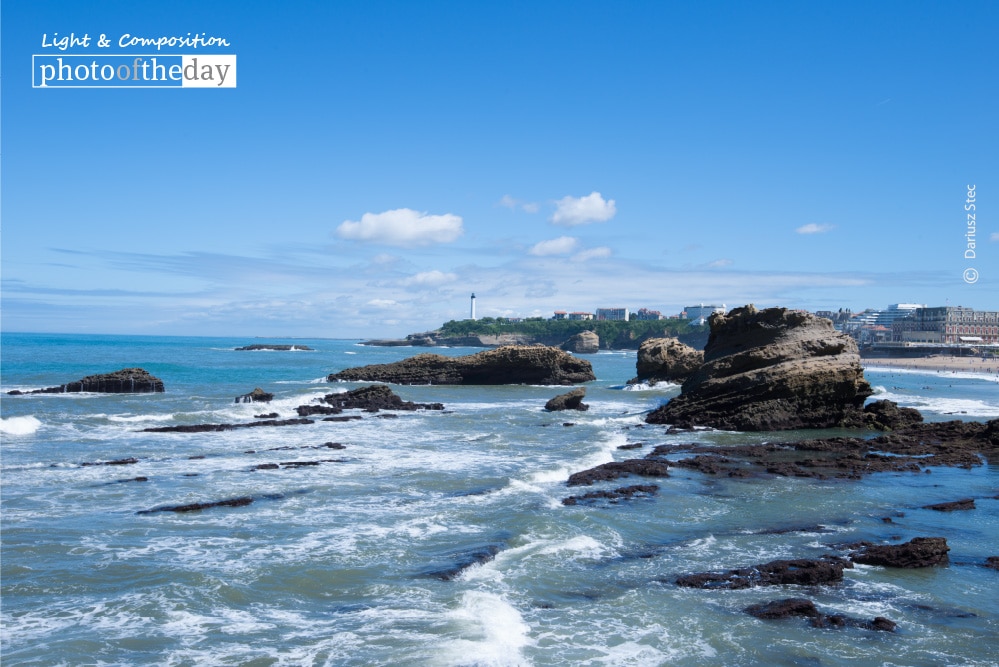
Rocks by Dariusz Stec
Captured during a 2014 holiday, this evocative image of Grande Plage in Biarritz masterfully balances the vibrant, atmospheric colors of the sky against the rugged, weathered textures of the shoreline. The photographer sought to create a compelling juxtaposition between the enduring solidity of the rocks and the ephemeral, silky motion of the incoming waves. This award-winning composition stands out for its deliberate use of light and texture, transforming a familiar coastal scene into a serene study of nature's contrasting elements, showcasing a keen eye for landscape detail and emotional resonance.
Dariusz Stec
Based in Northampton, UK, Dariusz Stec is a dedicated landscape and lifestyle photographer whose passion for the craft spans decades, beginning with his first Smena-8m camera in 1985. His artistic journey has been deeply influenced by his love for sailing and travel, which inform his unique perspective on the natural world. Together with his son, Adam Stec, he continues to refine his mastery of photographic art, blending technical precision with a profound desire to share his personal vision of the world through the lens.
Resonance Score Breakdown
Transparency Note: The resonance score (13.1/20) is calculated based on social engagement metrics collected before the award announcement.
Expert Photography Reviews · 8
The Patience of Stone
There is a wisdom in the way the earth meets the sea. The water arrives with urgency, white-crested and restless, eager to reshape the world in its own image. Yet the stone remains.
Read the reflection →The Weight of Water
The tide does not negotiate. It arrives with a heavy, rhythmic indifference, carving the stone until the stone forgets its own shape.
Read the reflection →Reviews & Comments
Share your thoughts about this award-winning photograph. Your reviews contribute to the community engagement score.
The tide was retreating, leaving the Grande Plage in a state of quiet surrender. I’ve stood in such places, feeling the salt air turn cold against my skin. Here, the light doesn’t just illuminate; it hums against the jagged stone. It’s a patient study of permanence against the fleeting silk of the sea. Looking at these rocks, I feel a sudden, sharp ache for the stillness that only the coast can provide. It’s truly beautiful.
The rocks here act as a datum, grounding the fluid, ephemeral motion of the tide. It’s a study of mass versus void, where the jagged edges define a threshold between the solid earth and the encroaching sea. I’m struck by how the light catches the wet stone, revealing a texture that feels almost tectonic. It’s not just a landscape; it’s a reminder that architecture is merely our attempt to impose order on such relentless, shifting forces.
The foreground rocks anchor the frame with necessary weight, providing a fulcrum against the blurred kinetic energy of the tide. It’s a rigid geometry that keeps the composition from dissolving into mere atmospheric fluff. The horizon line sits precisely where it must to maintain spatial tension. I’ve grown weary of such soft, coastal sentimentality, yet the structural discipline here holds my attention. It doesn’t collapse. The frame is tight, disciplined, and ultimately, it earns its keep.
f/11 at 0.6 seconds, ISO 100. A calculated choice for the long exposure. The shutter speed renders the water into a predictable silk, yet the rocks remain sharp. It’s technically sound, though it lacks risk. I’ve seen this exact motion blur a thousand times before. It’s competent, but it doesn’t challenge the sensor. The execution is precise, but it’s cold. I find myself wishing for a shutter speed that actually captured the water’s violence.
The tide hits the shutter and time freezes. It’s a long exposure that breathes, turning the Atlantic into a ghost of itself against the jagged, unyielding stone. I’ve spent hours watching waves break, but Stec caught the exact moment the ocean surrenders to the rock. The composition holds perfectly; any movement would have ruined the tension. It’s a quiet, cinematic miracle. I’d give anything to be standing on that shore right now, feeling that cold spray.
The bruised violet of the Biarritz dusk bleeds into the slate-grey of the tide, a chromatic ache that reminds me of Morandi’s dustiest canvases. It’s a haunting, liquid transition where the rocks, those stubborn anchors of ochre and iron, refuse to dissolve into the encroaching foam. I’m utterly breathless watching how the light clings to the wet stone; it’s a sensory surrender, a quiet, shivering harmony that makes one’s own heart feel quite heavy.
You’ve captured the weight of those rocks against the tide, and it’s quiet. I’ve stood on that Biarritz shore, and you’ve managed to pull the salt air right out of the frame. Because you waited for the water to blur, you found a stillness that feels like a long exhale. It’s honest. I can feel the cold stone under my own feet. You didn’t just take a picture; you felt the rhythm of the coast.
Biarritz’s Grande Plage is a playground for the privileged, yet here, the human presence vanishes. Why does Stec scrub the coast clean of its history and its people? It’s a pretty study of texture, sure, but I find the silence unsettling. Does the ocean look this serene when you aren’t a tourist passing through? By isolating these rocks, he turns a living, breathing shoreline into a static, decorative object. It’s technically polished, but ethically hollow.